News Detail

Hydropeaking: When rivers can no longer find peace
October 20, 2026 |
We are standing on the Rossens dam, which created Lake Gruyère behind us, and looking down 83 metres to the base of the dam. Two large pipes carry the water from the lake through a six-kilometre-long pressure tunnel to the Hauterive power station. “The small amount of water that flows out at the foot of the dam is what is known as ‘residual water’,” explains Nico Bätz, a project scientist in the Surface Water Department at Eawag. Looking down the valley, you can see the trickle of residual water winding its way around the gravel banks. In the past, the River Saane used to cut its way through the sandstone cliffs as a raging torrent. Today it is called Kleine Saane (the Little Saane).
“Because the residual water flow in most rivers is kept constant, the characteristic natural dynamics that are so important for the ecosystem are now lacking,” explains the scientist (see article “Lack of dynamics, degraded habitats”). A few kilometres further down the valley, we encounter the opposite – excessive dynamics. At the power station at the end of the pressure tunnel, the water drives the turbines and is then channelled into the riverbed – but only when electricity is being generated. This means that, depending on the power demand, the water level can rise suddenly and then drop again quickly. Experts refer to this as hydropeaking.
The flexible electricity generation provided by storage power stations and their dams is the major advantage of hydropower in the energy transition. When there is no wind or sunshine, this so-called ‘dark doldrums’ can be offset by climate-friendly hydropower. “For technical reasons relating to energy, these hydropeaking events are therefore almost impossible to avoid,” says Nico Bätz. He has been conducting research into the effects of hydropeaking on river ecosystems since 2017. This is part of a project being carried out by Eawag in collaboration with the Federal Office for the Environment, which is due to be completed in 2026.
A tsunami several times a day

On the footpath along the Saane, we come across a sign with the following warning: "It’s dangerous to stay in the riverbed!" "Hydropower plants can cause sudden flooding at any time." “We warn people about flash floods,” says the scientist, “but the river’s creatures, which cannot get to safety quickly enough, have to cope with it or they will die.” ‘Every surge is like a tsunami suddenly sweeping through the water – and this happens several times a day.’ On average, storage power stations in the Alpine region currently experience 3.5 fluctuations in discharge per day under hydropeaking operation. This is 20 to 60 times more frequent than under a natural flow regime. It must be assumed that hydropeaking will become even more common in these rivers in the future, as the energy transition increases the demand for flexible electricity generation. What matters is not the individual event, but how often it occurs. This is shown by a study conducted by Nico Bätz in collaboration with researchers from Austria and Germany, which examined, among other things, major river systems such as the Rhone, Doubs, Saane, Vorderrhein, Reuss and Ticino. Taken together, these recurring fluctuations in water flow cause greater damage to the ecosystem than the sum of the individual events. “We’re talking about cumulative effects,” explains the scientist: ‘It is a widespread myth that the environmental impact of hydropeaking is similar to that of natural floods.’ This is because the recovery periods are too short, meaning that the damage continues to accumulate with every fluctuation. "Aquatic organisms, such as fish and invertebrates, as well as the vegetation along the banks, are not adapted to these highly dynamic conditions."
A valuable habitat becomes a trap
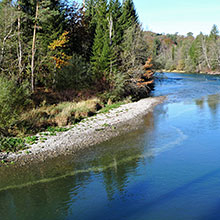
On the riverbank, we can see how much the water level rises and falls at any given time. When the water rises, it reaches the level where grass grows; when it falls, it drops within minutes to the green-brown layer of algae on the riverbed. Further downstream, we come to a wider section of the riverbed. During surges, water flows through a side channel between the bank and a gravel bank; but at low flow, the channel will soon run dry. We keep an eye out for small fish, invertebrates or other creatures in the shallow water, but we can’t spot anything. “Under natural flow conditions, side channels provide valuable habitats,” explains the scientist. "It is only because of frequent artificial fluctuations in water flow that such habitats can become traps." Juvenile fish, whose swimming ability is not yet fully developed, tend to stay in slow-flowing, shallow areas near the shore – a habitat that becomes so unstable due to frequent fluctuations that it is virtually unusable for these organisms. “Whenever the water level drops rapidly at low flow and a side channel or a gravel bank on the bank is left dry, some fish get stranded because they can’t make it back to the deeper main channel in time,” says Nico Bätz. His research team’s computer simulations showed that, with 3.5 hydropeaking events per day, the density of juvenile fish can decline significantly within one to two weeks.

The researchers observed a similar pattern in invertebrates. "The invertebrates live on and in the gravel. Every time the water’s flow becomes too fast and they can no longer hold on, they are swept away," explains the scientist. This was demonstrated, amongst other things, in a field experiment on the River Emme, in which the researchers used a specially designed experimental channel to simulate hydropeaking and investigated how invertebrates react when exposed to such fluctuations for the first time. Based on detailed on-site measurements, the researchers were able to show that the response of the invertebrates depends heavily on their habitat: In areas of slow-flowing water, it is primarily the increase in flow velocity that is decisive; in fast-flowing areas, however, it is the magnitude of the fluctuation. The cumulative effects of hydropeaking therefore manifest themselves differently across individual habitats within a river section – forming a heterogeneous mosaic.
Setting priorities
“The cumulative effects caused by hydropeaking frequency are scarcely taken into account in current ecological assessments of the impacts,” observes Nico Bätz. In the case of hydropeaking remediation (see box), the focus is also on regulating individual events, for example by constructing compensation basins into which the water is channelled after passing through the turbines and then released more slowly. Slowing down the release of water does, admittedly, give the organisms a little more time to find another habitat. However, even this remedial measure does little to reduce the high frequency of incidents.

“Solutions should not be considered in isolation at the level of individual power stations,” says the scientist: "Rather, a broader assessment is needed at the catchment area level: on the one hand, how important a hydroelectric power station is for energy production; on the other hand, how significant a particular stretch of river is ecologically, for example for the reproduction of certain key species." This would allow priorities to be set in a targeted manner, with energy production taking precedence in some sections of the river and biodiversity in others, whilst the other uses would be adapted accordingly (see article “Choosing the right location for power stations can help preserve habitats”). “This requires environmental monitoring and a continuous learning process on the part of all stakeholders,” says Nico Bätz: "Only such a holistic approach makes it possible to reconcile hydropower development and biodiversity in a sustainable and adaptive manner."
We have now reached a stretch of the river where large rocks line the banks. Here and there, there is gravel that has remained damp during low flow – actually an ideal habitat for small invertebrates. Nico Bätz turns over a few stones and finally finds what he’s looking for. In a handful of water, pebbles and grains of sand, we discover two tiny invertebrates. The two of them seem to have survived the last surge. The scientist carefully places them back in the water.
Remediation by 2030
The Swiss Water Protection Act requires owners of hydroelectric power stations to prevent or remedy any significant environmental damage caused by hydropeaking. Hydropeaking occurs when the discharge volume during the surge (i.e. during electricity generation) is at least 1.5 times greater than during low flow (i.e. when no electricity is being generated). By 2030, the facilities affected must implement remediation measures. Across Switzerland, 107 hydroelectric power stations are in need of remediation. The costs of the remediation measures are financed through the grid surcharge fund, which is funded by a surcharge on the electricity price (currently 2.3 centimes per kilowatt hour). By the end of 2022, planning or implementation of the remediation measures had begun at around 75 per cent of the facilities, whilst remediation had been completed at around 4 per cent of them.
Cover picture: The banks of the Saane, with the Hauterive power station in the background. When the water surges, the level reaches the point where grass grows; at low flow, it drops to the greenish-brown layer of algae on the riverbed. (Photo: Nico Bätz, Eawag)
Financing
- Eawag
- BAFU