Eawag
Überlandstrasse 133
Postfach 611
8600 Dübendorf
Schweiz

Tel. +41 (0)58 765 55 11
Fax +41 (0)58 765 50 28
info@eawag.ch
Forschung » Nahrungsnetze » Research
Eawag - Aquatic Research
  Home Kontakt Suche DE | EN | FR
 
Nahrungsnetze - Blake Matthews
Research

Research

Ecosystem consequences of food-web diversity

We are interested in how species diversification can influence the properties and functions of ecosystems. Species modify the environment in which the live, and can influence selective pressure in the environment. As a result, species diversification might create ecological opportunities that promote adaptive radiation. radiation

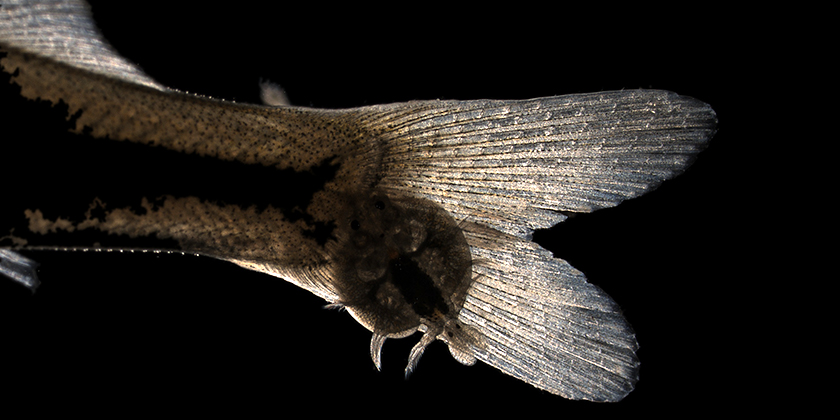
We are investigating this question with multiple radiations, including three spine stickleback, whitefish, cope pods, and daphnia. These radiations have species that are all well suited for experimental work and that differ in their degree of phenotypic divergence.

Dynamics of food web structure

Aquatic food webs differ in their number of species (i.e. richness) and in how their species interact (i.e. food web architecture), which gives rise to remarkable food web diversity over space and time.
foodweb

We therefore use stable isotopes of carbon and nitrogen to quantify the temporal and spatial variation in food web structure. We've done extensive work in freshwater plankton systems that illustrate the dynamic seasonal structure of lake food webs.

Particularly we are interested in the evolutionary dimensions of food webs diversity. For example, to what extent does individual variation in diet relate to phenotypic and fitness variation. The above graph shows the correlation between trophic position and individual variation in gill raker length in stickleback.

This suggests that trophic position could be a phenotypic trait that can evolve in response to selection on functional morphological traits.

stickle

Community assembly and environmental change

Environmental change can make community dynamics more or less predictable over time. Using long time series of phytoplankton community composition I am investigating the how rates of species turnover has changed in response to variation in lake productivity. This work is in close collaboration with Bas Ibelings and Francesco Pomati.
assembly

More generally, the goal is understand how variation in the pattern of community assembly (for both species and traits) affects ecosystem functioning.

Research integrating ecology, evolution, and ecosystem science

Ultimately our research aims to understand how the ecological and evolutionary dynamics affect ecosystems, and vice versa. Typically species adaptation is thought of as a process that occurs in response to environmental variation. However, organisms themselves may generate environmental heterogeneity that could modify the course of evolution. Eco-evolutionary feedbacks are a good example of how adaptation and the environment are reciprocally linked.

Kontakt

Kontakt

Abteilung für Aquatische Ökologie

Eawag
Überlandstrasse 133
Postfach 611
8600 Dübendorf
Schweiz

Telefon +41 (0)58 765 5132
Fax +41 (0)58 765 5315
arianne.maniglia@eawag.ch