
Staff
Ralf Kägi
Dr. Ralf Kägi
About Me
Research Interests
- Detection and fate of particulate contaminants (engineered, incidental and natural, micro- and nanoplastic particles) in natural environments and engineered systems
- Fluxes and impacts (nano)particulate of contaminants (engineered, incidental and natural (nano)particles, microplastics) through and on urban (waste)water systems
- Development and validation of new analytical approaches for (nano)particle detection and structural characterization
Research statement
Particulate contaminants (including engineered, incidental and natural nanoparticles (NP), colloids, micro- and nanoplastics) reach aqueous environments (both engineered and natural) through many different pathways. Whereas some of these contaminants are of less of concern due to their limited impact on ecosystems (e.g. clay minerals), others may have long-term and negative impacts on environmental health and are thus of increasing concern (e.g., toxic metals sorbed to iron colloids, carbon nanotubes, microplastics). The (unintended) release and the fate of these particulate contaminants into the aquatic environment are only poorly understood mainly due to the he lack of adequate analytical techniques to detect and characterize such materials in the environment. My research therefore, aims at combining well established standard characterization methods from colloidal sciences, with novel methods from materials science and with own developments to detect, quantify and understand the impacts of the particulate contaminants in the aquatic environment. The following research areas are of particular interest:
Fate of particulate contaminants in the natural environment and engineered systems.
Although a large variety of analytical methods exist to characterize nano scale materials (and especially nanoparticles), these methods were mainly developed for materials science applications. Therefore, these methods were optimized for detecting pure substances in high concentrations (such as Ag-NP in concentrated stock solutions). Transferring the methods to investigate (nano)particulate contaminants, present at trace concentrations and in complex matrices (e.g., soil, slugde) is very challenging. We therefore try to separate aquatic colloids, including engineered NP, microplastics or rate earth element-colloids from their surrounding matrices using different approaches such as density separation, field flow fractionation, magnetic seeded filtration, oxidative and enzymatic digestions. Isolated particles are the characterized and quantified using for example light scattering (DLS, SLS), mass and vibration spectroscopic (ICP-MS,µ-FT-IR) or (electron) microscopic (SEM, TEM) techniques.
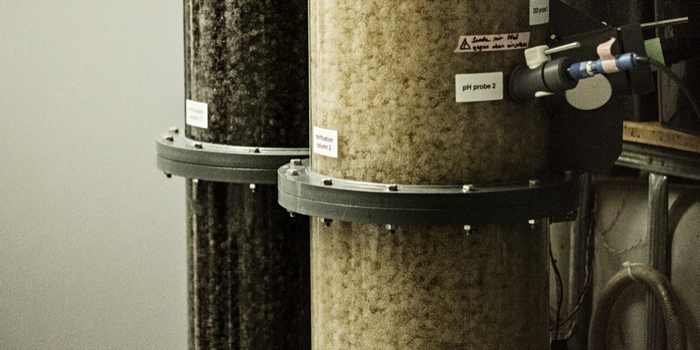
To study the fate of (nano)contaminants in (waste)water systems, our state of the art analytical facilities are complemented by a series of experimental facilities ranging from lab to pilot scale. This allows us to mimick real world conditions and address open questions at the most suitable (experimental) scale.
Development and validation of new approaches to quantify particulate (nano)contaminants
Electron microscopy represents an alternative and powerful approach to i) characterize individual (nano) particles down to the single digit nm range and ii) to extend the automated measurements of microplastic down to 1µm. In concert with other, bulk analytical methods, including inductively coupled plasma spectroscopy and synchrotron x-ray absorption spectroscopy, we use (automated) electron microscopy techniques (including own developments) to decipher the fate of (nano)particulate pollutant in managed waste facilities.
Currently, the lack of validated methods is one of the biggest challenge in microplastics research and hampers the comparison of results obtained from different studies. On the one hand address this issue by developing our own quality assurance and quality control measures, and on the other we are establishing uncertainty budgets for the whole analytical chain tailed for microplastics analysis.
Experimental facilities
- Wastewater
Conventional activated sludge system (nitrification, denitrification, secondary clarification)
Anaerobic digestion ('Apollo')
- Surface water
Custom made drum sieve designed for collection of particulate matter (e.g., microplastics) (planning phase)
- Weathering
UV-exposure (SunTESTER, CPS+) -> Photooxidation
Mechanical abrasion (Roller Mill, RM1) -> simulation of beach environments
Temperature fluctuations (computer controlled temperature baths) -> simulating freeze - thaw cycles (collaboration with Prof. Stephan Gruber, Carlton UNiversity, Ottawa, Canada)
Analytical facilities
- Particle size analysis
Dynamic Light Scattering (DLS) Analyzer (Zetasizer, NanoZS, Malvern)
Laser Diffraction Particle Size Analyzer (LS 13 320, Beckman Coulter)
asymmetric flow field flow fractionation system (Eclipse, Wyatt) in-line coupled to UV-DAD detector. DLS - detector, static light scattering (SLS) detector (Helios, Waytt) and a fraction collector.
- visible light microscope (VHX-7000, Keyence)
- Fourier Transform Infrared (FT-IR) Spectroscopy
Focal plain array (FPA)-µ-FT-IR microscope (Cary 670-IR, FTIR, Cary 610 IR Mikroskop)
- Electron microscopes
Scanning electron microscope (Gemini 460, equipped with 2 EDX detectors (Extreme and Ultrmate, Oxford) Zeiss). Shared with and operated by Empa
Transmission electron microscope (Talos, FEI and HD2700Cs, Hitachi). Both instruments are operated by ScopeM (access via user training).
Apart from my own research outlined above I also run the particle laboratory at Eawag. The particle laboratory is a contact-point for all sorts of particle-related questions, especially concerning microscopic work. My engagement in different projects covers all ranges from simple advice over a few measurements for a feasibility study up to solid collaborations. Thanks to very good contacts to the electron microscopy centers at ETHZ and Empa, experts on any kind of materials can be consulted if necessary.
[[ element.title ]]
[[ element.title ]]
[[ element.title ]]
Publications
[[item.title]]
[[ element.title ]]
[[ element.title ]]
Address
| E-Mail: | ralf.kaegi@cluttereawag.ch |
| Phone: | +41 58 765 5273 |
| Fax: | +41 58 765 5802 |
| Address: | Eawag
Überlandstrasse 133 8600 Dübendorf |
| Office: | BU B17 |