Department Urban Water Management
Urban Water Management
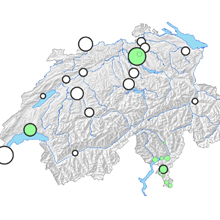
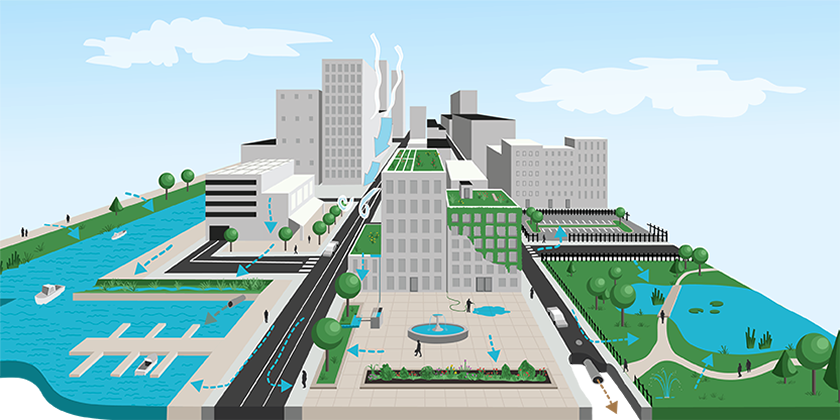
We aim to optimize the development and management of the urban water system using process-focused measurement techniques, targeted experiments, and innovative modeling methods. Using a systems approach, we bring together a range of aspects that are intertwined with the urban drainage network. Read more
Urban Water Observatory

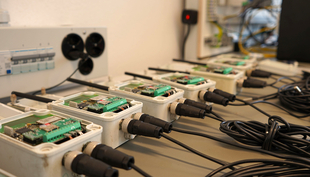
The Urban Water Observatory (UWO) is a long-term initiative of ETH and Eawag to establish a sensor network in Fehraltorf, allowing spatially-distributed monitoring of urban water cycle processes. Read more
Eawag-Empa Blue-Green Campus Lab

The Eawag-Empa Blue-Green Campus lab is a research initiative to investigate climate adaptation solutions and foster collaboration between Eawag and Empa. Read more
BlueX: Blue Nexus Lab – An urban living lab for water and climate adaptation

Urban Living Lab for linking different projects in the field of water and climate adaptation with each other. Read more
News


Publications
Cavadini, G. B., Manoli, G., & Cook, L. M. (2026). Cooling potential of stormwater blue-green infrastructure depends on soil type and water availability. Sustainable Cities and Society, 136, 107083 (15 pp.). doi:10.1016/j.scs.2025.107083, Institutional Repository
Dietzel, A., Moretti, M., Perrelet, K., & Cook, L. M. (2026). Urban heat exacerbates climatic risks to urban biodiversity. npj Urban Sustainability, 6, 4 (12 pp.). doi:10.1038/s42949-025-00309-6, Institutional Repository
Joshi, P., Maurer, M., & Leitão, J. P. (2026). Identifying similar rainfall events across different periods to investigate temporal changes in hydrological performance of blue-green infrastructure. Journal of Hydrology, 666, 134827 (14 pp.). doi:10.1016/j.jhydrol.2025.134827, Institutional Repository
Nature’s Science in Shorts awards - Lucas Gobatti
"If we want to cool down our cities with vegetation, we need to start planting as soon as possible, because it takes time to get the full cooling benefits of urban greenery"
Paper "Using satellite imagery to investigate Blue-Green Infrastructure establishment time for urban cooling"