Eawag
Überlandstrasse 133
P.O.Box 611
8600 Dübendorf
Switzerland

Ph. +41 (0)58 765 55 11
Fax +41 (0)58 765 50 28
info@eawag.ch
» Welcome » Research » Biofouling reduction using predation
Eawag - Aquatic Research
  Home Contact Search DE | EN | FR
 
Project: Gravity-Driven Membrane (GDM) technology
Biofouling reduction using predation

Biofouling reduction using predation

Predation by metazoa and protozoa improves the performance of membranes used for the filtration of contaminated water. Membrane filtration allows to securely remove most pathogens from contaminated water but efficient application of membranes is hampered by the development of biofilms on the surface of the membrane reducing the water flux. Strategies available to reduce biofilms on membranes are mostly energy and chemical intensive and lead to increasing operating costs. In our work we are developing an innovative approach that relies on biological mechanisms influencing the permeability of the biofilm to maintain water flux rather than chemical cleaning or energy intensive cross-flow.

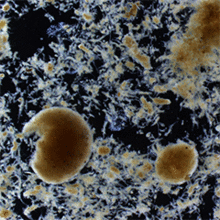
Membranes are operated at low pressures and in a dead-end mode. Without mechanical stress a porous and heterogeneous biofilm structure develops that is susceptible to predation by higher organisms. In presence of predators (upper panel in Figure), an open and heterogeneous biofilm structure developed with only partially coverage of the membrane surface (85%). In absence of predation (where higher organisms are chemically inhibited, lower panel in Figure) a flat and compact structure covering the whole membrane surface developed. We were able to demonstrate that metazoa (rotatoria, nematoda, and oligochaeta) were the main group of higher organisms responsible for the development of open biofilm structures.

im1 protozoa

Membrane filter imaged with a photographic camera (left hand column) and side-view images acquired using optical coherence tomography (right hand side) of biofilms developed in presence of predation (upper panel) and in absence of predation (lower panel).

The development of open structures is associated with enhanced system performances. In absence of predation flux stabilizes at a value of around 7 L /h/m2. In presence of predation flux stabilizes at a value of around 15 L/h/m2. In conclusion, we were able to demonstrate the feasibility of using biological processes (i.e., predation) to control biofilm structure and hydraulic conductivity in low pressure membrane systems. This process offers significant promise to reduce the need for energy and chemical input for water filtration – both in the developing world and in industrialized countries.

im2

Change in the permeate fluxes in presence of predation and in absence of predation

Last results indicated that metazoan organisms (in particular nematodes and oligochaetes) are the eukaryotes responsible for the formation of open and heterogeneous biofilm structures. Metazoan organisms built-up protective habitats, which resulted in the formation of open and spatially heterogeneous biofilms composed of biomass patches. The activity of metazoan organisms in natural river water and its impact on biofilm structure balances the detrimental effect of a high biofilm accumulation (due to high Total Organic Carbon contents), thus allowing for a broader application of GDM filtration. Finally, our results suggest that for surface waters with high particulate organic carbon (POC) content, the use of worms is suitable to enhance POC removal before ultrafiltration units.


Contact

Contact

Nicolas Derlon
Eawag
Process Engineering (Eng)
Überlandstrasse 133
P.O. Box 611
8600 Dübendorf
Switzerland

Tel. +41 (0)44 823 53 78
Fax +41 (0)44 823 50 28
nicolas.derlon@eawag.ch