Single house wastewater treatment with water reuse
In most of
the industrialized countries, wastewater is collected in large sewer systems
and treated in centralized wastewater treatment plants. This system is
beneficial for many reasons: infectious diseases spreading through deficient
sanitary conditions have been eradicated, the wastewater is treated at one
place under controlled conditions, the principle „out of sight, out of mind“ is
very comfortable for the users.
But there are also some disadvantages:
- Groundwater is contaminated because of leaking pipes
- A high water consumption is required in order to ensure good flushing of the sewers
- The wastewater is diluted with uncontaminated water (rainwater, infiltrating groundwater)
- Costs
- The nutrient cycle is not closed (sewage sludge has to be burned in Switzerland)
It’s called
into question, whether there are good alternatives to this conventional system,
without changing the habits of the users nor confining the existing comfort.
The requirements of an alternative system are the following:
- little water consumption or water recycling
- low costs (construction, maintenance)
- no concessions regarding the effluent quality
- the same comfort for the users
Based on
these considerations, the canton Solothurn and Eawag initiated the „Aquamin“
project. Within this project, a small-scale wastewater treatment plant was
installed in a one-family building in Zuchwil, SO, which is monitored by Eawag.
The main goals of the project include the safe operation, effluent quality,
water recycling and energy consumption. The project should be finished by the
end of 2007.
The treatment system
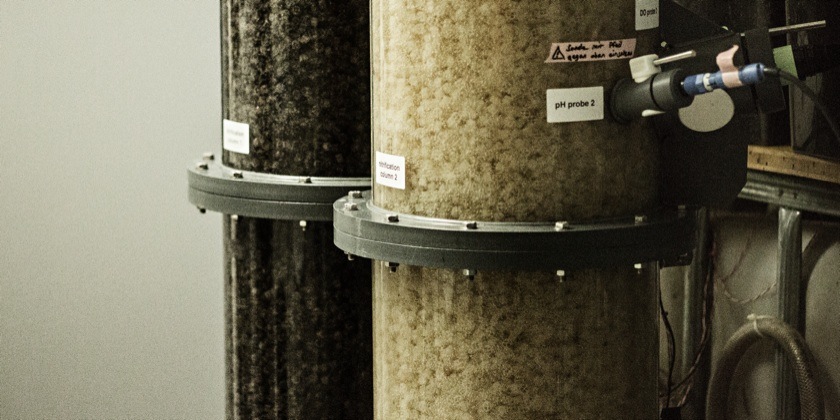
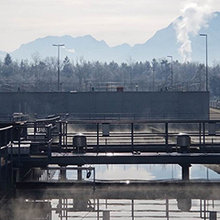
- Wastewater treatment plant: The plant consists of two reactors with a volume of
1.5 m3 each. The wastewater is purified biologically and withdrawn through a
membrane with 0.04 um pore size. The question to answer is, how to operate the
plant in order to minimize the pollutant load and energy consumption.
- Urine
treatment: Urine is collected separately with NoMix toilets. Urine contains
around 50% of the phosphate load. The phosphate is removed by precipitating
struvite - a fertilizer (see NOVA 4). What we do not know is, how the
combination of urine treatment and biological wastewater purification works.
- Sludge
treatment: The pollutants are removed from the wastewater by biological
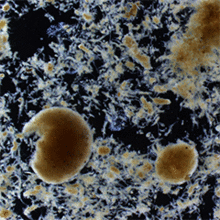
activity. The activated sludge (mixture of water and microorgansims) needs to
be removed from time to time. It is pumped into a filter bag which is located
outside the building. The solids are retained while the water flows back to the
treatment plant. Which pollutants accumulate in the sludge? Could we use it as
compost?
- 4. Water
recycling: The treated wastewater (permeate) is collected in a tank. It is
reused for toilet-flushing and gardening, thus reducing the water consumption
by 35%. Can this water be reused without problems? Are there substances
accumulating in the system and do they influence the wastewater treatment?
Further
questions considered are the user-friendliness, maintenance requirements
(costs), operational stability, monitoring, water and energy consumption.
Poster [79,2 KB]
Publications:
Abegglen, C., Sigrist, A., Siegrist, H. „Electrochemical
Phosphate Removal for Small-Scale Wastewater Treatment Plants”,
Wat.Sci.Techn., submitted
Abegglen, C., Joss, A., Boehler, M., Buetzer, S., Siegrist, H. (2009).
„Reducing the natural color of membrane bioreactor permeate with activated carbon or ozone”. Wat.Sci.Techn., accepted.
Abegglen, C. (2009). “Membrane bioreactor technology for decentralized wastewater treatment and reuse”, Diss. ETH No. 17998.
Abegglen,
C., Joss, A., McArdell, C.S., Fink, G., Schluesener, M.P., Ternes,
T.A., Siegrist, H. (2009). “The fate of selected micropollutants in a
single-house MBR”, Wat. Res. 43(7): 2036-2046.
Abegglen, C.,
Ospelt, M., Siegrist, H. (2008). „Biological nutrient removal in a
small-scale MBR treating household wastewater”, Wat.Res. 42(1-2):
338-346.
Abegglen, C., Siegrist, H. (2006). “Domestic wastewater treatment with a membrane bioreactor”, Wat.Sci.Techn. 53(3), 69-78.