Eawag
Überlandstrasse 133
P.O.Box 611
8600 Dübendorf
Switzerland

Ph. +41 (0)58 765 55 11
Fax +41 (0)58 765 50 28
info@eawag.ch
Research » Eng » Research » Wastewater » Dynamic of greenhouse gas emissions
Eawag - Aquatic Research
  Home Contact Search DE | EN | FR
 
Process Engineering
Dynamic of greenhouse gas emissions

Dynamic of greenhouse gas emissions

Dynamic of greenhouse gas emissions in nutrient removing wastewater treatment plants

Nitrous oxide is a greenhouse gas of potentially great relevance (by weight 310 times more relevant than CO2; N2O emission cause 6% of the greenhouse gas emission in Switzerland). The atmospheric nitrous oxide concentration increased by about 18% to pre-industrial level which is due primary to human activities. The major part, about two third, of the overall N2O emission is derived from agricultural soil management and fuel combustion is a second important source. The exact contribution of wastewater treatment plants (WWTPs) is still unknown.

The microbial N2O production is highly associated with microbial degradation of nitrogen compounds, known as nitrification and denitrification. The contribution of each of the two processes is still unknown. Basically, nitrification is the stepwise autotrophic oxidation of ammonia via nitrite to nitrate, and denitrification is the heterotrophic reduction of nitrate to atmospheric nitrogen, with nitrite, NO and N2O as intermediates.

In the last decade several attempts have been made to reduce energy consumption of WWTPs by reducing the aeration of the nitrification stage to the required minimum. Nevertheless, this may result in increased N2O emission completely annihilating the CO2-equivalent saving achieved by the reduced energy requirement for aeration. So far, the source and magnitude of N2O emissions in WWTPs is still subject of debate and up to date no general agreement exists about the most important parameters influencing it. Consequently, additional knowledge of the parameters and the microbial processes affecting N2O production is needed.

Within the scope of a PhD project, relevant parameters taking impact on N2O emission under operation conditions typical for municipal WWTPs will be identified. On the basis of this data a model is formulated and process control strategies are derived to avoid emission. The results will be validated on full scale installations.

N2O emissions are expected at suboptimal growth conditions. In this respect, the most important conditions in WWTPs are:

  • oxygen limitation
  • accumulation of nitrite
  • low ratio of readily degradable substrate to nitrate (denitrification)
  • accumulation of intermediates due to rapidly changing conditions


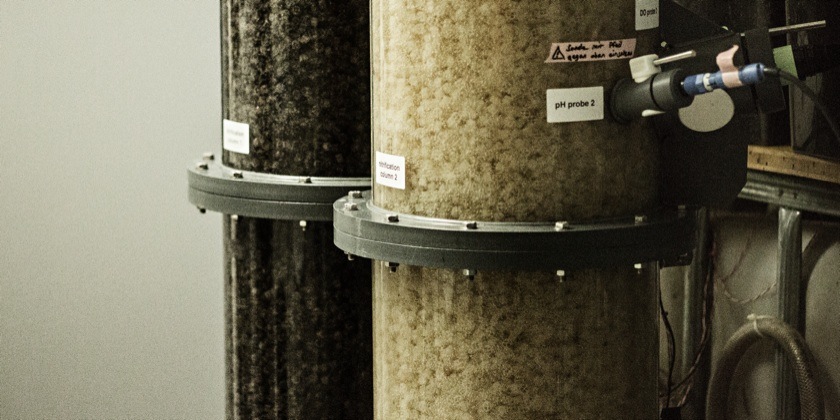
Experiments on the pilot scale wastewater treatment facility at Eawag showed (figure):

  • N2O emissions (from nitrification and denitrification stage) are highly dynamic.
  • Detected N2O emissions are relevant to environment (up to 5% of inflow NH4+-N (on average 25g N/h) was emitted as N2O-N) under normal aeration conditions (2 mg O2/L). This corresponds to 100-200% of the international recognized CO2 emissions for the aeration energy of a nutrient removal plant (average energy consumption of WWTPs: 0.3 kWhelectric/m3wastewater treated corresponding to 0.2 kg CO2,equivalents/m3wastewater treated).

lachgas


N2O (red) and CH4 (green) emissions from the pilot scale wastewater treatment facility at Eawag operated at 2 mg O2/L (blue) from June 10 to 11, as load and as CO2-equivalents (showed in the upper part of the figure).

Contact

Contact

Project manager
Prof. Dr. Hansruedi Siegrist

Project realization
Pascal Wunderlin
Dr. Adriano Joss

Partner
Dr. Lukas Emmenegger, Empa  
Dr. Joachim Mohn, Empa

Link to Empa, Abt. 134