Biological treatment of high strength ammonia wastewater
Idea
Usually during sludge digestion in municipal wastewater treatment
plants (WWTP) about 40-50% of the nitrogen incorporated in the raw sludge
is released as ammonium. As a result concentrations in the supernatant
between 600-1'000 gNH4-N m-3 occur. Recycling of the ammonium-rich supernatant
water of the sludge thickener and the sludge dewatering to the biological
step leads to an additional nitrogen load of about 15-20% related to
the total inlet nitrogen load. The biological step can be substantially
relieved by a separate treatment of these ammonium-rich waste water,
thus surplus tank volume is available for the denitrification and for
the enhanced biological phosphorus removal.
Aim of the study
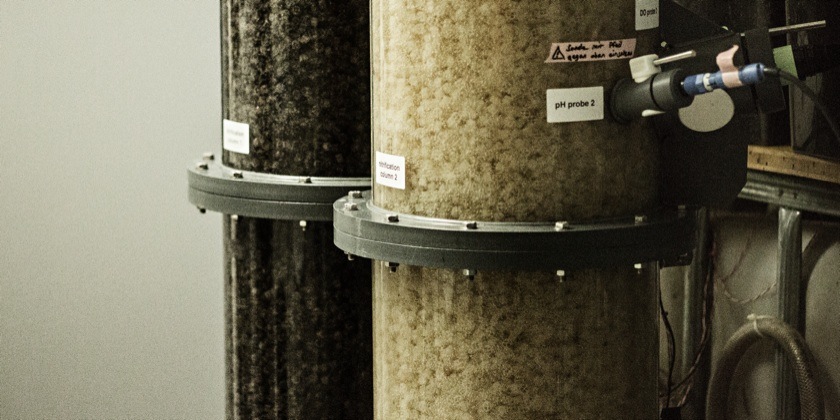
With a pilot plant (reactor volume 4,0 m3) three different processes
for the biological nitrogen removal are investigated. For each process
configuration the kinetics of the processes will be identified to develop
and calibrate a mathematical model. The heat production and loss of
these processes and the resulting reactor temperature are very strongly
linked with the process rates. To guarantee a stable operation of these
systems the heat balance and its impact on the process rates are examined.
Three different biological
processes
Relatively short experimental phase at first the complete nitrification/denitrification
with methanol in a Sequencing Batch Reactor (SBR) is investigated on
the WWTP Au (St. Gallen, CH) and the WWTP Werdhölzli (Zürich,
CH). First results show that with an exchange volume of 10-15% and a
cycle length of approx. three hours a complete nitrification and denitrification
without alkalinity limitation can be achieved.
In the second experimental phase ammonium is only oxidised to nitrite.
The nitrite oxidation will be inhibited. The oxygen consumption of the
nitrification reduces thereby by 25%. With the following denitrification
of nitrite to elementary nitrogen 40% of the necessary external carbon
source can be saved.
Reactor configurations for
the investigation of the autotrophic nitrogen elimination
Most recent investigations with fixed film reactors show, that a
nitrogen elimination is also possible without any carbon source. Under
anoxic conditions slowly growing autotrophic bacteria oxidizes ammonium
with nitrite to elementary nitrogen in the ratio of 1:1. For the third
experimental phase the pilot plant is therefore operated as cascade
reactor (see figure) with and without recirculation. The supply of the
necessary nitrite takes place in the first aerobic tank, where approx.
50% of the inlet ammonium are oxidized with suspended solids to nitrite.
In the following anaerobic fixed bed reactor autotrophic bacteria convert
the formed nitrite as well as the remaining ammonium completely to elementary
nitrogen.
Publications
Koch G. und Siegrist H. (1998). Separate biologische Faulwasserbehandlung
- Nitrifikation und Denitrifikation. VSA (Verband Schweizer Abwasser-
und Gewässerschutzfachleute), Verbandsbericht, 522,
33-48.
Siegrist H., Reithaar S. und Lais P. (1998). Nitrogen loss in a nitrifying rotating contactor treating ammonium-rich wastewater without organic carbon. Proceedings of the Nineteenth Biennial IAWQ conference, Vancouver, 1998.