Eawag
Überlandstrasse 133
P.O.Box 611
8600 Dübendorf
Switzerland

Ph. +41 (0)58 765 55 11
Fax +41 (0)58 765 50 28
info@eawag.ch
Research » Eng » Research » Wastewater » Heat recovery from wastewater
Eawag - Aquatic Research
  Home Contact Search DE | EN | FR
 
Process Engineering
Heat recovery from wastewater

Heat recovery from wastewater

The higher-than-ambient temperature of wastewater makes it a valuable source of energy. In recent years, technologies for exploiting this potential in Switzerland have been continuously improved. Through its research and the involvement of experts from various disciplines, Eawag has contributed to these advances – and to Switzerland’s leading role in this field.

In Swiss households alone, around 1.2 million m3 of wastewater is produced each day. Some of this has previously been heated by boilers, solar collectors, washing machines or dishwashers and retains its heat as wastewater. If all the wastewater in this country were to be continuously cooled by just 1 °C, the energy recovered would be equivalent to around 300 megawatts. Setting aside the question of cost-effectiveness, our wastewater could meet the heating energy requirements of more than 300,000 households. For example, when it is completed, the country’s largest wastewater energy plant – operated by the Schlieren (Canton Zurich) Energy Association, using effluent from the nearby Werdhölzli wastewater treatment plant (WWTP) – will save 5 million litres of heating oil a year, supplying the equivalent of 9000 “Minergie” homes.

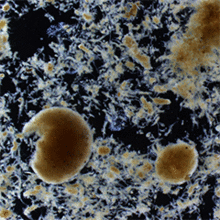
In practice, however, the fact that many wastewater treatment plants are located outside densely populated urban areas restricts the use of heat recovered from WWTP effluents in many places, because the distance from energy users is too great. So, depending on the area to be supplied, it may make environmental sense to recover waste heat from untreated wastewater.” This can be done locally in sizeable housing developments or enterprises with high levels of hot water consumption, where energy is extracted from wastewater with a temperature of around 20 °C in a temporary storage unit. Alternatively, with adequate and reasonably constant wastewater flows, heat recovery may also be possible within the sewer network. For this purpose, heat exchangers are directly installed in sewer pipes. However, the heating sector pioneers who installed the first systems of this kind in the 1980s underestimated the impact of biofouling in nutrient-rich raw wastewater on the performance of heat exchangers. Within just a few days, as shown by Eawag measurements, the development of biofilms can reduce the transfer of energy by up to 40 %. However, laboratory tests also indicated that a temporary increase in flow rates could – at least partly – flush away the unwanted layer of sewer slime. With weekly rinsing, the heat exchanger repeatedly regained more than 80 % of its original level of performance.

grafik_313

Heat from wastewater can be recovered in large buildings, from the sewer or from the effluent of a treatment plant


The recovery of heat from raw wastewater must not impair the efficiency of microbial treatment at WWTPs. This applies in the first instance to nitrification. To ensure that the wastewater temperature does not fall below the critical level of at least 8 °C, Eawag has developed an interactive simulation program for engineers and planners. Using simple parameters such as temperature, discharge, distance from WWTP and sewer network topography, TEMPEST can calculate the dynamics and profile of the wastewater temperature for a planned heat recovery system upstream of a WWTP and thus determine the reliable level of heat extraction.

Literature

Wanner, O., Panagiotidis, V. and Siegrist H. (2004). Wärmeentnahme aus der Kanalisation - Einfluss auf die Abwassertemperatur. Korrespondenz Abwasser, 51(5), 489-495.

Wanner, O. (2004). Wärmerückgewinnung aus Abwassersystemen. BFE-Projekt Nr. 44177. Schlussbericht [pdf 0.8 MB]

Wanner, O., Clavadetscher, P. and Siegrist H. (2005). Auswirkungen der Abwasserabkühlung auf den Kläranlagenbetrieb. Gas Wasser Abwasser, 2, 111-118.

Wanner, O., Panagiotidis, V., Clavadetscher, P. and Siegrist, H. (2005). Effect of Heat Recovery from Wastewater on Nitrification and Nitrogen Removal in Activated Sludge Plants. Wat. Res., 39, 4725-4734.

Dürrenmatt, D.J. and Wanner, O. (2008). Simulation of the wastewater temperature in sewers with TEMPEST. Wat. Sci. Technol. 57(11), 1809-1815.

Wanner, O. (2009). Wärmerückgewinnung aus Abwasser: Wärmetauscherverschmutzung – Auswirkungen und Gegenmassnahmen (Heat recovery from wastewater: heat exchanger biofouling – consequences and remedies). Schriftenreihe der Eawag Nr. 19 [pdf, 6.7 MB]

Contact

Contact

Prof. Dr. Hansruedi Siegrist
Marc Boehler
David Dürrenmatt