Drinking Water
The research group is active in the area of water treatment technology from the water resource to the consumer in several projects. A few examples are listed below.
Potable water production by membranes for „Point-of-Use“ application (POU)
In many areas worldwide the central water infrastructure is not reliable, resulting in unsafe drinking water at the tap and in some places no infrastructure is available at all. In such cases decentralized water treatment is considered to be a feasible solution. Membrane technology (Ultrafiltration) is suitable for a complete removal of pathogens in such situations. Although the price of membranes itself has decreased dramatically during the last decades, most available systems are still too expensive for most of the world population lacking access to safe drinking water. Furthermore, membrane systems in general require chemicals and energy for operation.
The advantage of gravity-driven membrane systems is the fact that no pumps and no energy is required for operation. The results of our investigations have shown that a stable operation can be obtained during extended periods of time (over 16 months) without any flushing or chemical cleaning. The fluxes are lower than found in fully automated treatment plants, but the integral costs for decentralized treatment are much lower than for conventional systems and thus ultrafiltration based on gravity can become affordable also for the poorest part of the world population.
There are several applications for this principle: for developing countries, the process is advantageous for decentralized applications, because the systems can be cheap and virtually no maintenance and operation is required. As part of the EU project TECHNEAU (www.techneau.org), a pilot plant was built and operated in France and South Africa. Furthermore, the process will tested for household application in Kenia. The principle of the process and a review paper on household water treatment have been published: POU papers. Link zu Papers Point-of-Use Trinkwasser (anstelle „Review“)
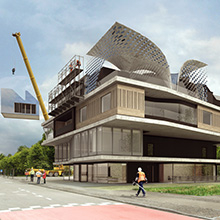
The same principle can also be applied for decentralized water treatment in industrialized countries. In collaboration with Empa, an autonomous living unit has been built which is independent of external water and energy supply. Rain water is collected on the roof and treated by gravity to privide reliable drinking water. This water is only used for drinking and cooking. Grey water is being recycled by MBR technology for flushing and washing.
A more detailed description is found here.
Membrane fouling
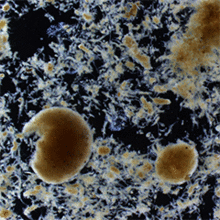
During filtration of natural water through membranes, fouling of membranes can not be avoided. In practical applications, complex operation schemes including flushing and cleaning cycles are applied in order to limit the fouling effects. However, the fundamental mechanisms of membrane fouling by natural organic compounds (NOM) are still only partially understood. A main problem in obtaining this understanding is the fact that the composition of natural waters is highly complex. In order to reveal the contribution of the individual compounds, synthetic media were used containing well-defined surrogates of the most important fouling components: biopolymers and humic acids. Also relevant inorganic water compounds were spiked to the model media, including Calcium and inorganic particles. The results have shown that, in contradiction to the general opinion, turbidity (caused by inorganic particles) is not a strong fouling component. Inorganic particles do not result in a large flux decrease and are easily removable from the membrane by flushing. However, elevated concentrations of inorganic particles in natural waters are often accompanied by high NOM concentrations. Especially humic acids appear to adsorb relatively strongly to the membrane and lead to membrane fouling that is not hydraulically reversible. Furthermore, it was shown that biopolymers (mainly polysaccharides) are also an important fouling component. Similar amounts of alginate resulted even in a larger flux decline than humic acids, especially in the presence of Calcium. In contrary to humic acids however, the major part of alginate fouling could be reversed hydraulically. The combination of humic acids, polysaccharides and Calcium leads to the most detrimental form of membrane fouling, both with respect to flux decline and to reversibility.
Some published papers on this topic can be found here. Link zu Papers Membranfouling
In-line flocculation for the optimization of Ultrafiltration
Membrane processes are increasingly applied worldwide and also in Switzerland. In some cases it used to extend the existing capacity and in other case to replace existing filtration units. Advantages of ultrafiltration membranes include the complete retention of pathogens and the relatively small footprint. However, some water components can lead to strong fouling. Such fouling components can also occur in water resources depending on the weather conditions, for example during intensive rain events, snow melting or phases of lake mixing. In-line flocculation has been shown to be an effective method to reduce fouling in such situations. However, the mechanisms behind this process are largely unknown and thus, optimization has been so far highly emperical. In a study supported by the Swiss EPA (BAFU), several flocculation agents and their effect on membrane performance and NOM composition is being studied in a systematic way. On basis of the results, dosing methods and process control will be optimized. The goal is to reduce the consumption of flocculation agents by 60-70% in comparison to conventional sand filtration plants. The investigations are carried out in close collaboration with the Swiss membrane company Membratec SA (www.membratec.ch).
Drinking water competence center
The group is participating in the Eawag drinking water competence center, which acts as a platform to join the different disciplines at Eawag active in drinking water. More information can be found on: wave21
List of publications
A complete list of recent peer-reviewed papers can be found here