Papers Point-of-Use
“Stabilization of flux during dead-end ultra-low pressure ultrafiltration” M. Peter-Varbanets, F. Hammes, M. Vital, W. Pronk, Water Research, 44, 2010, 3607-3616
Abstract
Gravity driven ultrafiltration
was operated in dead-end mode without any flushing or cleaning. In contrary to
general expectations, the flux value stabilized after about one week of
operation and remained constant during extended period of time (several
months). Different surface water types and diluted wastewater were used as feed
water and, depending on the feed water composition, stable flux values were in
the range of 4-10 L∙h 1∙m-2. When sodium azide was added to the feed water to
diminish the biological activity, no stabilization of flux occurred, indicating
that biological processes play an important role in the flux stabilization
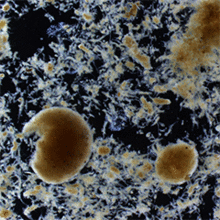
process. Confocal laser scanning microscopy revealed the presence of a
biofouling layer, of which the structure changed over time, leading to
relatively heterogeneous structures. It is assumed that the stabilization of
flux is related to the development of heterogeneous structures in the fouling
layer, due to biological processes in the layer. The phenomenon of flux
stabilization opens interesting possibilities for application, for instance in
simple and low-cost ultrafiltration systems for decentralized drinking water
treatment in developing and transition countries, independent of energy supply,
chemicals, or complex process control.
“Review: Decentralized Systems for Potable Water and the Potential of Membrane Technology” M. Peter-Varbanets, Chris Zurbrügg, Chris Swartz, Wouter Pronk, Water Research, 43 (2), 2009, 245-265
Abstract
Decentralized drinking-water systems are an important element in the process of reaching the Millennium Development Goals, as centralized systems are often deficient or non-existent in developing and transition countries (DC and TC). Most water-quality problems are due to hygiene factors and pathogens. A range of decentralized systems is available to counter these problems, including thermal and/or UV methods, physical removal and chemical treatment.
This review focuses on decentralized systems that treat the potable water (drinking and cooking) of a single household (point-of-use systems) or a community (small scale systems). For application in DC and TC, important boundary conditions for decentralized systems include low costs, ease of use, sustainability, low maintenance and independence of utilities (energy sources). Although some low-cost systems are available, their application is limited by time-consuming daily operation and maintenance. Other systems are too expensive for the poor populations of DC and TC and in most cases do not fulfill the system requirements described above. Point-of-use systems based on membranes are commercially available and are designed to operate on tap pressure or gravity.
Membrane systems are attractive since they provide an absolute barrier for pathogens and remove turbidity, thus increasing the palatability of the water. The costs of membrane have decreased rapidly during the last decades and therefore membrane systems also become in reach for application for low-cost applications in DC and TC. Some membrane systems rely on gravity as a driving force, thereby avoiding the use of pumps and electricity. On basis of the present literature data, no small scale systems could be identified which meet all the requirements for successful implementation. Furthermore, in the available literature the performance of highly fouling water types has not been reported. For such cases, more extensive studies are required and it a need for suitable pretreatment was identified.
It can be concluded that there are good perspectives for decentralized systems based on membranes, but that a need exists for research and development of systems with low costs and low maintenance, specifically designed for DC and TC.