Eawag
Überlandstrasse 133
P.O.Box 611
8600 Dübendorf
Switzerland

Ph. +41 (0)58 765 55 11
Fax +41 (0)58 765 50 28
info@eawag.ch
Research » Sandec Home » Research » Municipal Solid Waste Management
Eawag - Aquatic Research
  Home Contact Search DE | EN | FR
News

News

Events

The Nepali version of Sandec's Compendium of Sanitation Systems and Technologies was officially launched in Kathmandu - October 2012

Reinvent the Toilet Challenge - Eawag and their partner EOOS won the Special Recognition Award from the Bill & Melinda Gates Foundation - August 2012


Recent publications

Sandec News 13, the 2012 edition of our yearly newsletter - July 2012


Water and Sanitation in Developing Countries
Municipal Solid Waste Management

Municipal Solid Waste Management

Inadequate collection, recycling or treatment and uncontrolled disposal of municipal solid waste are particularly frequent in low and middle-income countries, and lead to severe health risks and environmental pollution. In such countries often more than 50% of the total municipal solid waste is organic. Our research focuses on enhancing resource recovery of organic waste, as close to the source as possible, in order to alleviate problems of transport and disposal.

Research themes and projects:

-    Anaerobic digestion of organic solid waste

Besides composting or direct animal feeding, anaerobic digestion (biomethanation) of organic solid waste is considered a promising treatment option for this particular waste fraction. Anaerobic digestion is a natural biological process that converts biomass into energy (biogas) in the absence of oxygen. Biogas – a mixture of CO2 and methane (CH4) – can be used as a renewable energy source for cooking, lighting or to generate electricity, thereby replacing other fuel sources. Biogas digestate is a nutrient-rich fertiliser that can be applied in gardens or agriculture.

-    Decentralised composting

The existing physical plan and socio-economical situation of many cities in low and middle-income countries strongly favours the implementation of decentralised systems. Decentralised composting systems are less technology dependent. Low cost, locally available materials and simple technology can be used. Our research on composting includes co-composting of organic waste and faecal sludge as well as market demand for compost from organic waste.

-    Conversion of Organic Refuse by Saprophages (CORS)

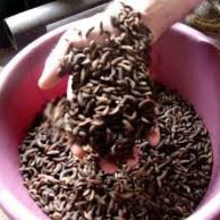
Saprophages include all organisms feeding of dead or decaying matter. Typical examples are earthworms, millipedes or insect larvae. Conversion of organic refuse by saprophages is an innovative technique to treat organic waste in low and middle-income countries, with degraded organic matter and saprophage organisms themselves as treatment products.


Key readings: We have compiled a list of key readings on the topic of Municipal Solid Waste Management.

Team Publications External links
Contact

Contact

Caterina Dalla Torre
Eawag
Water and Sanitation in Developing Countries
P.O. Box 611
8600 Dübendorf
Switzerland

Ph: +41 (0)58 765 52 86
Fax: +41 (0)58 765 53 99
caterina.dallatorre@eawag.ch

Absent: Monday,
Wednesday afternoon,
Thursday afternoon

In case of absence please contact Chris Zurbrügg