Eawag
Überlandstrasse 133
Postfach 611
8600 Dübendorf
Schweiz

Tel. +41 (0)58 765 55 11
Fax +41 (0)58 765 50 28
info@eawag.ch
Forschung » Sandec Home » Research » Municipal Solid Waste Management » » index_EN
Eawag - Aquatic Research
  Home Kontakt Suche DE | EN | FR
News

News

Events

The Nepali version of Sandec's Compendium of Sanitation Systems and Technologies was officially launched in Kathmandu - October 2012

Reinvent the Toilet Challenge - Eawag and their partner EOOS won the Special Recognition Award from the Bill & Melinda Gates Foundation - August 2012


Recent publications

Sandec News 13, the 2012 edition of our yearly newsletter - July 2012


Wasser und Siedlungshygiene in Entwicklungsländern
Co-composting Bangalore

Co-composting Bangalore

New Toilets for Indian Slums - Nutrients Mass Balance of a Co-Composting Plant in Bangalore, India

This project studied the eco-toilet installed in the Rajendra Nagar slum in Bangalore, India, and the co-composting site located on the Rayasandra campus of the ACTS Academy for Higher Education in Bangalore, where the material collected from the eco-toilet is composted together with waste paper.

The research project included the monitoring of the composting process. This was done by measuring the evolution of nitrogen-species, phosphorus and minerals, by determination of mass balances (volume, dry matter, nitrogen and phosphorus) and by recording the temperature and the pH in the compost. The hygiene quality of the compost was established (by studying faecal indicators (coliforms and E. coli) and observing parasite eggs as well as conducting research on the viability of tomato seeds incubated in the compost), and the effects of the compost as a fertiliser on plants were analysed (by conducting growth experiments with local and reference plants). The recording of the volume of material collected in the toilet was also a part of the work.
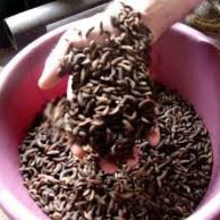
  co_composting_bang.jpg

Emptying of the faeces drums and covering the faeces with waste paper

The entire system, including the eco-toilet installation, was evaluated on its functionality, and improvements were proposed.

Through this work it was possible to show that the composting process works slowly but satisfactorily. There are neither parasites eggs nor a high concentration of total coliforms or E. coli to be found in the compost: it can be considered as fit for use. The hygienisation is not a thermal one, as the temperature in the compost remains too low, but can be due to a high alkalinity or to a high ammonia concentration in the compost.

The eco-toilet installation can be considered a success (800-900 users per day), however the transport of faeces still constitutes a cultural problem. The co-composting site still needs some improvements and, amongst other things, the high content of water in the compost should be eliminated.

The eco-toilet and co-composting pilot project in Bangalore can be considered as a good example for the implementation of separating toilets in slums. Some improvements, towards producing a compost with a constant chemical content and a reliable quality as well as to furthering development of the promotion and use of the compost, could help to extend the technology further.

Project partners: Technical College of Wädenswil, Seecon GmBH, ACTS Academy for Higher Education in Bangalore

Kontakt

Kontakt

Caterina Dalla Torre
Eawag
Wasser und Siedlungshygiene in Entwicklungsländern
Postfach 611
8600 Dübendorf
Schweiz

Tel: +41 (0)58 765 52 86
Fax +41 (0)58 765 53 99
caterina.dallatorre@eawag.ch

Abwesend: Montag,
Mittwoch- und Donnerstagnachmittag

Bei Abwesenheit kontaktieren sie bitte Chris Zurbrügg