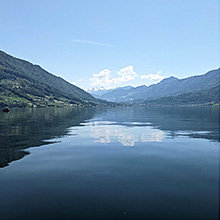
News from the lake Van expedition
Eawag Researchers are drilling lake Van in eastern Anatolia, Turkey, in the context of the PALEOVAN project. Due to it's volcanic and tectonically active environment the seaground's sediments keep precise records of paleoclimate and paleoenvironment. During the two months of the expedition, the team will be posting their impressions live on this site.
Also visit the Lake Van website at International Continental Scientific Drilling Program (ICDP)
1 September 2010
All expeditions and drilling projects come to an end sooner or later, even if the precise timetable is rarely kept to. Slowly but surely the afterpains of our project, conceived as a scientific idea and executed in a welter of steel and sweat, recede into the distance. Memories of waves, storms, horrible food, 12-hour shifts, flea bites, acid and pH, nausea, money problems, exhaustion and loud telephone conferences fade with time and a positive sheen settles over the experience.
The physical and mental reality of Exhaustion is giving way to a sensation somewhere between sober reflection and euphoria, depending on the individual. Not only physically were we pushed to our limits; from the science perspective, too, we did what we had to do and achieved our aims. Our main borehole at the Ahlat Ridge hit rock at a depth of 220 metres, preventing further drilling and meaning our hole was not as deep as planned. So much for the small bit of bad news. The big bit of good news is that the sediment cores extracted are most likely a window into the entire history of Lake Van, from the moment of its creation up to the present era. This is all the more interesting from a scientific perspective as the deepest sediments were presumably deposited in fresh water and contain mussels so big that even I can make them out. These older sediments were laid down in a ‘normal’ lake that had nothing in common with today’s Lake Van with its extreme hydrochemistry. This opens up completely new areas of scientific exploration: Why did a freshwater lake turn saline? What was the biological response to this change? These new learning opportunities soften our attitude to what we went through and let us put behind us the weeks of effort and expletives, which we had to go through to reach the point we are at.
Now that we are back in Switzerland, Lake
Van seems as far off as it was before the project began and we are now looking
ahead to Bremen, where the first scientific analyses will be carried out on the
cores before the year is out.
Rolf Kipfer
|
Sunset at Lake Van. |
28 August 2010
In the last weeks we had to fight constantly against the windy conditions of Lake Van. Fortunately the core recovery in the last hole on Ahlat Ridge was very good and we reached the lake basement on Aug 23 for the third time. By achieving this final goal the drill operations were shut down. In total 828.6 meters of sediment cores were recovered, the cores were cut into 1013 sections, 387 core catchers were analyzed and 1975 subsamples were taken during the last two months and already sent to the respective institutes. Against all expectations, the deepest noble-gas sample was taken at the astonishing depth of about 206 meters below the lake floor.
On 27th August the DOSECC platform reached the harbor of Ahlat and the DOSECC crew (without respite) started with the demobilization. The containers, once our daily working place, are used to store the great variety of tools and materials to be shipped to the next ICDP project on the Dead Sea. In the on-shore laboratory we started to pack all our material in order to send it back to Switzerland. The cooling container with the sediment cores was also prepared for shipping.
As the university boat is no more needed for the drill operations, we had the chance to recover, maintain, and redeploy the mooring. For five years sediment traps collect particles sinking through the water column of Lake Van on this mooring. Short cores were taken in the region of Ahlat Ridge to complete the drilled sediment record.
Now it is
time to say Good bye! After two months of 24 hour work, seven days a week in
eastern Anatolia everyone is quite happy to go back home. Nevertheless, this is
just the beginning of the PALEOVAN project: the sediment cores are on the way to
the core repository in Bremen (Germany), where the science team will meet again
for the opening party. We are really looking forward for all the information
that the sediments of Lake Van will unleash!
Yama
Tomonaga and Mona Stockhecke
25 August 2010
17 km/h at 20:05, 37 km/h at 20:17, 40km/h at 20:30: the wind speed during yesterday's nightshift. "Ain't no hurricane driller!" said Joe our drill master and turned the device off. The waves were already washing over the platform. Instead of the desired 30m, we only managed to drill 10m.
Planning in advance is impossible in drilling operations, is what we've learnt so far. Despite this, we are getting closer to our aim: three 220m long cores at Ahlat Ridge. The end is in sight, the tension of the expedition members is subsiding and the US-American drill team contemplates over bacon and spare ribs: as long as it's pork!
Besides the advancement of the drilling operation, it is also quite
thrilling to experience Ramadan. From sunup to sundown, the young hotel staff
fasts and dreams about the first cigarette in the evening. This daily
abstinence does have its advantages, especially for the nightshift. They can
breakfast with the Turkish at 3:15 before the morning prayer.
Paul Hammer
|
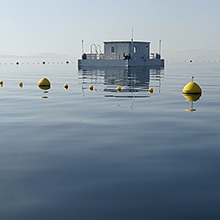
The waves make drilling impossible. The 540m long drilling rods may become damaged when suddenly plunging into the sediment. | |
|
Visibly relaxed scientists enjoy the first rays of sun in the morning. |
17 August 2010
It took two full days and nights of intensive drilling operations at HOLE 2D until the drill-head of the ALIEN-coring device reached finally the sediment basement of Lake Van on 12 August 2010, at 2:30am, at a sediment depth of 217 m. Coarse, well sorted volcanic sand with frequently white shell fragments awaited us there. Hurrah to our drillers! Congratulations also to our seismic colleagues, who predicted the basement at Ahlat Ridge rather exactly at 220 m!
So we reached the central goal of the expedition.
500’000 years of the earth’s history, recorded in sediment cores, are ready for
detailed investigation. This success makes us forget about the high waves of
the last days and the stomach problems of some expedition members. We have now
moved on to HOLE 2E and start quickly to drill a parallel core, for additional
material and for filling recovery gaps of HOLE 2D, given that wind and waves do
not cause unexpected interruptions.
Paul Hammer
|
Night-shift drillers Gary, Joe, Pete |
14 August 2010
Past 215 metres
below present lake floor in Ahlat Ridge, the drillers were getting lower and
lower recovery regardless of the techniques employed. The material coming up
was very dense, hard, dry, sandy and contained several white pieces, apparently
some shells remnants. The seismic datas, assuming clay material’s density, also
show noisy signals below this depth... Have we reached the „bottom“ of Lake
Van? We think so...
Marie-Eve Randlett
|
Nothing to compare with the clays or the tephras that we hit in our way down, this dry and sandy material seems impenetrable. |
9 August 2010
In the last 3 days, about 120 m of sediments
were brought to the shore of Lake Van, in our Hotel in Ahlat. The entire team
was fully busy and everyone was in a good mood, for nice samples were finally coming...
and fast! This afternoon, the Logging team took up the work on the platform. We
have now a good recovery and overlap for the upper part of Ahlat Ridge and the rest
of the Drilling operations will be focused on drilling deeper than the 120 m we
could reach so far. The drillers have experience with Lake Van sediment’s by
now and we are confident to recover cores from deeper sediments, prolonging the
climate record back further in time.
Marie.Eve
Randlett
7 August 2010
Knowing that Lake Van is surrounded by volcanoes, we were expecting (and we were even eager to) encounter layers of pyroclastic sediments (called tephra) while drilling. Indeed! By now our notebooks are filled with various tephra-entries, reporting different colors, grain sizes and textures. Just as exciting, fascinating and unique as they are, the tephra layers pose quite a challenge for the drillers: they can be quite thick and are usually poorly consolidated. „In the drill hole they [among other troubles!] form instable walls that can easily collapse“, explains DOSECC chief geologist Douglas W. Schnurrenberger.
So today the
weather is just fine and the drill mud has the right consistence. Instead, a
tephra layer is taking up the role of troublemaker. A „cave in“ blocked the hole
and slowed down the operations once again. The plan is to wash out the tephra
without coring it... and try it all over again. Surely we cross our fingers for
„more cooperative material“ deeper down.
Marie.Eve
Randlett
|
Lake Van team visiting Nemrut caldera. The later has a diameter of 7-8 km, which gives a sense of how powerful volcanic eruptions can be. |
4 August 2010
The borehole on the Ahlat Ridge is getting deeper and deeper. However,
drilling is becoming neither easier nor swifter the deeper we go and we have to
take the occasional break. During the night most of these breaks are spent
sleeping, which is mostly very relaxing thanks to the (more or less) gentle
rocking of the boat and the impressive night sky over Lake Van. When we are
not sleeping we give free rein to our imaginations, conjuring up culinary
delights for ourselves and the drilling crew from the modest ingredients on the
platform.
Matthias Brennwald
29 July 2010
Last Sunday night everything was in place: the drill pipe had been lowered 357 metres to a depth one metre above the surface sediment and drilling was ready to commence. The drilling went smoothly to a depth of around 30 metres into the sediment. After that, however, we were obliged to proceed a little more slowly. On one hand this is because of deterioration in wind and wave conditions and on the other because the sediment is frequently being replaced by the thick, impenetrable tephra layers. The drill head is currently at a depth of 95 metres.
The core segments are
taken from the platform to our hotel, where they undergo preliminary analysis
in the purpose-built laboratory. Our Turkish colleagues use a multisensor core logger to
measure depth profiles of the magnetisability, density, sonic speed and
conductivity of the individual segments. These profiles are helping us to
determine the precise chronological and geometric sequence of the different
segments relative to one another. This data will then be used to identify and precisely
characterise sedimentological units.
Matthias Brennwald
|
|
|
| The scientists discuss the new data. | On the ground floor of the hotel a laboratory has been set up where the physical characteristics of the core segments are constantly measured. |
25 July 2010
Flashback to 19.7.2010: "…and tomorrow the drilling platform will hopefully be anchored at the new drill site". But sometimes the small things are every bit as important as the big ones, such as the temporarily lost anchor platform. "Small is beautiful" applies to the waves in particular – and Murphy, of course, decided to blow all the waves on the lake into the area where we were working. And it certainly doesn’t help matters when the boat used to tow the platform is bobbing around helplessly on the lake with a faulty motor. So we had plenty of time to look at the first log data recorded at the drilling site, to explore our wonderful surroundings and even to train with the Turkish cross-country skiing stars.
When we then hoisted a brand-new Turkish flag on the platform, replacing the rather dusty old one, the gods were appeased and the platform was finally on the way to its destination. To everyone’s joy we were able to start drilling last night at the new site and embark on our second, most important journey into the past of Lake Van!
Matthias Brennwald
22 July 2010
Bad weather with wind and waves is delaying our efforts to anchor our drilling platform at the next site but the forecasts are better and we are confident that we will soon be able to drill the Ahlat ridge.
Everyone in Ahlat, the lakeside town in which we are based, now knows us and we are constantly asked about the drilling project in the street and in shops. Everyone assumes that we are drilling for raw materials and uranium is the one that crops up most often in conversations, though oil is also sometimes mentioned. We are therefore striving to inform people with leaflets and information about our scientific project. Yesterday at the hotel we took the opportunity to offer a large group of teenagers a tour of the laboratory and at the same time provide information on our drilling work. These athletes are Turkey’s top up-and-coming cross-country skiing team. They are being prepared by professionals for the 2014 Winter Olympics in Sochi and are training on roller skis on the roads here. Prof. Namik Cagatay, our colleague from Istanbul Technical University, let the cross-country skiers in on the secrets of our project in two groups. The Q&A session afterwards was longer than the presentation so a great deal of interest had evidently been awakened. Similar events are planned in the near future so that we can also provide the local population with something enduring once the drilling is over. Our close collaboration with colleagues from Van University will also ensure that the results of our work are not just published in international journals but in the most important channels of the Turkish geo scene.
Flavio Anselmetti
19 July 2010
The boring tool has now arrived at the first drill site, at a depth of more than 140 metres. We are very happy, that this long sedimentary layer has already been penetrated. Cores have piled up to a total depth of more than 200 metres in the refrigerated container, which we have placed in the hotel garden with a view overlooking the lake. In this way, more than 150,000 years of environmental and climatic history are already onshore – a great start, after just two weeks of drilling.
Now we are prepared to haul the drilling platform to the second drill site, located 7 kilometres towards the middle of the lake. But there was a massive shock waiting for us: The anchor float with the large cable winch, which had been attached to a cable for a few days, as well as four stationed buoys for mooring the anchor lines of the large platform, suddenly disappeared. They had simply vanished and were nowhere to be seen. Nothing was on the shipboard radar! The float consists of four connected freight containers which would be seen for kilometres. Could it have been the storm last week?
Whatever the cause, we had to find the anchor platform, otherwise it won’t be possible to anchor the drilling platform. So we all spread out, got into boats and cars, but the lake is more than 100 kilometres long with a surface area of more than 3500 km2 , and what‘s more it’s a complex coastline – we are quite literally talking about looking for a needle in a haystack. Just as hope was fading, salvation came in the form of an Apache attack helicopter: thanks to the coastguard, who had been actively supporting us since the beginning of the search campaign and also to the hotelier and his connections, the Turkish army were called in yesterday at short notice. The helicopter team discovered the anchor float when flying over the other side of the lake (!). It is now back in tow and the drilling platform will hopefully be anchored to the new drill site tomorrow. This way, we will soon be able to drill the Ahlat ridge, which is most important for us in order to reach our scientific goals.
Flavio Anselmetti
14 July 2010
More than 20 people are working day and night here on the drilling platform and in the laboratory. This is necessary, because a drilled hole in soft sediment has to be constantly flushed out. Furthermore, the financial resources are used more effectively in 24 hour work. The work is covered by two 12 hour shifts. Every day at 18:30 a more or less lively six man team appears at the harbor for the night shift. After a 20 minute speed boat trip we reach the platform and the team from the day shift, which has been roasting in the sun for twelve hours, tells us about the events of the day. The drilling continues through the night and a three meter long core, which is retrieved roughly every hour by a core collector, is brought on board. We scientists then work on the valuable sediment archives, i.e. we cut them in two, label them, take the first samples etc. We then prepare the core device and clear the mud covered deck. Communication is vital! Thus, we inform the drilling team at which depth the next core is to be drilled, and whether we should change anything in the drilling, or if we are content with the core quality.
Very soon the lively start of the shift is behind us and a long night sets in. And it is a very long shift. A few rounds of Turkish coffee are dully required in order to help experience the sunrise in good shape. Even the Americans in the drilling team, who actually do the most and the hardest work on the platform, have acquired the taste as well, because our coffee making technique keeps getting better. When the sun rises once again we head towards the shift change with a renewed energy and proudly bring the drilled meter sediment, our catch of the day, back to the laboratory.
Flavio Anselmetti
9 July 2010
The first really dirty problems started occurring today. As a reminder, you have to drill in order to obtain sediment core. That is easy as long as the sediment looks like fine black mud. If the sediment becomes more coarsely grained, like the “tephra” layer then the drilling head starts to wedge itself. Yes, once again, the drill is stuck in tephra. And now let us address the problem: in order to drill through coarse grained sediments, drilling mud is needed. This prevents the borehole from collapsing in the drilled section. Ready for use drilling mud looks like a yellowish jelly and is mixed together with water from Lake Van and a powder called GUAR, which is a polysaccharide. Although this was tested “at home” and although it is listed in the GUAR instructions that the agent also functions at the pH-value of 9.6 in Lake Van, the GUAR flocculates immediately when mixed with water from Lake Van. Upon inquiry, the GUAR manufacturer reckons that we should add potash, which additionally raises the pH-value! Now, this is going too far chemically even for me as a geophysicist: since according to the instructions GUAR can no longer be mixed with water at higher pH-values. We quickly and resolutely conducted experiments today to observe the reaction of mixing GUAR and Lake Van water in which the pH-value was reduced by the addition of acid contrary to expert advice. After some hours of searching we found in the nearby small town no real acids, however, but toilet decalcifier, vinegar and battery acid. The experiments were successful. GUAR and water mixed at pH 6.5 to form an ideal drilling mud. There is one remaining problem: to get our hands on 2000 liters of drilling mud for 12-hours of drilling we need 160 bottles of household decalcifier, 200 liters of vinegar or 100 liters of battery acid. These amounts are not readily available. Tomorrow we will receive highly concentrated hydrochloric acid and sulfuric acid and will continue our experiments in applied drilling mud or mud chemistry.
Rolf Kipfer
7 July 2010
Things are slowly getting back to normal. For days, we tried to break through hard layers of ejected volcanic material, so-called tephra, with a plastic liner. We also have to place the anchors for the main bore, but still have to handle minor matters on the side: It is time again to go to the telecommunication store: This damned bargain cell phone still won’t work.
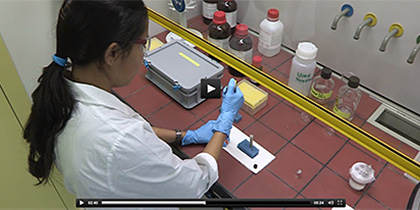
Everyone is hard at work day and night – not only at the platform but also in the homespun laboratory in the hotel. The arriving cores are measured, catalogued and scanned electromagnetically to get first results for their composition. The bottom areas of the cores ('core catcher') are divided into subsamples, pressed and centrifuged in Herculean presses just to extract a few millilitres of pore water. This is then filled into tiny bottles and should be analysed at Eawag starting next week. We are all learning, but moving up the learning curve quickly and steeply. Finally, today (7 July 2010) around noon, the tephra layer with more than 10 meters was pierced – everything here in the laboratory is ready for the new samples.
Rolf Kipfer
3 July 2010
If we are to reconstruct the ascent of humankind, trace the development of agriculture and urban centres, study the history of climate change and chart seismic and volcanic activity over the last half millennium, we need an archive. The sediment at the bottom of Lake Van, laid down with every passing year, provides one such archive. And when a lot of money and a lot of brains come together in one project, this archive can be read and interpreted. It also requires a lot of steel cable (kilometres of it) and a great deal of luck.
After much waiting and
anticipation, drilling began last Friday. In the swell an A-frame broke while an
anchor was being raised, but no fingers or heads were lost. The drill platform
had to be set up exactly horizontal to enable successive drill rods to be
screwed into one another. But the achievements are already plain to see. After
four years of planning and not a little sunburn the first stratum of sediment
was successfully penetrated at around 4.30pm on 3rd July
2010.
Rolf Kipfer