Eawag
Überlandstrasse 133
Case postale 611
8600 Dübendorf
Suisse

Tél. +41 (0)58 765 55 11
Fax +41 (0)58 765 50 28
info@eawag.ch
Recherche » Surf » Forschung » Project Overview » Bathymetry of Swiss Lakes
Eawag - Aquatic Research
  Home Contact Recherche DE | EN | FR
 
Eaux des surfaces
Bathymetry of Swiss Lakes

Bathymetry of Swiss Lakes

Swath bathymetric investigations of Swiss lakes. Implications for lake floor processes and natural hazards

Current knowledge of the morphology of the lake floors in Switzerland is in many places limited to a rough idea of the topography of the basins. The majority of the available data were collected more than 50 years ago for general mapping purposes, using single soundings (with wires) or single beam echosounders (acoustic measurements). The spatial density of these depth measurements is relatively low so that medium- to small-scale details cannot be identified. However, a detailed knowledge of the structure of lake floors is valuable with regard to many issues, e.g. in order to track physical processes such as sediment transport or mass wasting at different scales from metres to kilometres.

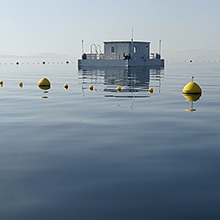
In order to substantially improve our knowledge of the lake floor, state-of-the-art swath bathymetry technology is applied for the first time in Swiss lakes in the framework of a pilot project. These modern hydrographic survey systems (multibeam echosounders, interferometric sonars) allow the collection of large datasets (Digital Terrain Models, DTMs) in relatively short time and yield resolutions that have not been possible with older techniques. Depending on water depth, a horizontal resolution of down to less than 1 m and a vertical resolution of a few dm are reached. This is sufficient to create geomorphological maps and images/visualisations based on the DTMs that include a wealth of features ranging from e.g. bedforms related to sediment transport (dunes, channels, levees), traces of subaquatic mass movements (slide scars, mass flow deposits and deformation structures in adjacent sediments), bedrock structures (bedding and fault traces) and features probably related to fluid expulsion (pockmarks) to large-scale elements such as subaquatic moraines or rockslide/rockfall deposits.

Based on the DTMs, detailed quantitative descriptions are as well possible as visual interpretations of the lake floor morphologies using computer-generated images. Periodic repetitions of such surveys allow tracking the evolution of the lake floor quantitatively over time. The availability of accurate maps of the lake also provides an opportunity for other disciplines of lake research to focus on the areas of interest more easily. Finally, the high-resolution DTMs are of great use for practical applications such as exploitation of natural resources (gravel mining), engineering and construction, charts for navigation or investigation of waste deposits. Ongoing work for this project includes pilot surveys in Swiss lakes and an evaluation of the applicability of the data to scientific questions (earth and environmental sciences). Special emphasis is put on the sedimentary processes and the evolution of river deltas.

Eawag News

Revealing the secrets of the lake floor [...]

Publication

Hilbe M., Anselmetti F.S., Eilertsen R.S., Hansen L. (2008)  Spuren von Massenbewegungen auf dem Grund des Vierwaldstättersees bei Weggis: Die Ereignisse von 1601 und 1795. Bulletin für Angewandte Geologie 13, 83-85 [pdf, 673KB]