Lacustrine Sediments
High Resolution Archives for Geomagnetic Field Behavior and Paleoclimate
Collaborative, Highly Interdisciplinary Research Project of the ETH Zurich
A
known link exists between radionuclide production rates and the
strength of the dipole magnetic field of the Earth. More controversial
are the postulated links between solar variability and climate or
magnetic field behavior and climate. Critical to the open questions
involving these links is to have a good model for field behavior. This
project is designed to examine these various links between the magnetic
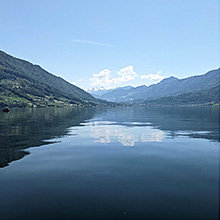
field, 10Be production rates and climate using lacustrine sediments from Swiss lakes as high-resolution, continuous archives.
- Project A:
Paleomagnetic measurements will provide directional information, i.e., declination and inclination, and relative paleointensity information that will serve as the input for modeling under Project B. - Project B:
The time-dependent field model will be used to encapsulate global knowledge of the evolution of the Earth’s magnetic field from scattered observations. - Project C:
The first part of this project is to ascertain the suitability of Swiss lacustrine sediments as archives for 10Be by measuring the isotope in the cores and samples from the catchment basin. Ultimately a 10Be model for lake sediments will be developed describing the various sources and sinks of 10Be. - Project D:
This project will focus on the climatic and environmental evolution stored in the lacustrine archive. Novel high-resolution geochemical core scanning techniques that are now available to the Climate Geology Group allow an unprecedented analytical spatial resolution down to 0.1 mm. This offers the possibility to extract information from sedimentary cores even on sub-annual timescales and permit new insights into the nature of abrupt climate changes.
Contact persons: Ann Hirt (Project leader, ETH), Jürg Beer (Co-Applicant, Eawag)
Co-Applicants (ETH)
Andrew Jackson, Gerald Haug, Christopher Finlay, Adrian Gilli
Funding: ETH, Eawag
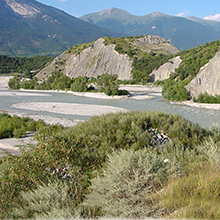
Left picture on top: Soppensee
Soppensee
is a small, eutrophic lake located in the central Swiss plateau about
30 km north of the Alps (600 m a.s.1., 8 ° 20' E, 47 ° 5' 30" N). It is
a kettle-lake that
formed at the end of the LGM, after the retreat
of the western arm of the Reuss Glacier. The lake has no major inlets
and receives only seasonal surface run-off.
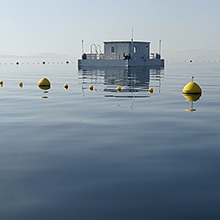
A series of 23 long cores (cut into one metre sections)
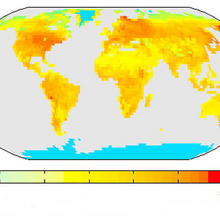
Right picture on top: Geomagnetic field by Gary Glatzmaier
Why
does the Earth have a magnetic field? As a result of the electrical
conductivity of the molten plasma of the Earth's core the current
magnetic field should decay in only thousands of years. Yet our five
billion year old Earth clearly causes magnets to point to north. The
mystery is thought related to motions in the Earth's liquid outer core.
Specifically, as portions of the outer core cool and fall inward,
oceans of the liquid iron-rich magma rise outward, forced into a
helical motion by the spin of the Earth. This motion is believed to
regenerate the Earth's magnetism. The picture shows the resulting
magnetic field lines of a computer simulation, with blue lines directed
inward and yellow lines directed outward.