Eawag
Überlandstrasse 133
P.O.Box 611
8600 Dübendorf
Switzerland

Ph. +41 (0)58 765 55 11
Fax +41 (0)58 765 50 28
info@eawag.ch
Research » Surf » Research » Project Overview » Mechanisms for methane release from hydropower reservoirs and river deltas
Eawag - Aquatic Research
  Home Contact Search DE | EN | FR
 
Surface Waters Research + Management
Mechanisms for methane release from hydropower reservoirs and river deltas

Mechanisms for methane release from hydropower reservoirs and river deltas

Methane (CH4) is known to be a powerful greenhouse gas (25 more potent than CO2) and has been recently under investigation in freshwater bodies. Results show large variations in CH4 emissions with respect to a wide range of factors. This highlights the necessity for a better understanding of the mechanisms, which trigger the atmospheric flux. For this purpose, this PhD project investigates these triggers in various systems in Switzerland. They are divided in three parts: (1) an alpine reservoir, (2) a large river delta, and (3) a chain of run-of-river reservoirs.

1) Lake Klöntal – An alpine reservoir

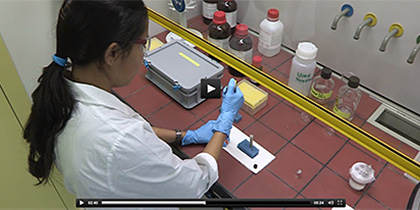
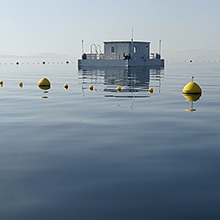
Physical triggers such as water level (± 15 m), ice melting (3 months of full cover), solar radiation and temperature are investigated in this alpine reservoir. Monthly surveys are conducted for water sampling and chambers deployment. An eddy covariance is setup and continuously measures the CH4 flux (in collaboration with W. Eugster, ETH). Emissions via ebullition are also investigated thanks to hydroacoustics surveys. The origin of CH4 (thermo- vs. biogenic) is also identified.

2) Lake Geneva – A large river delta

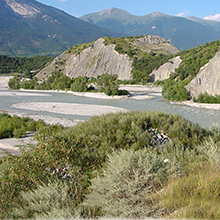
The complex submarine morphology of the Rhone River entering Lake Geneva close to Le Bouveret is believed to have an impact on methane ebullition and diffusion. The active delta, which is characterized by continuous loads from the Rhone, is compared with the old delta in terms of CH4 emissions. Both boat and submarine surveys are accomplished for a various set of samples and measurements: sediment, water, echosounder, etc.
This work is part of the éLEMO project.

3) Aare River – A chain of run-of-river reservoirs

More than 50 dams are built along the 295-km of the Aare River (ca. one every 6 km) leading to a wide range of reservoirs or run-of-river reservoirs. These installations are filtering the water downstream and keep the suspended particles upstream where methane emission is thought to prevail. A seasonal survey is conducted in 6 reservoirs (Lakes Wohlen, Niederried, Biel, Flumenthal, Wildegg-Brugg, and Klingnau) with a closer focus on sediments. For a continuous monitoring of CH4 flux, a new monitoring low-cost system will be built based on methane and humidity sensors.
This project is made in collaboration with Werner Eugster (ETH) and UniZH.