Eawag
Überlandstrasse 133
Case postale 611
8600 Dübendorf
Suisse

Tél. +41 (0)58 765 55 11
Fax +41 (0)58 765 50 28
info@eawag.ch
Recherche » Surf » Forschung » Project Overview » Particle dynamics in a proglacial alpine hydropower lake (Grimsel Lakes, Switzerland)
Eawag - Aquatic Research
  Home Contact Recherche DE | EN | FR
 
Eaux des surfaces
Particle dynamics in a proglacial alpine hydropower lake (Grimsel Lakes, Switzerland)

Particle dynamics in a proglacial alpine hydropower lake (Grimsel Lakes, Switzerland)

Hydroelectric energy covers in Switzerland about 60 % of the energy requirement. To increase production and to better cover peak demand periods, pump storage operations are becoming more and more important. The effect of hydropower activities on light regime and on primary production in downstream lakes has been studied recently (Finger et al, 2007, pdf 2.95MB; Jaun et al., 2007, pdf 1.06MB). It is, however, not well understood, how such increased pump activities affect suspended particle load, particle characteristics and sedimentation processes, and whether they may affect also ecologic conditions in downstream areas.

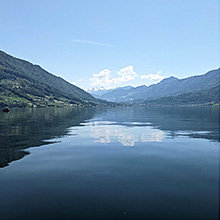
Oberaarsee and Grimselsee, two reservoirs located in a glaciated catchment in the Central Alps, are since 1980 part of a pump storage operations scheme with annual water exchanges amounting to several times the lake volumes. We are currently analyzing this system with the aim to understand how pump storage and turbine operations may influence the water turbidity and sedimentation in the reservoirs. Investigations are undertaken seasonally in different locations and depths of both reservoirs. We determined suspended particle content, combined vertical profiles of temperature and turbidity using a CTD instrument, analyzed composition, number and grain size of particles and used SEM imagery to determine particle shapes. Furthermore, sediment cores provide seasonally-resolved time series of reservoir sedimentation.

For almost all the CTD profiles and analyses of suspended particles collected in Oberaarsee and Grimselsee, a positive correlation exists between turbidity, grain size distribution, particle number and mass concentration. The highest turbidity in both reservoirs occured in summer whereas the lowest was found at the end of winter, when no river inflows and the reservoirs are covered by ice. Moreover, vertical profiles have shown that turbidity generally increases with increasing reservoir depth.

In every season, specific features have been observed related to the annual cycles of climate, runoff and pump storage operations. In summer, when the hypolimnion is characterized by similar conditions in both reservoirs, the epilimnion of Oberaarsee is clearer and warmer in comparison with that of Grimselsee, indicating that a stronger thermal stratification in Oberaarsee may favor the settling of the suspended particles. In winter, higher turbidity has been measured specifically in in the Eastern basin of Grimselsee, where the power operations are continuously exchanging water between the two reservoirs. The decrease in water level of the reservoir causes the emersion of bedrock ridges that impede the flow of this more turbid water of the Eastern basin into the clearer Western part of the reservoir.

A recognized effect of both reservoirs is that they retain sediment that would normally be carried downstream by the River Aare (Anselmetti et al., 2007, pdf 4.07MB). Further investigations will try to deepen also the ecological impact down rivers of pump storage operations.

Funding

  • CCEM (Competence Center Energy and Mobility)