Eawag
Überlandstrasse 133
Postfach 611
8600 Dübendorf
Schweiz

Tel. +41 (0)58 765 55 11
Fax +41 (0)58 765 50 28
info@eawag.ch
Forschung » Surf » Forschung » Projektübersicht » Release of POPs from Alpine glaciers
Eawag - Aquatic Research
  Home Kontakt Suche DE | EN | FR
Abteilung
Aktuell

Aktuell

Partnerschaften am Kivu-See
Zusammen mit dem Kigali Institute of Science and Technology (Ruanda) und dem Institut Supérieur Pédagogique Bukavu (Kongo) hat die Eawag vom 17.-22. Januar in Kigali und Bukavu zwei Workshops organisiert zu den jüngsten Forschungsresultaten aus dem Kivusee. «Lake Kivu: Learning from the past for managing its future» hiess das gemeinsame Forschungsprojekt der letzten drei Jahre. [...]


Oberflächengewässer
Release of POPs from Alpine glaciers

Release of POPs from Alpine glaciers

Mountainous regions such as the Alps represent a “cold trap” for atmospherically derived persistent organic pollutants (POPs) emitted in urbanized areas, due to the prevailing cold temperatures in combination with high precipitation rates. The awareness of the ubiquity of POPs such as dioxins, polychlorinated biphenyls (PCBs) and chlorinated pesticides in high-altitude regions and their conservation over long time periods leads to the hypothesis that melting Alpine glaciers may represent a secondary source of these “legacy pollutants”. Thus, POPs that were previously deposited to and incorporated into glaciers can now be released to the environment due to the rapid melting of glaciers.

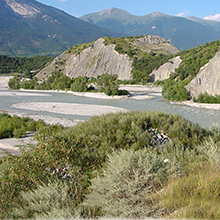
Sediments of proglacial lakes, which form efficient traps of glacially-derived particles, provide ideal environmental archives of pollutants associated with particles. In annually layered sediment cores of proglacial Alpine lakes, we reconstruct time series of POPs, for which environmental contamination in Switzerland has significantly decreased during the last decades. Investigated lakes include Lej da la Tscheppa in the Upper Engadine, as well as Oberaarsee and Steinsee in the Bernese Oberland. As a high-altitude and non-glacial reference lake, Engstlensee in the Bernese Oberland is considered. These studies reveal a first peak of persistent chemicals in the 1960s-1970s, which can be attributed to their use and emissions at that time. Since the late 1990s input of pollutants into the glacier-fed lakes has sharply increased again, confirming the glacier hypothesis.

Currently we study the processes governing the transport of POPs through Alpine glaciers. We investigate the deposition on, the incorporation into, the transport within and the release from Alpine glaciers by a combination of chemical multimedia models and glacier models. First mass balance calculations reveal that the release of POPs from melting Alpine glaciers largely accounts for the observed increase of concentrations in sediment from proglacial lakes. These model calculations further support the glacier hypothesis. Moreover, we can track pollutant trajectories within Alpine glaciers and determine the temporal delay between initial deposition of pollutants in remote Alpine sites and their release from glaciers.


Contact Person:
Flavio Anselmetti

Collaboration:
This interdisciplinary project is a close collaboration between different research teams covering complementary scientific fields. Involved groups include:

Publications:
Bogdal, C.; Schmid, P.; Zennegg, M.; Anselmetti, F. S.; Scheringer, M.; Hungerbühler, K., 2009, Blast from the past: Melting glaciers as a relevant source for persistent organic pollutants: Environ. Sci. Technol. 43, 8173–8177. (pdf, 6.42MB)

Bogdal, C.; Schmid, P.; Zennegg, M.; Anselmetti, F. S.; Scheringer, M.; Hungerbühler, K., 2009, History repeats itself: Persistent organic pollutants in the glacier-fed Lake Oberaar, Switzerland. Organohalogen Compounds.

Bogdal, C.; Schmid, P.; Zennegg, M.; Sturm, M.; Scheringer, M.; Hungerbühler, K., 2009, The haunting legacy: Sediment record of persistent organic pollutants in the glacier-fed Lake Tscheppa, Switzerland. Organohalogen Compounds.

Blüthgen N., 2009, Reconstruction of historical inputs of persistent organic pollutants (POPs) in remote Alpine lakes in Switzerland. Master Thesis, University of Zurich. 

Kontakt

Kontakt

Abteilungsleiter
Carsten Schubert

Administration
Eawag
Oberflächengewässer
Seestrasse 79
6047 Kastanienbaum
Schweiz

Tel. +41 (0)58 765 21 11
Fax +41 (0)58 765 21 68