Welcome
Eawag is a world-leading aquatic research
institute. Its research, which is driven by the needs of society, provides the
basis for innovative approaches and technologies in the water sector. Through
close collaboration with experts from industry, government and professional
associations, Eawag plays an important bridging role between theory and practice,
allowing new scientific insights to be rapidly implemented.
|
11 March 2013 |
Baselland21 Regional Water Supply project begun The "Basel-Landschaft 21 Regional Water Supply" project will examine current contamination issues and threats to groundwater and drinking water, as well as structural shortcomings in the water supply system. Appropriate solutions for the Canton will be developed from the examples in order to ensure the high quality of the drinking water. [...] |
|
|
11 March 2013 |
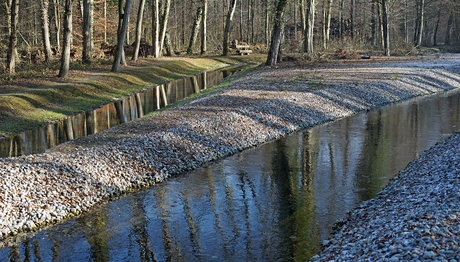
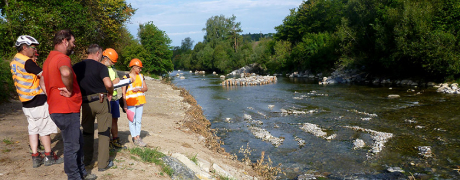
Improvement of the Chriesbach stream in Dübendorf for nature and leisure Having been heavily built up over the past century, the Chriesbach stream in Dübendorf will soon be returned to its natural state. A diverse range of animals and plants stand to benefit from this revitalisation. Not only this, but those who are looking for rest and relaxation will also be able to find this along the course of the revived stream. Eawag will be taking advantage of the improvement project to integrate its "own" stream into their educational and research work. [...] |
|
|
5 March 2013 |
One law to rule them all - sizes within a species appear to follow an universal distribution Researchers at Eawag and EPFL discovered what might be a universal property of size distributions in living systems. If valid throughout the animal kingdom, it could have profound implications on how we understand population dynamics of large ecosystems. Flocks of birds, schools of fish, and groups of any other living organisms might have a mathematical function in common. Studying aquatic microorganisms, Andrea Giometto, a researcher EPFL and Eawag, showed that for each species he studied, body sizes were distributed according to the same mathematical expression, where the only unknown is the average size of the species in an ecosystem. His article was published in PNAS in March 2013. [...] |