Fish populations
Population studies
carried out over many years take dynamic processes and fish responses into
account. Density and biomass change over time.
We are examining the temporal
pattern of population fluctuations, using studies on population dynamics. We
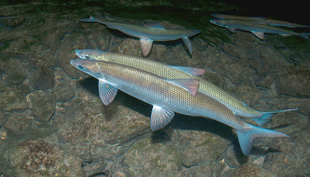
focus particularly on brown trout populations.
Current projects
Population dynamics and reproduction of brown trout in the River Lützelmurg: effects of hormonally active substances
Hormonally active
substances (endocrine disruptors – natural and synthetic chemicals, which are
capable of disrupting the hormonal system) have long been suspected to be
partly responsible for anomalies during sexual development and decreasing
fishing yields. Reports, especially from England, but also from Switzerland,
make a connection between the feminisation of male fish and wastewater from
sewage treatment plants. To date, only little is known about the behaviour of
hormonally active substances in the environment and their effects on organisms,
in particular, on populations. The SAFE project (“Endocrine disruption in
Switzerland: assessment of fish exposure and effects”), which is a part of the
national research programme NRP50,
addresses these issues.
The study at the Lützelmurg aims to determine the effects of hormonally active substances on the fish fauna and, in particular, on the population dynamics and reproduction of brown trout. The results gained will be used to determine better the role of hormonally active substances as a potential cause of the decrease in fish yields.
- Contact person: Sara Schubert (PhD thesis), Armin Peter
- Funding: SNFS, Eawag, University of
Basel
Publication
- Schubert, S., A. Peter, R. Burki, R. Schönenberger, M.J.-F. Suter, H. Segner & P. Burkhardt-Holm. 2008. Sensitivity of brown trout reproduction to long-term estrogenic exposure. Aquatic Toxicology 90:65-72.