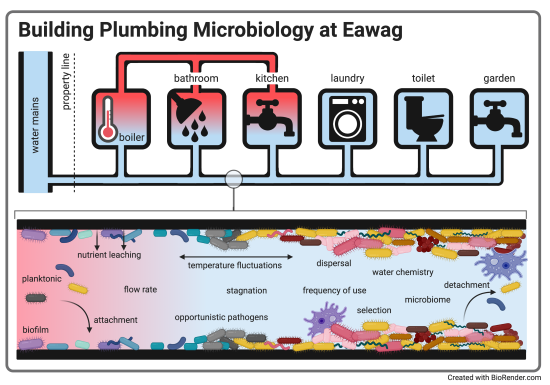
Die Forschung unserer Gruppe fokussiert sich auf das Messen und Verstehen bakterieller Dynamiken im Trinkwasser, von der Quelle bis zum Wasserhahn. Unter Anwendung modernster Forschungsmethoden und -techniken versuchen wir mikrobiologische Beobachtungen mittels ökologischer Prinzipien zu erklären, um sie so besser verstehen und gegebenenfalls beeinflussen zu können.
Aktuell liegt ein Hauptfokus auf der Trinkwassermikrobiologie innerhalb von Gebäudeinstallationen. Hierbei untersuchen wir grundlegende Aspekte der Biofilmbildung, insbesondere auf flexiblen Kunststoffmaterialien und eruieren das Potential für die Etablierung sogenannter probiotischer bakterieller Gemeinschaften.
Des Weiteren untersuchen wir im speziellen die Kontamination von Gebäudeinstallationen durch Legionellen unter Berücksichtigung beeinflussender Umweltfaktoren, ökologischer Wechselbeziehungen und der Ermittlung möglicher (vorbeugender) Massnahmen.
Für eine vollständige Publikationsliste siehe: Google Scholar
array(4 items)0 => Snowflake\Publications\Domain\Model\Publicationprototypepersistent entity (uid=34849, pid=124)originalId => protected34849 (integer)
authors => protected'Hammes, F.; Gabrielli, M.; Cavallaro, A.; Eichelberg, A. ; Barigelli, S.; Bigler, M.; Faucher, S. P.; Füchslin,& nbsp;H. P.; Gaia, V.; Gomez-Valero, L.; Grimard-Conea, M .; Haas, C. N.; Hamilton, K. A.; Healy, H. G.; Héchard, Y.; Julian, T.; Kieper, L.; Lauper, U.; Lefeb vre, X.; Mäusezahl, D.; Ortiz, C.; Pereira, A.; Prevost , M.; Quon, H.; Roy, S.; Silva, A. R.; Sylvestre,&n bsp;É.; Tang, L.; Reyes, E. V.; Van Der Wielen, P.  ;W. J. J.; Waak, M.' (642 chars)
title => protected'Foresight 2035: a perspective on the next decade of research on the manageme nt of <em>Legionella </em>spp. in engineered aquatic environments' (141 chars)
journal => protected'FEMS Microbiology Reviews' (25 chars)
year => protected2025 (integer)
volume => protected49 (integer)
issue => protected'2025' (4 chars)
startpage => protected'fuaf022 (18 pp.)' (16 chars)
otherpage => protected'' (0 chars)
categories => protected'legionella; Legionnaires' disease; legionellosis; building plumbing; opportu nistic pathogens; waterborne disease' (112 chars)
description => protected'The disease burden from <em>Legionella </em>spp. infections has been increas ing in many industrialized countries and, despite decades of scientific adva nces, ranks amongst the highest for waterborne diseases. We review here seve ral key research areas from a multidisciplinary perspective and list critica l research needs to address some of the challenges of <em>Legionella </em>sp p. management in engineered environments. These include: (i) a consideration of Legionella species diversity and cooccurrence, beyond <em>Legionella pne umophila</em> only; (ii) an assessment of their environmental prevalence and clinical relevance, and how that may affect legislation, management, and in tervention prioritization; (iii) a consideration of <em>Legionella </em>spp. sources, their definition and prioritization; (iv) the factors affecting Le gionnaires' disease seasonality, how they link to sources, <em>Legionella </ em>spp. proliferation and ecology, and how these may be affected by climate change; (v) the challenge of saving energy in buildings while controlling <e m>Legionella </em>spp. with high water temperatures and chemical disinfectio n; and (vi) the ecological interactions of <em>Legionella </em>spp. with oth er microbes, and their potential as a biological control strategy. Ultimatel y, we call for increased interdisciplinary collaboration between multiple re search domains, as well as transdisciplinary engagement and collaboration ac ross government, industry, and science as the way toward controlling and red ucing <em>Legionella</em>-derived infections.' (1565 chars)
serialnumber => protected'0168-6445' (9 chars)
doi => protected'10.1093/femsre/fuaf022' (22 chars)
uid => protected34849 (integer)
_localizedUid => protected34849 (integer)modified_languageUid => protectedNULL
_versionedUid => protected34849 (integer)modifiedpid => protected124 (integer)1 => Snowflake\Publications\Domain\Model\Publicationprototypepersistent entity (uid=25620, pid=124)originalId => protected25620 (integer)
authors => protected'Cavallaro, A.; Rhoads, W. J.; Huwiler, S. G.; Stach ler, E.; Hammes, F.' (105 chars)
title => protected'Potential probiotic approaches to control <em>Legionella</em> in engineered aquatic ecosystems' (94 chars)
journal => protected'FEMS Microbiology Ecology' (25 chars)
year => protected2022 (integer)
volume => protected98 (integer)
issue => protected'8' (1 chars)
startpage => protected'1' (1 chars)
otherpage => protected'9' (1 chars)
categories => protected'Legionella; probiotics; antagonism; competition; biofilm; protozoa; pathogen –host interaction; predation' (106 chars)
description => protected'Opportunistic pathogens belonging to the genus <em>Legionella</em> are among the most reported waterborne-associated pathogens in industrialized countri es. <em>Legionella</em> colonize a variety of engineered aquatic ecosystems and persist in biofilms where they interact with a multitude of other reside nt microorganisms. In this review, we assess how some of these interactions could be used to develop a biological-driven "probiotic" control approach ag ainst <em>Legionella</em>. We focus on: (i) mechanisms limiting the ability of <em>Legionella</em> to establish and replicate within some of their natur al protozoan hosts; (ii) exploitative and interference competitive interacti ons between <em>Legionella</em> and other microorganisms; and (iii) the pote ntial of predatory bacteria and phages against <em>Legionella</em>. This fie ld is still emergent, and we therefore specifically highlight research for f uture investigations, and propose perspectives on the feasibility and public acceptance of a potential probiotic approach.' (1034 chars)
serialnumber => protected'0168-6496' (9 chars)
doi => protected'10.1093/femsec/fiac071' (22 chars)
uid => protected25620 (integer)
_localizedUid => protected25620 (integer)modified_languageUid => protectedNULL
_versionedUid => protected25620 (integer)modifiedpid => protected124 (integer)2 => Snowflake\Publications\Domain\Model\Publicationprototypepersistent entity (uid=21565, pid=124)originalId => protected21565 (integer)
authors => protected'Rhoads, W.; Hammes, F.' (32 chars)
title => protected'Growth of <em>Legionella</em> during COVID-19 lockdown stagnation' (65 chars)
journal => protected'Environmental Science: Water Research and Technology' (52 chars)
year => protected2021 (integer)
volume => protected7 (integer)
issue => protected'1' (1 chars)
startpage => protected'10 (6 pp.)' (10 chars)
otherpage => protected'' (0 chars)
categories => protected'' (0 chars)
description => protected'While "avoiding stagnation" has been the mantra of many building water quali ty experts, the foundational support for how this terminology is used in pee r-reviewed publications and building water management guidelines is not over ly convincing. With COVID-19 lockdowns and subsequent reopening, the concern that extended stagnation will trigger increased incidence (or even an epide mic) of legionellosis has been widely raised in news and social media. Here, we provide a perspective on four simple questions to a complex topic, with hope that it encourages a broader dialogue and more critical assessment of a ssumptions and communication strategies surrounding stagnation and <em>Legio nella</em> growth.' (702 chars)
serialnumber => protected'2053-1400' (9 chars)
doi => protected'10.1039/D0EW00819B' (18 chars)
uid => protected21565 (integer)
_localizedUid => protected21565 (integer)modified_languageUid => protectedNULL
_versionedUid => protected21565 (integer)modifiedpid => protected124 (integer)3 => Snowflake\Publications\Domain\Model\Publicationprototypepersistent entity (uid=21117, pid=124)originalId => protected21117 (integer)
authors => protected'Neu, L.; Hammes, F.' (29 chars)
title => protected'Feeding the building plumbing microbiome: the importance of synthetic polyme ric materials for biofilm formation and management' (126 chars)
journal => protected'Water' (5 chars)
year => protected2020 (integer)
volume => protected12 (integer)
issue => protected'6' (1 chars)
startpage => protected'1774 (17 pp.)' (13 chars)
otherpage => protected'' (0 chars)
categories => protected'building plumbing systems; synthetic polymeric material; microbiome; managem ent' (79 chars)
description => protected'The environmental conditions in building plumbing systems differ considerabl y from the larger distribution system and, as a consequence, uncontrolled ch anges in the drinking water microbiome through selective growth can occur. I n this regard, synthetic polymeric plumbing materials are of particular rele vance, since they leach assimilable organic carbon that can be utilized for bacterial growth. Here, we discuss the complexity of building plumbing in re lation to microbial ecology, especially in the context of low-quality synthe tic polymeric materials (i.e., plastics) and highlight the major knowledge g aps in the field. We furthermore show how knowledge on the interaction betwe en material properties (e.g., carbon migration) and microbiology (e.g., grow th rate) allows for the quantification of initial biofilm development in bui ldings. Hence, research towards a comprehensive understanding of these proce sses and interactions will enable the implementation of knowledge-based mana gement strategies. We argue that the exclusive use of high-quality materials in new building plumbing systems poses a straightforward strategy towards m anaging the building plumbing microbiome. This can be achieved through compr ehensive material testing and knowledge sharing between all stakeholders inc luding architects, planners, plumbers, material producers, home owners, and scientists.' (1379 chars)
serialnumber => protected'2073-4441' (9 chars)
doi => protected'10.3390/w12061774' (17 chars)
uid => protected21117 (integer)
_localizedUid => protected21117 (integer)modified_languageUid => protectedNULL
_versionedUid => protected21117 (integer)modifiedpid => protected124 (integer)
Foresight 2035: a perspective on the next decade of research on the management of Legionella spp. in engineered aquatic environments
The disease burden from Legionella spp. infections has been increasing in many industrialized countries and, despite decades of scientific advances, ranks amongst the highest for waterborne diseases. We review here several key research areas from a multidisciplinary perspective and list critical research needs to address some of the challenges of Legionella spp. management in engineered environments. These include: (i) a consideration of Legionella species diversity and cooccurrence, beyond Legionella pneumophila only; (ii) an assessment of their environmental prevalence and clinical relevance, and how that may affect legislation, management, and intervention prioritization; (iii) a consideration of Legionella spp. sources, their definition and prioritization; (iv) the factors affecting Legionnaires' disease seasonality, how they link to sources, Legionella spp. proliferation and ecology, and how these may be affected by climate change; (v) the challenge of saving energy in buildings while controlling Legionella spp. with high water temperatures and chemical disinfection; and (vi) the ecological interactions of Legionella spp. with other microbes, and their potential as a biological control strategy. Ultimately, we call for increased interdisciplinary collaboration between multiple research domains, as well as transdisciplinary engagement and collaboration across government, industry, and science as the way toward controlling and reducing Legionella-derived infections.
Hammes, F.; Gabrielli, M.; Cavallaro, A.; Eichelberg, A.; Barigelli, S.; Bigler, M.; Faucher, S. P.; Füchslin, H. P.; Gaia, V.; Gomez-Valero, L.; Grimard-Conea, M.; Haas, C. N.; Hamilton, K. A.; Healy, H. G.; Héchard, Y.; Julian, T.; Kieper, L.; Lauper, U.; Lefebvre, X.; Mäusezahl, D.; Ortiz, C.; Pereira, A.; Prevost, M.; Quon, H.; Roy, S.; Silva, A. R.; Sylvestre, É.; Tang, L.; Reyes, E. V.; Van Der Wielen, P. W. J. J.; Waak, M. (2025) Foresight 2035: a perspective on the next decade of research on the management of Legionella spp. in engineered aquatic environments, FEMS Microbiology Reviews, 49(2025), fuaf022 (18 pp.), doi:10.1093/femsre/fuaf022, Institutional Repository
Potential probiotic approaches to control Legionella in engineered aquatic ecosystems
Opportunistic pathogens belonging to the genus Legionella are among the most reported waterborne-associated pathogens in industrialized countries. Legionella colonize a variety of engineered aquatic ecosystems and persist in biofilms where they interact with a multitude of other resident microorganisms. In this review, we assess how some of these interactions could be used to develop a biological-driven "probiotic" control approach against Legionella. We focus on: (i) mechanisms limiting the ability of Legionella to establish and replicate within some of their natural protozoan hosts; (ii) exploitative and interference competitive interactions between Legionella and other microorganisms; and (iii) the potential of predatory bacteria and phages against Legionella. This field is still emergent, and we therefore specifically highlight research for future investigations, and propose perspectives on the feasibility and public acceptance of a potential probiotic approach.
Cavallaro, A.; Rhoads, W. J.; Huwiler, S. G.; Stachler, E.; Hammes, F. (2022) Potential probiotic approaches to control Legionella in engineered aquatic ecosystems, FEMS Microbiology Ecology, 98(8), 1-9, doi:10.1093/femsec/fiac071, Institutional Repository
Growth of Legionella during COVID-19 lockdown stagnation
While "avoiding stagnation" has been the mantra of many building water quality experts, the foundational support for how this terminology is used in peer-reviewed publications and building water management guidelines is not overly convincing. With COVID-19 lockdowns and subsequent reopening, the concern that extended stagnation will trigger increased incidence (or even an epidemic) of legionellosis has been widely raised in news and social media. Here, we provide a perspective on four simple questions to a complex topic, with hope that it encourages a broader dialogue and more critical assessment of assumptions and communication strategies surrounding stagnation and Legionella growth.
Rhoads, W.; Hammes, F. (2021) Growth of Legionella during COVID-19 lockdown stagnation, Environmental Science: Water Research and Technology, 7(1), 10 (6 pp.), doi:10.1039/D0EW00819B, Institutional Repository
Feeding the building plumbing microbiome: the importance of synthetic polymeric materials for biofilm formation and management
The environmental conditions in building plumbing systems differ considerably from the larger distribution system and, as a consequence, uncontrolled changes in the drinking water microbiome through selective growth can occur. In this regard, synthetic polymeric plumbing materials are of particular relevance, since they leach assimilable organic carbon that can be utilized for bacterial growth. Here, we discuss the complexity of building plumbing in relation to microbial ecology, especially in the context of low-quality synthetic polymeric materials (i.e., plastics) and highlight the major knowledge gaps in the field. We furthermore show how knowledge on the interaction between material properties (e.g., carbon migration) and microbiology (e.g., growth rate) allows for the quantification of initial biofilm development in buildings. Hence, research towards a comprehensive understanding of these processes and interactions will enable the implementation of knowledge-based management strategies. We argue that the exclusive use of high-quality materials in new building plumbing systems poses a straightforward strategy towards managing the building plumbing microbiome. This can be achieved through comprehensive material testing and knowledge sharing between all stakeholders including architects, planners, plumbers, material producers, home owners, and scientists.
Neu, L.; Hammes, F. (2020) Feeding the building plumbing microbiome: the importance of synthetic polymeric materials for biofilm formation and management, Water, 12(6), 1774 (17 pp.), doi:10.3390/w12061774, Institutional Repository
Projekte
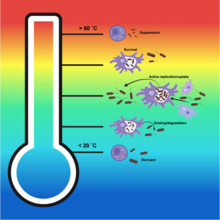
Temperature-driven growth dynamics of Legionella species and their hosts across laboratory, microfluidic, and pilot-scale building water systems.
In warmem Wasser fühlen sie sich besonders wohl – Legionellen. Doch werden sie eingeatmet, kann das krankmachen: Wie die Gefahr durch diese Bakterien einzudämmen ist, untersucht nun ein multidisziplinäres Forschungsteam unter Leitung der Eawag in einem neu gestarteten Projekt.