Notizie

Medaglia del PF per Elena Gimmi

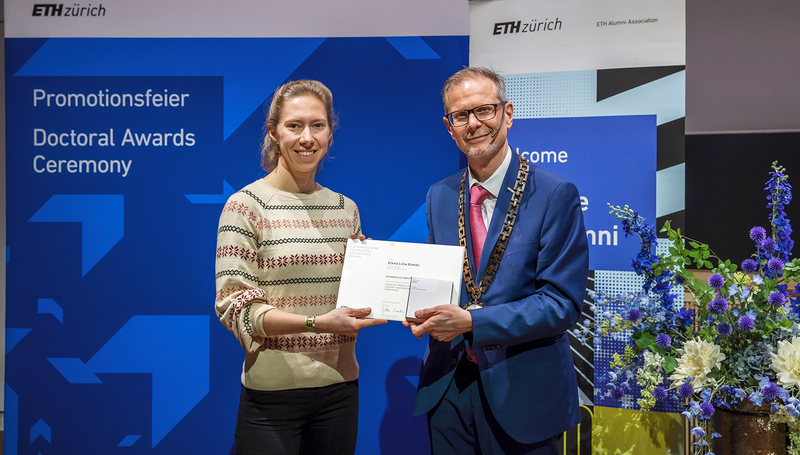
Il Politecnico di Zurigo premia le migliori tesi di laurea e di dottorato con la Medaglia ETH. Elena Gimmi ha ricevuto il premio per la sua tesi di laurea lo scorso venerdì 24 gennaio 2025. Il premio riconosce le scoperte di Gimmi sull'influenza delle "guardie del corpo" batteriche sulla co-evoluzione dell'afide nero del fagiolo, un importante parassita delle colture alimentari, e del suo nemico naturale, la vespa itneumone.

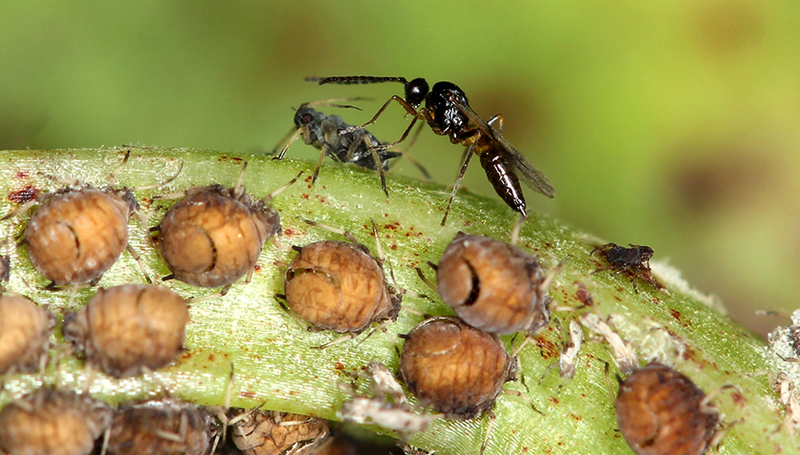
Come dottoranda presso l'istituto di ricerca acquatica Eawag, Elena Gimmi ha analizzato la relazione triangolare tra l'afide nero del fagiolo (Aphis fabae), la minuscola vespa itneumone Lysiphlebus fabarum e il batterio Hamiltonella defensa. È stata supervisionata dal Prof. Christoph Vorburger e dal Prof. Jukka Jokela. Il gruppo di ricerca di Vorburger studia da anni l'interazione tra i tre diversi partner. I test di laboratorio hanno dimostrato che il batterio H. defensa vive come un simbionte nel corpo degli afidi: riceve dagli afidi "cibo e alloggio" e in cambio li protegge dalle vespe parassite ichneumon, le cui larve si nutrono degli afidi. I batteri presumibilmente producono tossine che uccidono le uova delle vespe.

Serie completa di dati dal campo - nonostante la corona

Elena Gimmi ha ora testato per la prima volta i risultati della ricerca di base in condizioni naturali su popolazioni selvatiche, esaminando in particolare i modelli e le dinamiche stagionali della resistenza degli afidi. "Ho trovato emozionante e stimolante confrontare i risultati di laboratorio con le osservazioni del mondo reale", afferma la biologa ambientale.

Il fulcro del lavoro di Gimmi è stato uno studio sul campo su larga scala, durato oltre due anni. In tre diverse aree intorno a Zurigo, Gimmi ha monitorato la frequenza dei batteri negli afidi su base mensile. Nello stesso periodo, ha anche analizzato come cambiava il rischio che gli afidi venissero parassitati dalle vespe. "All'inizio era chiaro che molte cose potevano andare storte. Ma grazie a una combinazione di perseveranza e fortuna, i piani originali del mio lavoro hanno funzionato abbastanza bene", osserva Gimmi.

"L'impegno profuso sul campo è stato enorme. La qualità dei dati raccolti è altrettanto elevata e siamo riusciti a ricavarne molte nuove e importanti conoscenze".
Christoph Vorburger

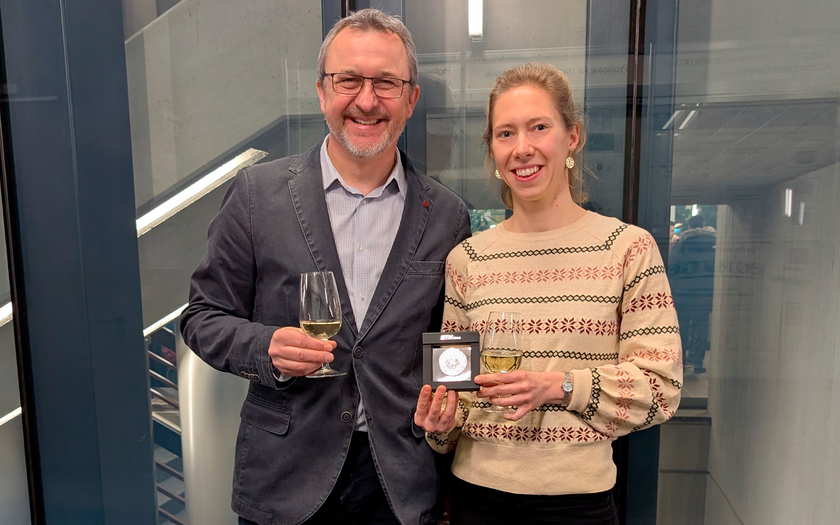
Christoph Vorburger sottolinea: "L'impegno profuso nelle indagini sul campo è stato enorme. La qualità dei dati raccolti, da cui abbiamo potuto trarre molte nuove e importanti conoscenze, è di conseguenza elevata". L'importante secondo anno del progetto sul campo è stato seriamente compromesso dalla pandemia di coronavirus. Senza ulteriori indugi, la ricercatrice ha allestito un piccolo laboratorio di insetti a casa con l'aiuto del padre e ha assunto il fratello come assistente sul campo. Di conseguenza, la serie di dati è rimasta ininterrotta e sembra che non ci sia mai stato un blocco. Vorburger: "È stato davvero un grande risultato e sono anche molto grato alla famiglia di Elena per il suo sostegno".
 

Sorprendente influenza della temperatura ambiente

I dati di Gimmi forniscono nuove e a volte sorprendenti informazioni sul rapporto tra i tre partner ineguali. Tra le altre cose, il ricercatore è riuscito a dimostrare che la frequenza dei batteri nelle popolazioni di afidi fluttua nel corso dell'anno e che la temperatura ambientale ha un'influenza molto maggiore di quanto si pensasse. In altre parole, più fa caldo, più si trovano le "guardie del corpo" batteriche e maggiore è la resistenza degli afidi. Ciò potrebbe indicare che il riscaldamento globale sta influenzando l'uso delle vespe parassite nella lotta biologica ai parassiti.
La ricerca continua a Eawag

Christoph Vorburger è impegnato nell'insegnamento accademico da oltre 20 anni. Egli descrive il premio come molto meritato: "Siamo stati davvero fortunati a poter assumere Elena per questo progetto. Oltre al suo talento, è coscienziosa, meticolosa e ha una sana dose di ambizione, che l'ha aiutata a portare avanti con determinazione l'ambizioso progetto. Allo stesso tempo, è un'ottima collaboratrice. È impressionante anche il fatto che, poco dopo aver completato il dottorato, tutti i capitoli del suo lavoro siano stati pubblicati in pubblicazioni originali di alta qualità, senza eccezioni".

Le scoperte di Gimmi costituiscono anche la base per un progetto di follow-up presso l'Eawag, che sarà sostenuto dal Fondo nazionale svizzero per la ricerca scientifica fino al 2027.

Immagine di copertina: Elena Gimmi con il rettore dell'ETH Günther Dissertori (Foto: Alessandro della Bella).

Pubblicazioni originali

Extbase Variable Dump
array(3 items)
   publications => '31284,32898,32442,30906,23917' (29 chars)
   libraryUrl => '' (0 chars)
   layout => '0' (1 chars)
Extbase Variable Dump
array(5 items)
   0 => Snowflake\Publications\Domain\Model\Publicationprototypepersistent entity (uid=31284, pid=124)
      originalId => protected31284 (integer)
      authors => protected'Gimmi, E. L.' (22 chars)
      title => protected'Defensive symbiosis in the wild - patterns and dynamics of symbiont-conferre
         d resistance in natural host-parasitoid communities
' (127 chars) journal => protected'' (0 chars) year => protected2023 (integer) volume => protected0 (integer) issue => protected'' (0 chars) startpage => protected'175 p' (10 chars) otherpage => protected'' (0 chars) categories => protected'' (0 chars) description => protected'Defensive symbiosis describes the interaction between two species where one
         species protects the other from dangers, in exchange for another benefit. Pr
         otagonist of this thesis is <em>Hamiltonella defensa</em>, a vertically tran
         smitted bacterial endosymbiont of aphids. <em>H. defensa</em> can defend its
          aphid host against parasitoid wasps and in return profits from nutrients an
         d shelter inside the aphid body. In wild aphid populations, <em>H. defensa</
         em> often occurs at intermediate prevalence, that is, some aphid individuals
          carry the bacteria, but others do not. This might be explained by balancing
          selection, as carrying <em>H. defensa</em> has not only benefits but also c
         osts for the aphid. The tripartite interaction between aphids, <em>H. defens
         a</em> and aphid parasitoids is considered a model system for symbiont-drive
         n hostparasite coevolution and has been studied from various angles during t
         he past twenty years. However, there is still a lack of data on the role of
         defensive symbiosis in the ecology and evolution of natural communities. Wit
         h my PhD work, I sought to improve on that by studying patterns and dynamics
          of <em>H. defensa</em>-conferred resistance in the field. [...]<br /><br />
         Symbiose beschreibt das enge Zusammenleben zweier unterschiedlicher Organism
         en. In sogenannten defensiven Symbiosen bietet eine Art der anderen Schutz o
         der Resistenz gegen Feinde oder Gefahren. Protagonist der vorliegenden Arbei
         t ist <em>Hamiltonella defensa</em>, ein endosymbiotisches Bakterium, das im
          Körper von Blattläusen lebt und von einer zur nächsten Blattlausgenerati
         on vererbt wird. <em>H. defensa</em> kann Blattläusen Resistenz gegen paras
         itische Schlupfwespen verleihen, welche wichtige natürliche Feinde der Läu
         se sind. <em>H. defensa</em> ist also ein defensiver Symbiont von Blattläus
         en. Im Gegenzug profitiert <em>H. defensa</em> von 'Kost und Logis' im Inner
         n der Blattlaus. In natürlichen Blattlauspopulationen leben meist einige In
         dividuen mit, andere ohn...
' (2465 chars) serialnumber => protected'' (0 chars) doi => protected'10.3929/ethz-b-000617575' (24 chars) uid => protected31284 (integer) _localizedUid => protected31284 (integer)modified _languageUid => protectedNULL _versionedUid => protected31284 (integer)modified pid => protected124 (integer)
1 => Snowflake\Publications\Domain\Model\Publicationprototypepersistent entity (uid=32898, pid=124) originalId => protected32898 (integer) authors => protected'Gimmi,&nbsp;E.; Wallisch,&nbsp;J.; Vorburger,&nbsp;C.' (53 chars) title => protected'Ecological divergence despite common mating sites: genotypes and symbiotypes
          shed light on cryptic diversity in the black bean aphid species complex
' (148 chars) journal => protected'Heredity' (8 chars) year => protected2024 (integer) volume => protected132 (integer) issue => protected'' (0 chars) startpage => protected'320' (3 chars) otherpage => protected'330' (3 chars) categories => protected'' (0 chars) description => protected'Different host plants represent ecologically dissimilar environments for phy
         tophagous insects. The resulting divergent selection can promote the evoluti
         on of specialized host races, provided that gene flow is reduced between pop
         ulations feeding on different plants. In black bean aphids belonging to the
         <em>Aphis fabae</em> complex, several morphologically cryptic taxa have been
          described based on their distinct host plant preferences. However, host cho
         ice and mate choice are largely decoupled in these insects: they are host-al
         ternating and migrate between specific summer host plants and shared winter
         hosts, with mating occurring on the shared hosts. This provides a yearly opp
         ortunity for gene flow among aphids using different summer hosts, and raises
          the question if and to what extent the ecologically defined taxa are reprod
         uctively isolated. Here, we analyzed a geographically and temporally structu
         red dataset of microsatellite genotypes from <em>A. fabae</em> that were mos
         tly collected from their main winter host <em>Euonymus europaeus</em>, and a
         dditionally from another winter host and fourteen summer hosts. The data rev
         eals multiple, strongly differentiated genetic clusters, which differ in the
         ir association with different summer and winter hosts. The clusters also dif
         fer in the frequency of infection with two heritable, facultative endosymbio
         nts, separately hinting at reproductive isolation and divergent ecological s
         election. Furthermore, we found evidence for occasional hybridization among
         genetic clusters, with putative hybrids collected more frequently in spring
         than in autumn. This suggests that similar to host races in other phytophago
         us insects, both prezygotic and postzygotic barriers including selection aga
         inst hybrids maintain genetic differentiation among <em>A. fabae</em> taxa,
         despite a common mating habitat.
' (1856 chars) serialnumber => protected'0018-067X' (9 chars) doi => protected'10.1038/s41437-024-00687-0' (26 chars) uid => protected32898 (integer) _localizedUid => protected32898 (integer)modified _languageUid => protectedNULL _versionedUid => protected32898 (integer)modified pid => protected124 (integer)
2 => Snowflake\Publications\Domain\Model\Publicationprototypepersistent entity (uid=32442, pid=124) originalId => protected32442 (integer) authors => protected'Gimmi,&nbsp;E.; Vorburger,&nbsp;C.' (34 chars) title => protected'High specificity of symbiont-conferred resistance in an aphid-parasitoid fie
         ld community
' (88 chars) journal => protected'Journal of Evolutionary Biology' (31 chars) year => protected2024 (integer) volume => protected37 (integer) issue => protected'2' (1 chars) startpage => protected'162' (3 chars) otherpage => protected'170' (3 chars) categories => protected'host–parasite interactions; specificity of resistance; genotype-by-genotyp
         e interactions; aphids; Hamiltonella defensa; local adaptation
' (138 chars) description => protected'Host–parasite coevolution is mediated by genetic interactions between the
         antagonists and may lead to reciprocal adaptation. In the black bean aphid,
         <em>Aphis fabae fabae</em>, resistance to parasitoids can be conferred by th
         e heritable bacterial endosymbiont <em>Hamiltonella defensa</em>. <em>H. def
         ensa</em> has been shown to be variably protective against different parasit
         oid species, and different genotypes of the black bean aphid's main parasito
         id <em>Lysiphlebus fabarum</em>. However, these results were obtained using
         haphazard combinations of laboratory-reared insect lines with different orig
         ins, making it unclear how representative they are of natural, locally (co)a
         dapted communities. We therefore comprehensively sampled the parasitoids of
         a natural <em>A. f. fabae</em> population and measured the ability of the fi
         ve most abundant species to parasitize aphids carrying the locally prevalent
          <em>H. defensa</em> haplotypes. <em>H. defensa</em> provided resistance onl
         y against the dominant parasitoid <em>L. fabarum</em> (70% of all parasitoid
         s), but not against less abundant parasitoids, and resistance to <em>L. faba
         rum</em> acted in a genotype-specific manner (G × G interactions betwee
         n <em>H. defensa</em> and <em>L. fabarum</em>). These results confirm that s
         trong species- and genotype-specificity of symbiont-conferred resistance is
         indeed a hallmark of wild <em>A. f. fabae</em> populations, and they are con
         sistent with symbiont-mediated adaptation of aphids to the parasitoids posin
         g the highest risk.
' (1539 chars) serialnumber => protected'1010-061X' (9 chars) doi => protected'10.1093/jeb/voad013' (19 chars) uid => protected32442 (integer) _localizedUid => protected32442 (integer)modified _languageUid => protectedNULL _versionedUid => protected32442 (integer)modified pid => protected124 (integer)
3 => Snowflake\Publications\Domain\Model\Publicationprototypepersistent entity (uid=30906, pid=124) originalId => protected30906 (integer) authors => protected'Gimmi,&nbsp;E.; Wallisch,&nbsp;J.; Vorburger,&nbsp;C.' (53 chars) title => protected'Defensive symbiosis in the wild: seasonal dynamics of parasitism risk and sy
         mbiont‐conferred resistance
' (105 chars) journal => protected'Molecular Ecology' (17 chars) year => protected2023 (integer) volume => protected32 (integer) issue => protected'14' (2 chars) startpage => protected'4063' (4 chars) otherpage => protected'4077' (4 chars) categories => protected'balancing selection; defensive symbiosis; Hamiltonella defensa; host-parasit
         e interactions; symbiont-conferred resistance; trade-offs
' (133 chars) description => protected'Parasite-mediated selection can rapidly drive up resistance levels in host p
         opulations, but fixation of resistance traits may be prevented by costs of r
         esistance. Black bean aphids (<em>Aphis fabae</em>) benefit from increased r
         esistance to parasitoids when carrying the defensive bacterial endosymbiont
         <em>Hamiltonella defensa</em>. However, due to fitness costs that come with
         symbiont infection, symbiont-conferred resistance may result in either a net
          benefit or a net cost to the aphid host, depending on parasitoid presence a
         s well as on the general ecological context. Balancing selection may therefo
         re explain why in natural aphid populations, <em>H. defensa</em> is often
         found at intermediate frequencies. Here we present a 2-year field study wher
         e we set out to look for signatures of balancing selection in natural aphid
         populations. We collected temporally well-resolved data on the prevalence of
          <em>H. defensa</em> in <em>A. f. fabae</em> and estimated the risk im
         posed by parasitoids using sentinel hosts. Despite a marked and consistent e
         arly-summer peak in parasitism risk, and significant changes in symbiont pre
         valence over time, we found just a weak correlation between parasitism risk
         and <em>H. defensa</em> frequency dynamics. <em>H. defensa</em> prevalen
         ce in the populations under study was, in fact, better explained by the numb
         er of heat days that previous aphid generations were exposed to. Our study g
         rants an unprecedentedly well-resolved insight into the dynamics of endosymb
         iont and parasitoid communities of <em>A. f. fabae</em> populations, and
          it adds to a growing body of empirical evidence suggesting that not only pa
         rasitism risk, but rather multifarious selection is shaping <em>H. defensa
         </em> prevalence in the wild.
' (1777 chars) serialnumber => protected'0962-1083' (9 chars) doi => protected'10.1111/mec.16976' (17 chars) uid => protected30906 (integer) _localizedUid => protected30906 (integer)modified _languageUid => protectedNULL _versionedUid => protected30906 (integer)modified pid => protected124 (integer)
4 => Snowflake\Publications\Domain\Model\Publicationprototypepersistent entity (uid=23917, pid=124) originalId => protected23917 (integer) authors => protected'Gimmi,&nbsp;E.; Vorburger,&nbsp;C.' (34 chars) title => protected'Strong genotype-by-genotype interactions between aphid-defensive symbionts a
         nd parasitoids persist across different biotic environments
' (135 chars) journal => protected'Journal of Evolutionary Biology' (31 chars) year => protected2021 (integer) volume => protected34 (integer) issue => protected'12' (2 chars) startpage => protected'1944' (4 chars) otherpage => protected'1953' (4 chars) categories => protected'aphids; defensive symbiosis; genotype-by-genotype interactions; host–paras
         ite coevolution; parasitoids; resistance
' (116 chars) description => protected'The dynamics of coevolution between hosts and parasites are influenced by th
         eir genetic interactions. Highly specific interactions, where the outcome of
          an infection depends on the precise combination of host and parasite genoty
         pes (G × G interactions), have the potential to maintain genetic variatio
         n by inducing negative frequency-dependent selection. The importance of this
          effect also rests on whether such interactions are consistent across differ
         ent environments or modified by environmental variation (G × G × E int
         eraction). In the black bean aphid, <em>Aphis fabae</em>, resistance to its
         parasitoid <em>Lysiphlebus fabarum</em> is largely determined by the possess
         ion of a heritable bacterial endosymbiont, <em>Hamiltonella defensa</em>, wi
         th strong G × G interactions between <em>H</em>. <em>defensa</em> and <e
         m>L</em>. <em>fabarum</em>. A key environmental factor in this system is th
         e host plant on which the aphid feeds. Here, we exposed genetically identica
         l aphids harbouring three different strains of <em>H</em>. <em>defensa</em>
          to three asexual genotypes of <em>L</em>. <em>fabarum</em> and measured pa
         rasitism success on three common host plants of <em>A</em>. <em>fabae</em>,
          namely <em>Vicia faba</em>, <em>Chenopodium album</em> and <em>Beta vulgari
         s</em>. As expected, we observed the pervasive G × G interaction between
         <em>H</em>. <em>defensa</em> and <em>L</em>. <em>fabarum</em>, but despite
          strong main effects of the host plants on average rates of parasitism, this
          interaction was not altered significantly by the host plant environment (n
         o G × G × E interaction). The symbiont-conferred specificity of resist
         ance is thus likely to mediate the coevolution of <em>A</em>. <em>fabae</em
         > and <em>L</em>. <em>fabarum</em>, even when played out across diverse hos
         t plants of the aphid.
' (1846 chars) serialnumber => protected'1010-061X' (9 chars) doi => protected'10.1111/jeb.13953' (17 chars) uid => protected23917 (integer) _localizedUid => protected23917 (integer)modified _languageUid => protectedNULL _versionedUid => protected23917 (integer)modified pid => protected124 (integer)
Gimmi, E. L. (2023) Defensive symbiosis in the wild - patterns and dynamics of symbiont-conferred resistance in natural host-parasitoid communities, 175 p, doi:10.3929/ethz-b-000617575, Institutional Repository
Gimmi, E.; Wallisch, J.; Vorburger, C. (2024) Ecological divergence despite common mating sites: genotypes and symbiotypes shed light on cryptic diversity in the black bean aphid species complex, Heredity, 132, 320-330, doi:10.1038/s41437-024-00687-0, Institutional Repository
Gimmi, E.; Vorburger, C. (2024) High specificity of symbiont-conferred resistance in an aphid-parasitoid field community, Journal of Evolutionary Biology, 37(2), 162-170, doi:10.1093/jeb/voad013, Institutional Repository
Gimmi, E.; Wallisch, J.; Vorburger, C. (2023) Defensive symbiosis in the wild: seasonal dynamics of parasitism risk and symbiont‐conferred resistance, Molecular Ecology, 32(14), 4063-4077, doi:10.1111/mec.16976, Institutional Repository
Gimmi, E.; Vorburger, C. (2021) Strong genotype-by-genotype interactions between aphid-defensive symbionts and parasitoids persist across different biotic environments, Journal of Evolutionary Biology, 34(12), 1944-1953, doi:10.1111/jeb.13953, Institutional Repository

Finanziamento / Cooperazione

  • Eawag
  • Politecnico di Zurigo