Nota: Questo testo è stato tradotto in italiano automaticamente con DeepL Pro. Per l'articolo originale si prega di selezionare Tedesco, Inglese o Francese (per cambiare lingua vedasi in alto nella pagina).
La chimica ambientale Joanna Houska è stata premiata per la sua tesi di dottorato dalla Società tedesca di chimica dell'acqua. Houska ha condotto una ricerca presso l'Eawag e l'EPFL e ha dimostrato sia teoricamente che sperimentalmente come il trattamento ossidativo dell'acqua con ozono o cloro possa essere utilizzato in modo più efficiente se si conosce con maggiore precisione quali sostanze organiche sono disciolte nell'acqua da trattare.
"Il lavoro è una pietra miliare per una migliore comprensione del ruolo della materia organica disciolta nel trattamento ossidativo dell'acqua", afferma il supervisore di Joanna Houska, Urs von Gunten. È professore all'EPFL e dirige il gruppo di chimica dell'acqua potabile presso l'istituto di ricerca acquatica Eawag. Secondo von Gunten, Houska ha "un'enorme capacità di affrontare questioni scientifiche complesse a livello teorico e sperimentale e di risolvere con successo i problemi con grande indipendenza". Nei suoi esperimenti, ma anche con la modellazione, la ricercatrice ha prodotto e interpretato nuovi dati interessanti che possono essere utilizzati per migliorare il trattamento ossidativo dell'acqua.
Inefficiente e pericoloso senza un'analisi precisa
Qual è il problema? Quando si usa il cloro o l'ozono per disinfettare/ossidare l'acqua, l'obiettivo principale è quello di rendere innocui gli agenti patogeni e i microinquinanti. Tuttavia, la maggior parte degli agenti ossidanti reagisce con i componenti della matrice dell'acqua, come la materia organica disciolta. Questo non solo riduce l'efficienza del processo, ma nel peggiore dei casi può portare alla formazione di sottoprodotti tossici. È quindi importante sapere con la massima precisione possibile cosa è disciolto nell'acqua da trattare per rendere efficiente il processo di ossidazione. È qui che è entrata in gioco la ricercatrice Houska, perché finora si utilizzavano soprattutto parametri sommari, derivati ad esempio dall'assorbimento dei raggi UV. Nella sua tesi di laurea, quindi, ha innanzitutto sviluppato metodi per misurare la concentrazione dei composti rilevanti. Li ha poi caratterizzati e ha valutato se e in che misura possono formare sottoprodotti problematici. Infine, ha utilizzato gli isotopi dell'ossigeno nel perossido di idrogeno per scoprire come i precursori problematici possano essere differenziati gli uni dagli altri. È interessante notare che la Houska non ha limitato la sua ricerca alla disinfezione/ossidazione dell'acqua utilizzata come acqua potabile. Piuttosto, ha seguito anche la formazione di sottoprodotti dell'ozonizzazione in un impianto di trattamento delle acque reflue e la loro successiva degradazione nel post-trattamento biologico delle acque reflue depurate.
Prima volta in Svizzera
Il premio di dottorato nel campo della chimica delle acque viene assegnato dal 1992 ed è dotato di 1500 euro. Nel 2024 sarà assegnato per la prima volta alla Svizzera. Joanna Houska sa già cosa farà con i soldi del premio: "La mia bicicletta ha urgentemente bisogno di essere aggiornata, per questo motivo i soldi del premio saranno probabilmente investiti in essa". Ora lavora nel dipartimento ambientale di Roche, nel settore della protezione delle acque reflue e dell'acqua.
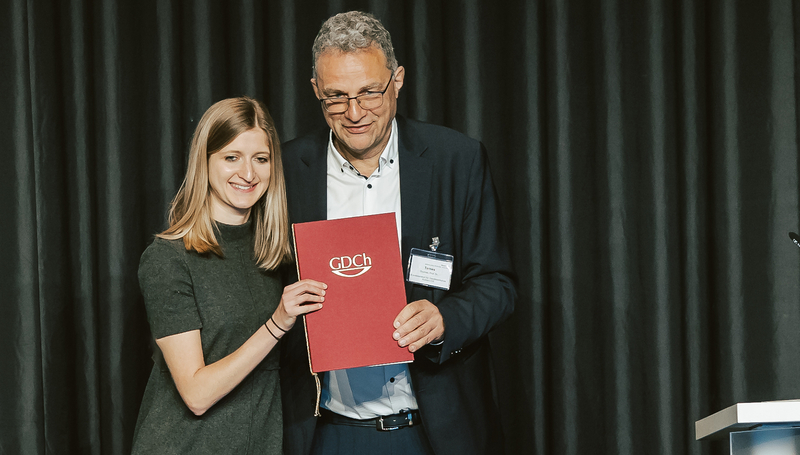
Immagine di copertina: Joanna Houska alla cerimonia di premiazione con il Prof. Thomas Ternes alla conferenza annuale della Società di Chimica dell'Acqua a Limburgo (D) (Foto: Nina Hermes, BfG).
array(4 items)0 => Snowflake\Publications\Domain\Model\Publicationprototypepersistent entity (uid=23921, pid=124)originalId => protected23921 (integer)
authors => protected'Houska, J.; Salhi, E.; Walpen, N.; von Gunten, U.' (69 chars)
title => protected'Oxidant-reactive carbonous moieties in dissolved organic matter: selective q uantification by oxidative titration using chlorine dioxide and ozone' (145 chars)
journal => protected'Water Research' (14 chars)
year => protected2021 (integer)
volume => protected207 (integer)
issue => protected'' (0 chars)
startpage => protected'117790 (11 pp.)' (15 chars)
otherpage => protected'' (0 chars)
categories => protected'dissolved organic matter; oxidative titration; chlorine dioxide; ozone; elec tron-donating capacity; molecular tagging; electron-rich moieties; phenols; oxidation byproducts' (172 chars)
description => protected'The application of oxidants for disinfection or micropollutant abatement dur ing drinking water and wastewater treatment is accompanied by oxidation of m atrix components such as dissolved organic matter (DOM). To improve predicti ons of the efficiency of oxidation processes and the formation of oxidation products, methods to determine concentrations of oxidant-reactive phenolic, olefinic or amine-type DOM moieties are critical.<br />Here, a novel selecti ve oxidative titration approach is presented, which is based on reaction kin etics of oxidation reactions towards certain DOM moieties. Phenolic moieties were determined by oxidative titration with ClO<sub>2</sub> and O<sub>3</su b> for five DOM isolates and two secondary wastewater effluent samples. The determined concentrations of phenolic moieties correlated with the electron- donating capacity (EDC) and the formation of inorganic ClO<sub>2</sub>-bypro ducts (HOCl, ClO<sub>2</sub><sup>−</sup>, ClO<sub>3</sub><sup>−</sup>). ClO<sub>2</sub>-byproduct yields from phenol and DOM isolates and changes du e to the application of molecular tagging for phenols revealed a better unde rstanding of oxidant-reactive structures within DOM.<br />Overall, oxidative titrations with ClO<sub>2</sub> and O<sub>3</sub> provide a novel and promi sing tool to quantify oxidant-reactive moieties in complex mixtures such as DOM and can be expanded to other matrices or oxidants.' (1422 chars)
serialnumber => protected'0043-1354' (9 chars)
doi => protected'10.1016/j.watres.2021.117790' (28 chars)
uid => protected23921 (integer)
_localizedUid => protected23921 (integer)modified_languageUid => protectedNULL
_versionedUid => protected23921 (integer)modifiedpid => protected124 (integer)1 => Snowflake\Publications\Domain\Model\Publicationprototypepersistent entity (uid=30070, pid=124)originalId => protected30070 (integer)
authors => protected'Houska, J.; Manasfi, T.; Gebhardt, I.; von Gunten, U.' (73 chars)
title => protected'Ozonation of lake water and wastewater: identification of carbonous and nitr ogenous carbonyl-containing oxidation byproducts by non-target screening' (148 chars)
journal => protected'Water Research' (14 chars)
year => protected2023 (integer)
volume => protected232 (integer)
issue => protected'' (0 chars)
startpage => protected'119484 (17 pp.)' (15 chars)
otherpage => protected'' (0 chars)
categories => protected'high resolution mass spectrometry; ozonation; carbonyl compounds; dissolved organic matter; lake water; wastewater; phenols' (123 chars)
description => protected'Ozonation of drinking water and wastewater is accompanied by the formation o f disinfection byproducts (DBPs) such as low molecular weight aldehydes and ketones from the reactions of ozone with dissolved organic matter (DOM). By applying a recently developed non-target workflow, 178 carbonous and nitroge nous carbonyl compounds were detected during bench-scale ozonation of two la ke waters and three secondary wastewater effluent samples and full-scale ozo nation of secondary treated wastewater effluent. An overlapping subset of ca rbonyl compounds (20%) was detected in all water types. Moreover, wastewater effluents showed a significantly higher fraction of <em>N</em>-containing c arbonyl compounds (30%) compared to lake water (17%). All carbonyl compounds can be classified in 5 main formation trends as a function of increasing sp ecific ozone doses. Formation trends upon ozonation and comparison of result s in presence and absence of the <sup>•</sup>OH radical scavenger DMSO in combination with kinetic and mechanistic information allowed to elucidate po tential carbonyl structures. A link between the detected carbonyl compounds and their precursors was established by ozonating six model compounds (pheno l, 4-ethylphenol, 4-methoxyphenol, sorbic acid, 3-buten-2-ol and acetylaceto ne). About one third of the detected carbonous carbonyl compounds detected i n real waters was also detected by ozonating model compounds.<br />Evaluatio n of the non-target analysis data revealed the identity of 15 carbonyl compo unds, including hydroxylated aldehydes and ketones (e.g. hydroxyacetone, con fidence level (CL) = 1), unsaturated dicarbonyls (e.g. acrolein, CL = 1; 2-butene-1,4-dial, CL = 1; 4-oxobut-2-enoic acid, CL = 2) and also a ni trogen-containing carbonyl compound (2-oxo-propanamide, CL =1).<br />Overall , this study shows the formation of versatile carbonous and nitrogenous carb onyl compounds upon ozonation involving ozone and <sup>•</sup>OH reactions . Carbonyl compounds wit...' (2196 chars)
serialnumber => protected'0043-1354' (9 chars)
doi => protected'10.1016/j.watres.2022.119484' (28 chars)
uid => protected30070 (integer)
_localizedUid => protected30070 (integer)modified_languageUid => protectedNULL
_versionedUid => protected30070 (integer)modifiedpid => protected124 (integer)2 => Snowflake\Publications\Domain\Model\Publicationprototypepersistent entity (uid=30998, pid=124)originalId => protected30998 (integer)
authors => protected'Houska, J.; Stocco, L.; Hofstetter, T. B.; Gunten, U. von' (87 chars)
title => protected'Hydrogen peroxide formation during ozonation of olefins and phenol: mechanis tic insights from oxygen isotope signatures' (119 chars)
journal => protected'Environmental Science and Technology' (36 chars)
year => protected2023 (integer)
volume => protected57 (integer)
issue => protected'' (0 chars)
startpage => protected'18950' (5 chars)
otherpage => protected'18959' (5 chars)
categories => protected'ozonation; hydrogen peroxide; reaction mechanisms; olefins; phenol; oxygen i sotopes; isotope ratio mass spectrometry' (116 chars)
description => protected'Mitigation of undesired byproducts from ozonation of dissolved organic matte r (DOM) such as aldehydes and ketones is currently hampered by limited knowl edge of their precursors and formation pathways. Here, the stable oxygen iso tope composition of H<sub>2</sub>O<sub>2</sub> formed simultaneously with th ese byproducts was studied to determine if it can reveal this missing inform ation. A newly developed procedure, which quantitatively transforms H<sub>2< /sub>O<sub>2</sub> to O<sub>2</sub> for subsequent <sup>18</sup>O/<sup>16</s up>O ratio analysis, was used to determine the δ<sup>18</sup>O of H<sub>2</ sub>O<sub>2</sub> generated from ozonated model compounds (olefins and pheno l, pH 3-8). A constant enrichment of <sup>18</sup>O in H<sub>2</sub>O<sub>2< /sub> with a δ<sup>18</sup>O value of ∼59‰ implies that <sup>16</sup>O- <sup>16</sup>O bonds are cleaved preferentially in the intermediate Criegee ozonide, which is commonly formed from olefins. H<sub>2</sub>O<sub>2</sub> f rom the ozonation of acrylic acid and phenol at pH 7 resulted in lower <sup> 18</sup>O enrichment (δ<sup>18</sup>O = 47-49‰). For acrylic acid, enhanc ement of one of the two pathways followed by a carbonyl-H<sub>2</sub>O<sub>2 </sub> equilibrium was responsible for the smaller δ<sup>18</sup>O of H<sub >2</sub>O<sub>2</sub>. During phenol ozonation at pH 7, various competing re actions leading to H<sub>2</sub>O<sub>2</sub> via an intermediate ozone addu ct are hypothesized to cause lower δ<sup>18</sup>O in H<sub>2</sub>O<sub>2< /sub>. These insights provide a first step toward supporting pH-dependent H< sub>2</sub>O<sub>2</sub> precursor elucidation in DOM.' (1650 chars)
serialnumber => protected'0013-936X' (9 chars)
doi => protected'10.1021/acs.est.3c00788' (23 chars)
uid => protected30998 (integer)
_localizedUid => protected30998 (integer)modified_languageUid => protectedNULL
_versionedUid => protected30998 (integer)modifiedpid => protected124 (integer)3 => Snowflake\Publications\Domain\Model\Publicationprototypepersistent entity (uid=30345, pid=124)originalId => protected30345 (integer)
authors => protected'Manasfi, T.; Houska, J.; Gebhardt, I.; von Gunten, U.' (73 chars)
title => protected'Formation of carbonyl compounds during ozonation of lake water and wastewate r: development of a non-target screening method and quantification of target compounds' (162 chars)
journal => protected'Water Research' (14 chars)
year => protected2023 (integer)
volume => protected237 (integer)
issue => protected'' (0 chars)
startpage => protected'119751 (14 pp.)' (15 chars)
otherpage => protected'' (0 chars)
categories => protected'carbonyl compounds; disinfection byproducts; ozonation; dissolved organic ma tter; non-target analysis; high-resolution mass spectrometry' (136 chars)
description => protected'Ozonation of natural waters is typically associated with the formation of ca rbonyl compounds (aldehydes, ketones and ketoacids), a main class of organic disinfection byproducts (DBPs). However, the detection of carbonyl compound s in water and wastewater is challenged by multiple difficulties inherent to their physicochemical properties. A non-target screening method involving t he derivatisation of carbonyl compounds with <em>p</em>-toluenesulfonylhydra zine (TSH) followed by their analysis using liquid chromatography coupled to electrospray ionisation high-resolution mass spectrometry (LC-ESI-HRMS) and an advanced non-target screening and data processing workflow was developed . The workflow was applied to investigate the formation of carbonyl compound s during ozonation of different water types including lake water, aqueous so lutions containing Suwannee River Fulvic acid (SRFA), and wastewater. A high er sensitivity for most target carbonyl compounds was achieved compared to p revious derivatisation methods. Moreover, the method allowed the identificat ion of known and unknown carbonyl compounds. 8 out of 17 target carbonyl com pounds were consistently detected above limits of quantification (LOQs) in m ost ozonated samples. Generally, the concentrations of the 8 detected target compounds decreased in the order: formaldehyde > acetaldehyde > glyox ylic acid > pyruvic acid > glutaraldehyde > 2,3-butanedione > gl yoxal > 1-acetyl-1-cyclohexene. The DOC concentration-normalised formatio n of carbonyl compounds during ozonation was higher in wastewater and SRFA-c ontaining water than in lake water. The specific ozone doses and the type of the dissolved organic matter (DOM) played a predominant role for the extent of formation of carbonyl compounds. Five formation trends were distinguishe d for different carbonyl compounds. Some compounds were produced continuousl y upon ozonation even at high ozone doses, while others reached a maximum co ncentration at a certain...' (2551 chars)
serialnumber => protected'0043-1354' (9 chars)
doi => protected'10.1016/j.watres.2023.119751' (28 chars)
uid => protected30345 (integer)
_localizedUid => protected30345 (integer)modified_languageUid => protectedNULL
_versionedUid => protected30345 (integer)modifiedpid => protected124 (integer)
Oxidant-reactive carbonous moieties in dissolved organic matter: selective quantification by oxidative titration using chlorine dioxide and ozone
The application of oxidants for disinfection or micropollutant abatement during drinking water and wastewater treatment is accompanied by oxidation of matrix components such as dissolved organic matter (DOM). To improve predictions of the efficiency of oxidation processes and the formation of oxidation products, methods to determine concentrations of oxidant-reactive phenolic, olefinic or amine-type DOM moieties are critical. Here, a novel selective oxidative titration approach is presented, which is based on reaction kinetics of oxidation reactions towards certain DOM moieties. Phenolic moieties were determined by oxidative titration with ClO2 and O3 for five DOM isolates and two secondary wastewater effluent samples. The determined concentrations of phenolic moieties correlated with the electron-donating capacity (EDC) and the formation of inorganic ClO2-byproducts (HOCl, ClO2−, ClO3−). ClO2-byproduct yields from phenol and DOM isolates and changes due to the application of molecular tagging for phenols revealed a better understanding of oxidant-reactive structures within DOM. Overall, oxidative titrations with ClO2 and O3 provide a novel and promising tool to quantify oxidant-reactive moieties in complex mixtures such as DOM and can be expanded to other matrices or oxidants.
Houska, J.; Salhi, E.; Walpen, N.; von Gunten, U. (2021) Oxidant-reactive carbonous moieties in dissolved organic matter: selective quantification by oxidative titration using chlorine dioxide and ozone, Water Research, 207, 117790 (11 pp.), doi:10.1016/j.watres.2021.117790, Institutional Repository
Ozonation of lake water and wastewater: identification of carbonous and nitrogenous carbonyl-containing oxidation byproducts by non-target screening
Ozonation of drinking water and wastewater is accompanied by the formation of disinfection byproducts (DBPs) such as low molecular weight aldehydes and ketones from the reactions of ozone with dissolved organic matter (DOM). By applying a recently developed non-target workflow, 178 carbonous and nitrogenous carbonyl compounds were detected during bench-scale ozonation of two lake waters and three secondary wastewater effluent samples and full-scale ozonation of secondary treated wastewater effluent. An overlapping subset of carbonyl compounds (20%) was detected in all water types. Moreover, wastewater effluents showed a significantly higher fraction of N-containing carbonyl compounds (30%) compared to lake water (17%). All carbonyl compounds can be classified in 5 main formation trends as a function of increasing specific ozone doses. Formation trends upon ozonation and comparison of results in presence and absence of the •OH radical scavenger DMSO in combination with kinetic and mechanistic information allowed to elucidate potential carbonyl structures. A link between the detected carbonyl compounds and their precursors was established by ozonating six model compounds (phenol, 4-ethylphenol, 4-methoxyphenol, sorbic acid, 3-buten-2-ol and acetylacetone). About one third of the detected carbonous carbonyl compounds detected in real waters was also detected by ozonating model compounds. Evaluation of the non-target analysis data revealed the identity of 15 carbonyl compounds, including hydroxylated aldehydes and ketones (e.g. hydroxyacetone, confidence level (CL) = 1), unsaturated dicarbonyls (e.g. acrolein, CL = 1; 2-butene-1,4-dial, CL = 1; 4-oxobut-2-enoic acid, CL = 2) and also a nitrogen-containing carbonyl compound (2-oxo-propanamide, CL =1). Overall, this study shows the formation of versatile carbonous and nitrogenous carbonyl compounds upon ozonation involving ozone and •OH reactions. Carbonyl compounds with unknown toxicity might be formed, and it could be demonstrated that acrolein, malondialdehyde, methyl glyoxal, 2-butene-1,4-dial and 4-oxo-pentenal are degraded during biological post-treatment.
Houska, J.; Manasfi, T.; Gebhardt, I.; von Gunten, U. (2023) Ozonation of lake water and wastewater: identification of carbonous and nitrogenous carbonyl-containing oxidation byproducts by non-target screening, Water Research, 232, 119484 (17 pp.), doi:10.1016/j.watres.2022.119484, Institutional Repository
Hydrogen peroxide formation during ozonation of olefins and phenol: mechanistic insights from oxygen isotope signatures
Mitigation of undesired byproducts from ozonation of dissolved organic matter (DOM) such as aldehydes and ketones is currently hampered by limited knowledge of their precursors and formation pathways. Here, the stable oxygen isotope composition of H2O2 formed simultaneously with these byproducts was studied to determine if it can reveal this missing information. A newly developed procedure, which quantitatively transforms H2O2 to O2 for subsequent 18O/16O ratio analysis, was used to determine the δ18O of H2O2 generated from ozonated model compounds (olefins and phenol, pH 3-8). A constant enrichment of 18O in H2O2 with a δ18O value of ∼59‰ implies that 16O-16O bonds are cleaved preferentially in the intermediate Criegee ozonide, which is commonly formed from olefins. H2O2 from the ozonation of acrylic acid and phenol at pH 7 resulted in lower 18O enrichment (δ18O = 47-49‰). For acrylic acid, enhancement of one of the two pathways followed by a carbonyl-H2O2 equilibrium was responsible for the smaller δ18O of H2O2. During phenol ozonation at pH 7, various competing reactions leading to H2O2 via an intermediate ozone adduct are hypothesized to cause lower δ18O in H2O2. These insights provide a first step toward supporting pH-dependent H2O2 precursor elucidation in DOM.
Houska, J.; Stocco, L.; Hofstetter, T. B.; Gunten, U. von (2023) Hydrogen peroxide formation during ozonation of olefins and phenol: mechanistic insights from oxygen isotope signatures, Environmental Science and Technology, 57, 18950-18959, doi:10.1021/acs.est.3c00788, Institutional Repository
Formation of carbonyl compounds during ozonation of lake water and wastewater: development of a non-target screening method and quantification of target compounds
Ozonation of natural waters is typically associated with the formation of carbonyl compounds (aldehydes, ketones and ketoacids), a main class of organic disinfection byproducts (DBPs). However, the detection of carbonyl compounds in water and wastewater is challenged by multiple difficulties inherent to their physicochemical properties. A non-target screening method involving the derivatisation of carbonyl compounds with p-toluenesulfonylhydrazine (TSH) followed by their analysis using liquid chromatography coupled to electrospray ionisation high-resolution mass spectrometry (LC-ESI-HRMS) and an advanced non-target screening and data processing workflow was developed. The workflow was applied to investigate the formation of carbonyl compounds during ozonation of different water types including lake water, aqueous solutions containing Suwannee River Fulvic acid (SRFA), and wastewater. A higher sensitivity for most target carbonyl compounds was achieved compared to previous derivatisation methods. Moreover, the method allowed the identification of known and unknown carbonyl compounds. 8 out of 17 target carbonyl compounds were consistently detected above limits of quantification (LOQs) in most ozonated samples. Generally, the concentrations of the 8 detected target compounds decreased in the order: formaldehyde > acetaldehyde > glyoxylic acid > pyruvic acid > glutaraldehyde > 2,3-butanedione > glyoxal > 1-acetyl-1-cyclohexene. The DOC concentration-normalised formation of carbonyl compounds during ozonation was higher in wastewater and SRFA-containing water than in lake water. The specific ozone doses and the type of the dissolved organic matter (DOM) played a predominant role for the extent of formation of carbonyl compounds. Five formation trends were distinguished for different carbonyl compounds. Some compounds were produced continuously upon ozonation even at high ozone doses, while others reached a maximum concentration at a certain ozone dose above which they decreased. Concentrations of target and peak areas of non-target carbonyl compounds during full-scale ozonation at a wastewater treatment plant showed an increase as a function of the specific ozone dose (sum of 8 target compounds ∼ 280 µg/L at 1 mgO3/mgC), followed by a significant decrease after biological sand filtration (> 64-94% abatement for the different compounds). This highlights the biodegradability of target and non-target carbonyl compounds and the importance of biological post-treatment.
Manasfi, T.; Houska, J.; Gebhardt, I.; von Gunten, U. (2023) Formation of carbonyl compounds during ozonation of lake water and wastewater: development of a non-target screening method and quantification of target compounds, Water Research, 237, 119751 (14 pp.), doi:10.1016/j.watres.2023.119751, Institutional Repository