Notizie

Premio Otto Jaag per la protezione dell'acqua 2024 per Valentin Faust

18 novembre 2024 | Claudia Carle

Nota: Questo testo è stato tradotto in italiano automaticamente con DeepL Pro. Per l'articolo originale si prega di selezionare Tedesco, Inglese o Francese (per cambiare lingua vedasi in alto nella pagina).
 

L'ingegnere ambientale Valentin Faust ha ricevuto il Premio Otto Jaag per la protezione dell'acqua per la sua tesi di laurea in occasione della Giornata dei PF del 16 novembre 2024. Il suo lavoro fornisce importanti risultati per la produzione di fertilizzanti dall'urina umana.

Il Politecnico di Zurigo assegna il Premio Otto Jaag per la protezione dell'acqua a tesi di laurea e di dottorato eccellenti nel campo della protezione dell'acqua e dell'idrologia. Quest'anno, Valentin Faust ha ricevuto questo premio durante la Giornata del Politecnico di Zurigo del 16 novembre per la sua tesi "Effetti del pH sulla nitrificazione delle urine: dalla selezione microbica alle prestazioni del processo".

Il suo lavoro faceva parte del programma di ricerca spaziale MELiSSA dell'Agenzia spaziale europea ESA. MELiSSA è l'acronimo di "Micro Ecological Life Support System Alternative" e mira a sviluppare sistemi che consentano missioni spaziali a lungo termine con equipaggio, ad esempio su Marte. Ciò richiede sistemi rigenerativi che producano cibo, acqua e ossigeno dai rifiuti sotto forma di cicli chiusi. Il fertilizzante per la produzione di cibo deve essere ottenuto dall'urina.

Aumentare la stabilità dei processi per l'uso nello spazio

Eawag lavora da tempo sui processi necessari per consentire il recupero di risorse dalle acque reflue e sistemi igienico-sanitari autosufficienti per i luoghi privi di fognature e allacciamenti idrici. Per l'uso nello spazio, il processo a più fasi per il recupero di azoto, fosforo e altri nutrienti dall'urina deve funzionare in modo particolarmente affidabile e senza problemi. L'obiettivo del lavoro di Valentin Faust, dottorando presso il dipartimento di ingegneria di processo dell'Eawag, è stato quindi quello di aumentare la stabilità del processo di trattamento delle urine e di ridurre l'impronta di CO2 del processo. Si è concentrato in particolare sulla fase del processo di nitrificazione, in cui i batteri convertono l'ammonio contenuto nell'urina in nitrato. Questa reazione è molto sensibile alle variazioni del valore del pH. Faust ha studiato come il valore del pH influisca sulla composizione dei microrganismi e sulla formazione di prodotti di reazione indesiderati come i nitriti e il protossido di azoto.

Tra le altre cose, ha lavorato con reattori di nitrificazione su scala di laboratorio e pilota e ha modellato il processo di nitrificazione per prevedere le condizioni in cui il processo si arresta e quali strategie operative consentono una nitrificazione stabile e il più possibile rispettosa del clima.

Risultati preziosi anche per l'uso sulla Terra

"I risultati di Valentin Faust forniscono importanti indicazioni per il funzionamento dei reattori di nitrificazione per la produzione di un fertilizzante dall'urina umana", spiega Kai Udert, capogruppo del dipartimento di Ingegneria dei processi dell'Eawag, che ha supervisionato la tesi di dottorato di Faust. "Questo è molto utile per l'ulteriore sviluppo di una gestione delle acque urbane orientata alle risorse, con l'obiettivo di chiudere i cicli dei nutrienti e proteggere le risorse idriche".

Valentin Faust è molto soddisfatto del premio. "Mi è piaciuto molto lavorare in un team internazionale sulle sfide di un sistema circolare, da utilizzare sulla Terra o nello spazio". Non sa ancora cosa farà con il premio in denaro. "Non ho certo intenzione di comprarmi un biglietto per la luna". Dopo un breve postdoc presso l'Eawag, Faust lavora ora come project manager presso l'Università di Scienze Applicate della Svizzera Orientale (OST) nel gruppo di Chimica Applicata nel campo delle acque reflue, dell'acqua e degli odori.
 

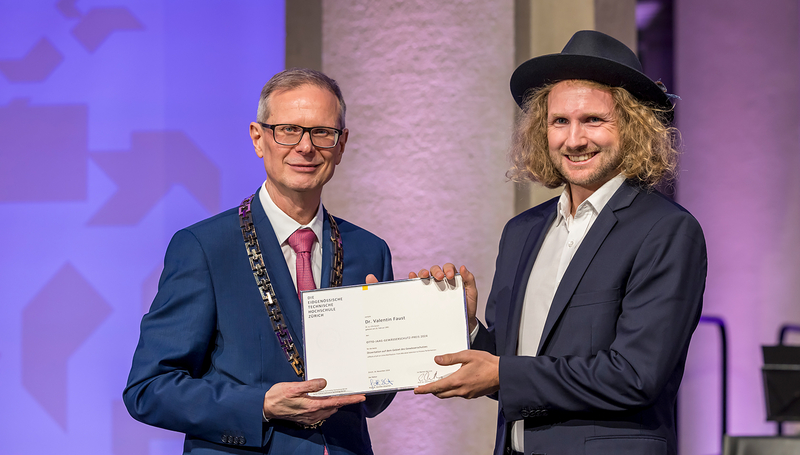
Immagine di copertina: il rettore del Politecnico di Zurigo Günther Dissertori consegna a Valentin Faust il Premio Otto Jaag per la protezione dell'acqua 2024 (Foto: Politecnico di Zurigo, Alessandro Della Bella).
 

Pubblicazioni originali

Extbase Variable Dump
array(3 items)
   publications => '25984,25835,32033,32321' (23 chars)
   libraryUrl => '' (0 chars)
   layout => '0' (1 chars)
Extbase Variable Dump
array(4 items)
   0 => Snowflake\Publications\Domain\Model\Publicationprototypepersistent entity (uid=25984, pid=124)
      originalId => protected25984 (integer)
      authors => protected'Faust, V.; van Alen, T. A.; Op den Camp, H. J.&nbsp
         ;M.; Vlaeminck, S. E.; Ganigué, R.; Boon, N.; Udert,&nb
         sp;K. M.
' (165 chars) title => protected'Ammonia oxidation by novel "<em>Candidatus </em>Nitrosacidococcus urinae" is
          sensitive to process disturbances at low pH and to iron limitation at neutr
         al pH
' (157 chars) journal => protected'Water Research X' (16 chars) year => protected2022 (integer) volume => protected17 (integer) issue => protected'' (0 chars) startpage => protected'100157 (11 pp.)' (15 chars) otherpage => protected'' (0 chars) categories => protected'nitrification; acidophilic AOB; source separation; chemical nitrite oxidatio
         n; human urine; life support system
' (111 chars) description => protected'Acid-tolerant ammonia-oxidizing bacteria (AOB) can open the door to new appl
         ications, such as partial nitritation at low pH. However, they can also be p
         roblematic because chemical nitrite oxidation occurs at low pH, leading to t
         he release of harmful nitrogen oxide gases. In this publication, the role of
          acid-tolerant AOB in urine treatment was explored. On the one hand, the tec
         hnical feasibility of ammonia oxidation under acidic conditions for source-s
         eparated urine with total nitrogen concentrations up to 3.5 g-N L<sup>-1</
         sup> was investigated. On the other hand, the abundance and growth of acid-t
         olerant AOB at more neutral pH was explored. Under acidic conditions (pH of
          5), ammonia oxidation rates of 500 mg-N L<sup>-1</sup> d<sup>-1</sup> an
         d 10 g-N g-VSS<sup>-1</sup> d<sup>-1</sup> were observed, despite high con
         centrations of 15 mg-N L<sup>-1</sup> of the AOB-inhibiting compound nitro
         us acid and low concentration of 0.04 mg-N L<sup>-1</sup> of the substrate
          ammonia. However, ammonia oxidation under acidic conditions was very sensit
         ive to process disturbances. Even short periods of less than 12 h without ox
         ygen or without influent resulted in a complete cessation of ammonia oxidati
         on with a recovery time of up to two months, which is a problem for low main
         tenance applications such as decentralized treatment. Furthermore, undesirab
         le nitrogen losses of about 10% were observed. Under acidic conditions, a no
         vel AOB strain was enriched with a relative abundance of up to 80%, for whic
         h the name “<em>Candidatus (Ca.)</em> Nitrosacidococcus urinae” is propo
         sed. While <em>Nitrosacidococcus</em> members were present only to a small e
         xtent (0.004%) in urine nitrification reactors operated at pH values between
          5.8 and 7, acid-tolerant AOB were always enriched during long periods witho
         ut influent, resulting in an uncontrolled drop in pH to as low as 2.5. Long-
         term experiments at different pH values showed that the activity of “<em>C
         a.</em> Nitrosacidococcu...
' (2324 chars) serialnumber => protected'2589-9147' (9 chars) doi => protected'10.1016/j.wroa.2022.100157' (26 chars) uid => protected25984 (integer) _localizedUid => protected25984 (integer)modified _languageUid => protectedNULL _versionedUid => protected25984 (integer)modified pid => protected124 (integer)
1 => Snowflake\Publications\Domain\Model\Publicationprototypepersistent entity (uid=25835, pid=124) originalId => protected25835 (integer) authors => protected'Faust,&nbsp;V.; Gruber,&nbsp;W.; Ganigué,&nbsp;R.; Vlaeminck,&nbsp;S.&nbsp;
         E.; Udert,&nbsp;K.&nbsp;M.
' (102 chars) title => protected'Nitrous oxide emissions and carbon footprint of decentralized urine fertiliz
         er production by nitrification and distillation
' (123 chars) journal => protected'ACS ES&T Engineering' (20 chars) year => protected2022 (integer) volume => protected2 (integer) issue => protected'9' (1 chars) startpage => protected'1745' (4 chars) otherpage => protected'1755' (4 chars) categories => protected'greenhouse gas emissions; resource recovery; MELiSSA; nitrite sensor; digest
         er supernatant
' (90 chars) description => protected'Combining partial nitrification, granular activated carbon (GAC) filtration,
          and distillation is a well-studied approach to convert urine into a fertili
         zer. To evaluate the environmental sustainability of a technology, the opera
         tional carbon footprint and therefore nitrous oxide (N<sub>2</sub>O) emissio
         ns should be known, but N<sub>2</sub>O emissions from urine nitrification ha
         ve not been assessed yet. Therefore, N<sub>2</sub>O emissions of a decentral
         ized urine nitrification reactor were monitored for 1 month. During nitrific
         ation, 0.4-1.2% of the total nitrogen load was emitted as N<sub>2</sub>O-N w
         ith an average N<sub>2</sub>O emission factor (EF<sub>N<sub>2</sub>O</sub>)
         of 0.7%. Additional N<sub>2</sub>O was produced during anoxic storage betwee
         n nitrification and GAC filtration with an estimated EF<sub>N<sub>2</sub>O</
         sub> of 0.8%, resulting in an EF<sub>N<sub>2</sub>O</sub> of 1.5% for the tr
         eatment chain. N<sub>2</sub>O emissions during nitrification can be mitigate
         d by 60% by avoiding low dissolved oxygen or anoxic conditions and nitrite c
         oncentrations above 5 mg-N L<sup>-1</sup>. Minimizing the hydraulic retentio
         n time between nitrification and GAC filtration can reduce N<sub>2</sub>O fo
         rmation during intermediate storage by 100%. Overall, the N<sub>2</sub>O emi
         ssions accounted for 45% of the operational carbon footprint of 14 kg-CO<sub
         >2,equiv</sub> kg-N<sup>-1</sup> for urine fertilizer production. Using elec
         tricity from renewable sources and applying the proposed N<sub>2</sub>O miti
         gation strategies could potentially lower the carbon footprint by 85%.
' (1590 chars) serialnumber => protected'' (0 chars) doi => protected'10.1021/acsestengg.2c00082' (26 chars) uid => protected25835 (integer) _localizedUid => protected25835 (integer)modified _languageUid => protectedNULL _versionedUid => protected25835 (integer)modified pid => protected124 (integer)
2 => Snowflake\Publications\Domain\Model\Publicationprototypepersistent entity (uid=32033, pid=124) originalId => protected32033 (integer) authors => protected'Faust,&nbsp;V.; Boon,&nbsp;N.; Ganigué,&nbsp;R.; Vlaeminck,&nbsp;S.&nbsp;E.
         ; Udert,&nbsp;K.&nbsp;M.
' (100 chars) title => protected'Optimizing control strategies for urine nitrification: narrow pH control ban
         d enhances process stability and reduces nitrous oxide emissions
' (140 chars) journal => protected'Frontiers in Environmental Science' (34 chars) year => protected2023 (integer) volume => protected11 (integer) issue => protected'' (0 chars) startpage => protected'1275152 (14 pp.)' (16 chars) otherpage => protected'' (0 chars) categories => protected'resource recovery; decentralized treatment; microbial diversity; source sepa
         ration; robustness; MELiSSA; process stability
' (122 chars) description => protected'Nitrification is well-suited for urine stabilization. No base dosage is requ
         ired if the pH is controlled within an appropriate operating range by urine
         feeding, producing an ammonium-nitrate fertilizer. However, the process is h
         ighly dependent on the selected pH set-points and is susceptible to process
         failures such as nitrite accumulation or the growth of acid-tolerant ammonia
         -oxidizing bacteria. To address the need for a robust and reliable process i
         n decentralized applications, two different strategies were tested: operatin
         g a two-position pH controller (inflow on/off) with a narrow pH control band
          at 6.20/6.25 (∆pH = 0.05, narrow-pH) vs. a wider pH control band at 6.00/
         6.50 (∆pH = 0.50, wide-pH). These variations in pH also cause variations i
         n the chemical speciation of ammonia and nitrite and, as shown, the microbia
         l production of nitrite. It was hypothesized that the higher fluctuations wo
         uld result in greater microbial diversity and, thus, a more robust process.
         The diversity of nitrifiers was higher in the wide-pH reactor, while the div
         ersity of the entire microbiome was similar in both systems. However, the wi
         de-pH reactor was more susceptible to tested process disturbances caused by
         increasing pH or temperature, decreasing dissolved oxygen, or an influent st
         op. In addition, with an emission factor of 0.47%, the nitrous oxide (N<sub>
         2</sub>O) emissions from the wide-pH reactor were twice as high as the N<sub
         >2</sub>O emissions from the narrow-pH reactor, most likely due to the nitri
         te fluctuations. Based on these results, a narrow control band is recommende
         d for pH control in urine nitrification.
' (1636 chars) serialnumber => protected'' (0 chars) doi => protected'10.3389/fenvs.2023.1275152' (26 chars) uid => protected32033 (integer) _localizedUid => protected32033 (integer)modified _languageUid => protectedNULL _versionedUid => protected32033 (integer)modified pid => protected124 (integer)
3 => Snowflake\Publications\Domain\Model\Publicationprototypepersistent entity (uid=32321, pid=124) originalId => protected32321 (integer) authors => protected'Faust,&nbsp;V.; Vlaeminck,&nbsp;S.&nbsp;E.; Ganigué,&nbsp;R.; Udert,&nbsp;K
         .&nbsp;M.
' (85 chars) title => protected'Influence of pH on urine nitrification: community shifts of ammonia-oxidizin
         g bacteria and inhibition of nitrite-oxidizing bacteria
' (131 chars) journal => protected'ACS ES&T Engineering' (20 chars) year => protected2024 (integer) volume => protected4 (integer) issue => protected'2' (1 chars) startpage => protected'342' (3 chars) otherpage => protected'353' (3 chars) categories => protected'source separation; resource recovery; nutrient recovery; decentralized treat
         ment; fertilizer production
' (103 chars) description => protected'Urine nitrification is pH-sensitive due to limited alkalinity and high resid
         ual ammonium concentrations. This study aimed to investigate how the pH affe
         cts nitrogen conversion and the microbial community of urine nitrification w
         ith a pH-based feeding strategy. First, kinetic parameters for NH<sub>3</sub
         >, HNO<sub>2</sub>, and NO<sub>2</sub><sup>-</sup> limitation and inhibition
          were determined for nitrifiers from a urine nitrification reactor. The turn
         ing point for ammonia-oxidizing bacteria (AOB), i.e., the substrate concentr
         ation at which a further increase would lead to a decrease in activity due t
         o inhibitory effects, was at an NH<sub>3</sub> concentration of 12 mg-N L<su
         p>-1</sup>, which was reached only at pH values above 7. The total nitrite t
         urning point for nitrite-oxidizing bacteria (NOB) was pH-dependent, e.g., 18
          mg-N L<sup>-1</sup> at pH 6.3. Second, four years of data from two 120 L re
         actors were analyzed, showing that stable nitrification with low nitrite was
          most likely between pH 5.8 and 6.7. And third, six 12 L urine nitrification
          reactors were operated at total nitrogen concentrations of 1300 and 3600 mg
         -N L<sup>-1</sup> and pH values between 2.5 and 8.5. At pH 6, the AOB Nitros
         omonas europaea was found, and the NOB belonged to the genus Nitrobacter. At
          pH 7, nitrite accumulated, and Nitrosomonas halophila was the dominant AOB.
          NOB were inhibited by HNO<sub>2</sub> accumulation. At pH 8.5, the AOB Nitr
         osomonas stercoris became dominant, and NH<sub>3</sub> inhibited NOB. Withou
         t influent, the pH dropped to 2.5 due to the growth of the acid-tolerant AOB
          “Candidatus Nitrosacidococcus urinae”. In conclusion, pH is a decisive
         process control parameter for urine nitrification by influencing the selecti
         on and kinetics of nitrifiers.
' (1778 chars) serialnumber => protected'' (0 chars) doi => protected'10.1021/acsestengg.3c00320' (26 chars) uid => protected32321 (integer) _localizedUid => protected32321 (integer)modified _languageUid => protectedNULL _versionedUid => protected32321 (integer)modified pid => protected124 (integer)
Faust, V.; van Alen, T. A.; Op den Camp, H. J. M.; Vlaeminck, S. E.; Ganigué, R.; Boon, N.; Udert, K. M. (2022) Ammonia oxidation by novel "Candidatus Nitrosacidococcus urinae" is sensitive to process disturbances at low pH and to iron limitation at neutral pH, Water Research X, 17, 100157 (11 pp.), doi:10.1016/j.wroa.2022.100157, Institutional Repository
Faust, V.; Gruber, W.; Ganigué, R.; Vlaeminck, S. E.; Udert, K. M. (2022) Nitrous oxide emissions and carbon footprint of decentralized urine fertilizer production by nitrification and distillation, ACS ES&T Engineering, 2(9), 1745-1755, doi:10.1021/acsestengg.2c00082, Institutional Repository
Faust, V.; Boon, N.; Ganigué, R.; Vlaeminck, S. E.; Udert, K. M. (2023) Optimizing control strategies for urine nitrification: narrow pH control band enhances process stability and reduces nitrous oxide emissions, Frontiers in Environmental Science, 11, 1275152 (14 pp.), doi:10.3389/fenvs.2023.1275152, Institutional Repository
Faust, V.; Vlaeminck, S. E.; Ganigué, R.; Udert, K. M. (2024) Influence of pH on urine nitrification: community shifts of ammonia-oxidizing bacteria and inhibition of nitrite-oxidizing bacteria, ACS ES&T Engineering, 4(2), 342-353, doi:10.1021/acsestengg.3c00320, Institutional Repository