Abteilung Umweltmikrobiologie

MicroscapesX

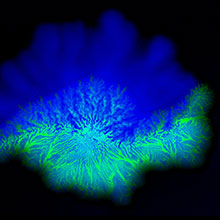
In ihrem natürlichen Umfeld existieren Mikroben selten alleine als einzelne Zellen, sondern sie leben meistens in Gemeinschaften, wo sie von Artgenossen und anderen mikrobiellen Spezies umgeben sind. Die räumliche Anordnung bestimmt wie die verschiedenen Zelltypen miteinander interagieren können (z.B. können sie positive oder negative Effekte auf ihre Nachbarn haben) und prägt somit die emergenent Eigenschaften der Gemeinschaft. Das Ziel des Projektes Microscapes besteht darin, die grundlegenden Prozesse welche die räumliche Selbstorganisation bestimmen zu verstehen um deren Auswirkungen auf die Ökosystemfunktion vorhersagen zu können.

Um die grundlegenden Prozesse zu untersuchen verwenden wir synthetische mikrobielle Ökosysteme, in denen wir spezifische Interaktionen zwischen verschiedenen Zelltypen kontrolliert herstellen können. Dies erlaubt uns, die Interaktionen gezielt zu manipulieren und deren Auswirkungen auf die räumliche Selbstorganisation und die emergenten Eigenschaften der Gemeinschaft zu messen. Mit diesem Wissen entwickeln wir schliesslich quantitative Modelle, mit denen wir die Entstehung und Dynamik von mikrobiellen Gemeinschaften vorhersagen können.

Als inhärent interdisziplinäres Projekt beinhaltet Microscapes eine Vielfalt von Disziplinen aus der Biologie wie: Mikrobiologie, Ökologie, Evolution und Systembiologie. Ausserdem verbinden wir die Experimente mit mathematischen Modellen um Vorhersagen machen zu können. Das Projekt ist deshalb eine Zusammenarbeit von Fünf Forschungsgruppen mit verschiedenen Expertisen. Drei Gruppen arbeiten experimentell (Jan Roelof van der Meer, UNIL; Yok Que Ai, CHUV; David R. Johnson, Eawag) während die anderen Zwei auf mathematische Modelle spezialisiert sind (Dani Or, ETHZ; Vassily Hatzimanikatis, EPFL).

Publikationen
Extbase Variable Dump
array(2 items)
   publications => '7100' (4 chars)
   libraryUrl => '' (0 chars)
Extbase Variable Dump
array(1 item)
   0 => Snowflake\Publications\Domain\Model\Publicationprototypepersistent entity (uid=7100, pid=124)
      originalId => protected7100 (integer)
      authors => protected'Johnson, D. R.; Goldschmidt, F.; Lilja, E. E.; Acke
         rmann, M.
' (90 chars) title => protected'Metabolic specialization and the assembly of microbial communities' (66 chars) journal => protected'ISME Journal' (12 chars) year => protected2012 (integer) volume => protected6 (integer) issue => protected'11' (2 chars) startpage => protected'1985' (4 chars) otherpage => protected'1991' (4 chars) categories => protected'metabolic specialization; community assembly; biochemical conflicts; trade-o
         ffs; cross-feeding
' (94 chars) description => protected'Metabolic specialization is a general biological principle that shapes the a
         ssembly of microbial communities. Individual cell types rarely metabolize a
         wide range of substrates within their environment. Instead, different cell t
         ypes often specialize at metabolizing only subsets of the available substrat
         es. What is the advantage of metabolizing subsets of the available substrate
         s rather than all of them? In this perspective piece, we argue that biochemi
         cal conflicts between different metabolic processes can promote metabolic sp
         ecialization and that a better understanding of these conflicts is therefore
          important for revealing the general principles and rules that govern the as
         sembly of microbial communities. We first discuss three types of biochemical
          conflicts that could promote metabolic specialization. Next, we demonstrate
          how knowledge about the consequences of biochemical conflicts can be used t
         o predict whether different metabolic processes are likely to be performed b
         y the same cell type or by different cell types. We then discuss the major c
         hallenges in identifying and assessing biochemical conflicts between differe
         nt metabolic processes and propose several approaches for their measurement.
          Finally, we argue that a deeper understanding of the biochemical causes of
         metabolic specialization could serve as a foundation for the field of synthe
         tic ecology, where the objective would be to rationally engineer the assembl
         y of a microbial community to perform a desired biotransformation.
' (1510 chars) serialnumber => protected'1751-7362' (9 chars) doi => protected'10.1038/ismej.2012.46' (21 chars) uid => protected7100 (integer) _localizedUid => protected7100 (integer)modified _languageUid => protectedNULL _versionedUid => protected7100 (integer)modified pid => protected124 (integer)
Johnson, D. R.; Goldschmidt, F.; Lilja, E. E.; Ackermann, M. (2012) Metabolic specialization and the assembly of microbial communities, ISME Journal, 6(11), 1985-1991, doi:10.1038/ismej.2012.46, Institutional Repository