Archiv Detail

Fluorid im Grundwasser: Globale Karte zeigt erstmals alle Risikogebiete auf

11. August 2022 | Isabel Plana

Als Zusatz in Zahnpasta schützt es unsere Zähne vor Karies. Doch wenn Fluorid in der Natur in grösseren Mengen vorkommt und sich im Grundwasser anreichert, kann es zu einer Gefahr für unsere Gesundheit werden. Erstmals haben Wissenschaftler der Eawag eine detaillierte Karte der globalen Fluoridbelastung im Grundwasser erstellt und aufgezeigt, welche Weltregionen besonders betroffen sind.

Nicht jeder Schadstoff ist menschengemacht. Manche kommen von Natur aus im Gestein und damit auch im Grundwasser vor. So etwa Fluorid, das in grösseren Mengen aufgenommen toxisch wirkt und dazu führt, dass Knochen und Gelenke degenerieren. Neben der Geologie ist vor allem das Klima ein entscheidender Faktor für die Fluoridanreicherung im Grundwasser. Besonders hoch sind die Konzentrationen in trockenen, heissen Regionen: Zum einen weil höhere Temperaturen die Verwitterung und damit die Auflösung von Fluorid aus dem Gestein begünstigen, und zum anderen, weil das Fluorid länger im Grundwasser verbleibt, da sich dieses aufgrund der geringen Niederschlagsmengen nur sehr langsam erneuert. Die Vermutung liegt nahe, dass sich mit dem Klimawandel und der fortschreitenden Wüstenbildung in vielen Teilen der Erde auch das Fluorid-Problem verschärfen könnte.

Erschwerend hinzu kommt, dass Fluorid oft unentdeckt bleibt, weil es geruchlos und unsichtbar ist. Nur Wasseranalysen geben Aufschluss über zu hohe Konzentrationen. In vielen Ländern des globalen Südens wird das Grundwasser jedoch kaum getestet, und nicht wenige Menschen beziehen das Wasser direkt von einer Grundwasserpumpe. «Die Risikogebiete sind daher nicht flächendeckend bekannt, es gibt viele Lücken», sagt Joel Podgorski, der bei der Eawag zu Wasserressourcen und Trinkwasser forscht. «Diese Lücken wollten wir mit unserer Arbeit schliessen, um eine Grundlage für ein besseres Grundwasser-Monitoring zu schaffen.»

Machine-Learning schliesst Wissenslücken

Dazu haben Joel Podgorski und sein Kollege Michael Berg ein auf Machine-Learning basiertes Modell entwickelt. Ausgehend von bestimmten Bodeneigenschaften sowie topografischen, geologischen und klimatischen Faktoren berechnet dieses Modell die Wahrscheinlichkeit, mit der der Fluoridgehalt über dem gesundheitlich relevanten Grenzwert von 1,5 Milligramm pro Liter liegt. Voraussetzung dafür, dass das Modell tatsächlich richtig funktioniert, sind genügend Messdaten, um den Computeralgorithmus zu trainieren. «Unser erster Versuch vor einigen Jahren scheiterte noch daran, dass wir zu wenig Messdaten für ein verlässliches Modell hatten», erzählt Podgorski. Mittlerweile würden aber immer mehr Länder ihre Daten öffentlich zugänglich machen. Deshalb konnten die beiden Forscher eine Datenbank von 400'000 Fluoridmessungen im Grundwasser erstellen – den bisher grössten globalen Datensatz.
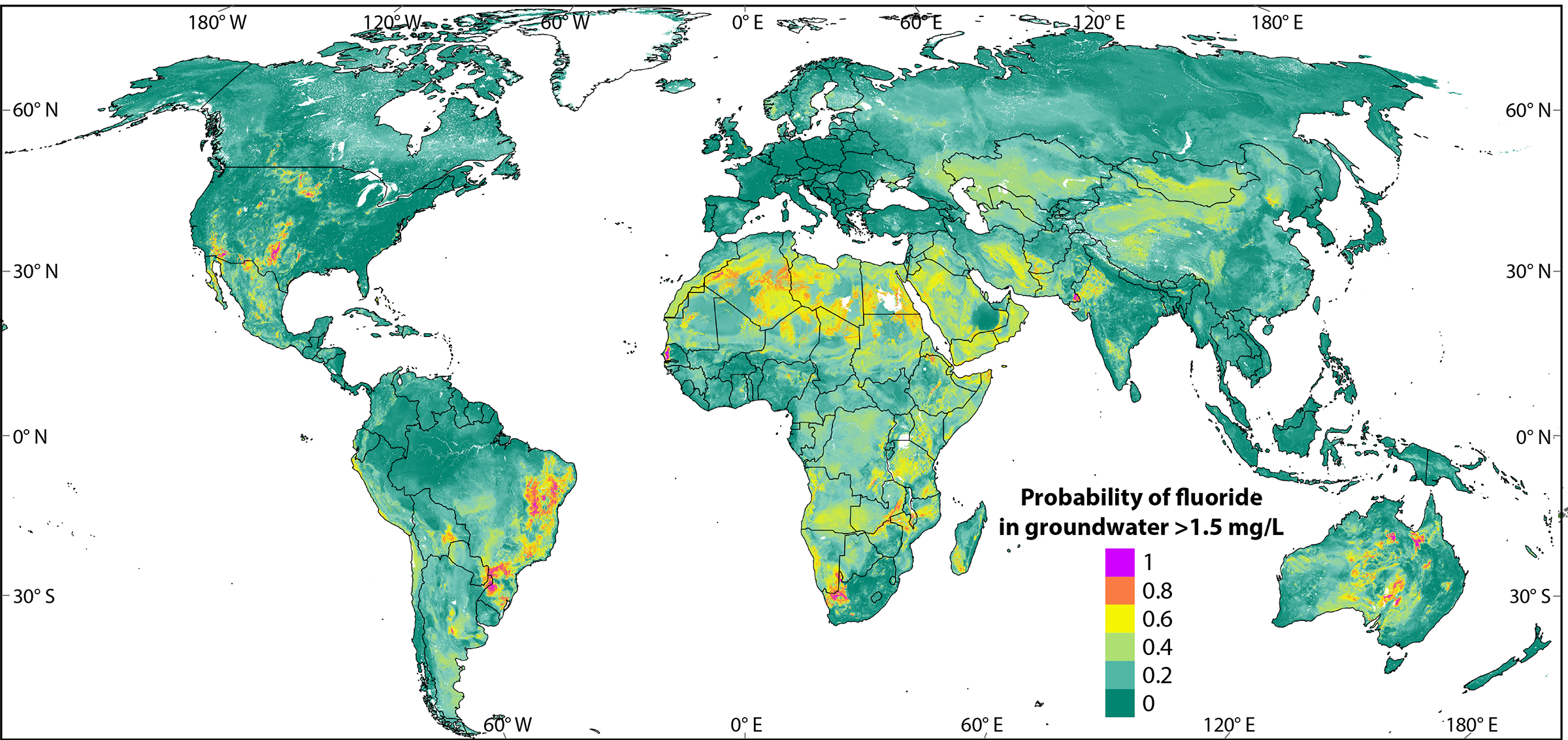
 

Die Karte zeigt flächendeckend, mit welcher Wahrscheinlichkeit die Fluoridkonzentration im Grundwasser über dem von der Weltorganisation für Gesundheit festgelegten Grenzwert liegt. Praktisch ganz Afrika und grosse Teile Asiens weisen eine potenziell gefährliche Fluoridbelastung auf. Eine interaktive Version der Karte ist auf der GIS-Plattform gapmaps.org verfügbar.

Das Resultat ist eine Karte, die flächendeckend mit einer hohen Auflösung von 250 Metern aufzeigt, wo das Risiko einer Fluorid-Grenzwertüberschreitung besteht. «Wir sehen, dass die Konzentrationen etwa im südlichen Afrika, in Zentralasien, China und der Mongolei zu hoch sein dürften. In Ländern, in denen das Grundwasser bisher kaum getestet wird», sagt Podgorski. In der Schweiz und Europa ist das Risiko gering. «Unsere Ergebnisse liefern somit neue Informationen für Forschende und Behörden vor Ort und geben einen wichtigen Anstoss, das Grundwasser in den betroffenen Regionen künftig genauer unter die Lupe zu nehmen und Massnahmen zu ergreifen, etwa Kampagnen zur Sensibilisierung der Bevölkerung oder das Entfluoridieren von Trinkwasser.» Überrascht hat Podgorski, dass das Modell auch für Gebiete im Nordosten Brasiliens eine hohe Fluoridkonzentration voraussagt. «Das passt nicht ins übliche Muster, wonach vor allem trockene Gebiete hohe Fluoridwerte im Grundwasser aufweisen.» Ein interessantes Resultat also, das dazu anregt, die Situation in dieser Region in einer künftigen Studie genauer zu untersuchen – so wie das Podgorski und weitere Forschende jüngst bereits für Ghana und Pakistan gemacht haben.

Viele Menschen betroffen, viele Fragen offen

Nebst den Risikogebieten haben die beiden Forscher auch berechnet, wie viele Menschen weltweit durch die Fluoridbelastung gefährdet sind. Dazu haben sie nicht nur Bevölkerungszahlen beigezogen, sondern auch Daten zum Wasserkonsum berücksichtigt. Denn ob Fluorid problematisch ist, hängt letztlich davon ab, woher die Menschen ihr Trinkwasser beziehen, ob es aufbereitet aus der Leitung kommt oder direkt von einer Grundwasserpumpe. Die Berechnung ergab, dass potenziell rund 180 Millionen Menschen weltweit fluoridbelastetem Grundwasser ausgesetzt sind. Und zwar fast ausschliesslich in Asien und Afrika.
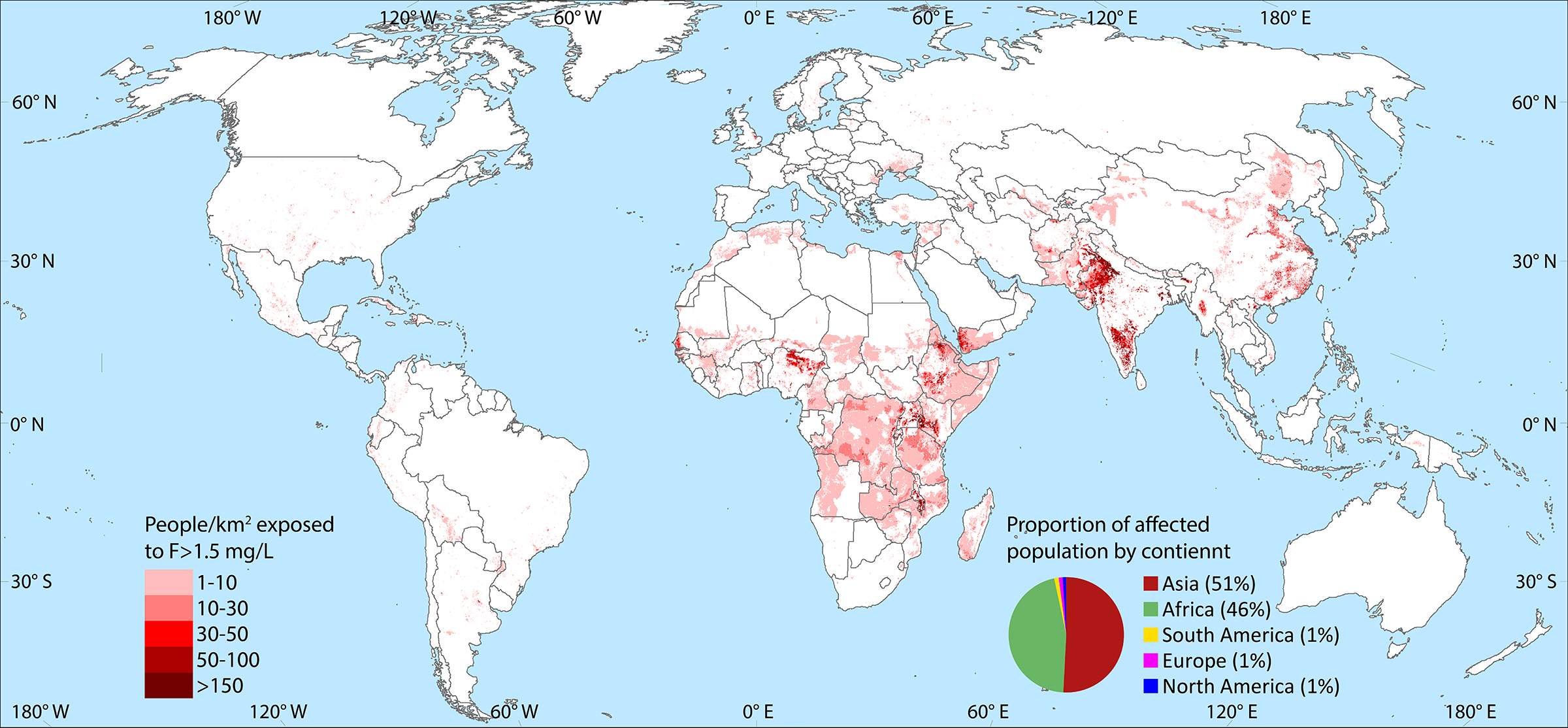
 

Zu hohe Fluoridkonzentrationen sind nur dort eine Gefahr, wo Menschen unbehandeltes Trinkwasser von Brunnen und Grundwasserpumpen beziehen. So ist in Australien fast niemand gefährdet, obwohl die Fluoridwerte im Grundwasser vielerorts über dem Grenzwert liegen. In Afrika und Asien hingegen sind insgesamt über 170 Millionen Menschen betroffen. Eine interaktive Version der Karte ist auf der GIS-Plattform gapmaps.org verfügbar.

Inwiefern das Fluorid aus dem Grundwasser seinen Weg in landwirtschaftliche Erzeugnisse und damit in Lebensmittel findet, wie es etwa mit dem Schwermetall Arsen bei Reis der Fall ist, sei bisher noch wenig erforscht. «Ich bin immer wieder erstaunt, wie viele Aspekte im Zusammenhang mit Fluorid noch ungeklärt sind», sagt Podgorski. «Da besteht noch viel Forschungsbedarf. Umso mehr, als dass der Klimawandel die Fluoridbelastung in vielen Regionen verschärfen könnte. Ich denke, unsere Karte schafft nicht nur eine wichtige Grundlage für Präventivmassnahmen, sondern auch für weiterführende Forschungsfragen.»

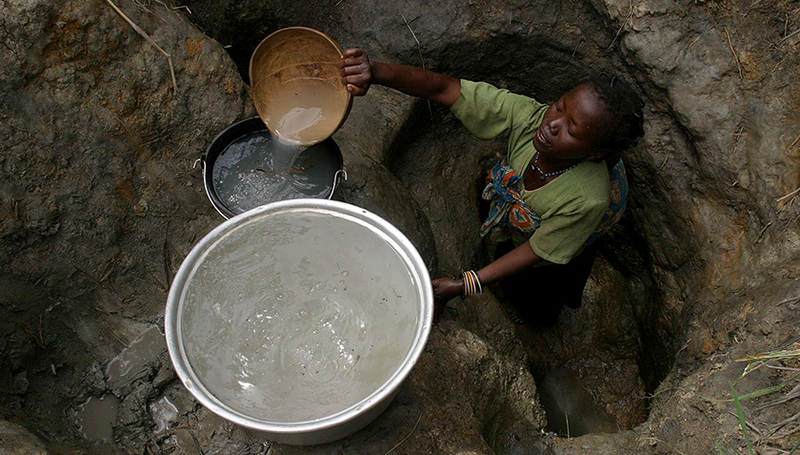
Titelbild: Tägliches Wasserschöpfen aus einem Wasserloch in der Zentralafrikanischen Republik. (Foto: Unicef/Pierre Hotz)
 

Originalpublikation

Extbase Variable Dump
array(2 items)
   publications => '25552' (5 chars)
   libraryUrl => '' (0 chars)
Extbase Variable Dump
array(1 item)
   0 => Snowflake\Publications\Domain\Model\Publicationprototypepersistent entity (uid=25552, pid=124)
      originalId => protected25552 (integer)
      authors => protected'Podgorski, J.; Berg, M.' (33 chars)
      title => protected'Global analysis and prediction of fluoride in groundwater' (57 chars)
      journal => protected'Nature Communications' (21 chars)
      year => protected2022 (integer)
      volume => protected13 (integer)
      issue => protected'1' (1 chars)
      startpage => protected'4232 (9 pp.)' (12 chars)
      otherpage => protected'' (0 chars)
      categories => protected'' (0 chars)
      description => protected'The health of millions of people worldwide is negatively impacted by chronic
          exposure to elevated concentrations of geogenic fluoride in groundwater. Du
         e to health effects including dental mottling and skeletal fluorosis, the Wo
         rld Health Organization maintains a maximum guideline of 1.5 mg/L in drink
         ing water. As groundwater quality is not regularly tested in many areas, it
         is often unknown if the water in a given well or spring contains harmful lev
         els of fluoride. Here we present a state-of-the-art global fluoride hazard m
         ap based on machine learning and over 400,000 fluoride measurements (10% of
         which >1.5 mg/L), which is then used to estimate the human population a
         t risk. Hotspots indicated by the groundwater fluoride hazard map include pa
         rts of central Australia, western North America, eastern Brazil and many are
         as of Africa and Asia. Of the approximately 180 million people potentially a
         ffected worldwide, most reside in Asia (51–59% of total) and Africa (37-46
         % of total), with the latter representing 6.5% of the continent’s populati
         on. Africa also contains 14 of the top 20 affected countries in terms of pop
         ulation at risk. We also illuminate and discuss the key globally relevant hy
         drochemical and environmental factors related to fluoride accumulation.
' (1287 chars) serialnumber => protected'' (0 chars) doi => protected'10.1038/s41467-022-31940-x' (26 chars) uid => protected25552 (integer) _localizedUid => protected25552 (integer)modified _languageUid => protectedNULL _versionedUid => protected25552 (integer)modified pid => protected124 (integer)
Podgorski, J.; Berg, M. (2022) Global analysis and prediction of fluoride in groundwater, Nature Communications, 13(1), 4232 (9 pp.), doi:10.1038/s41467-022-31940-x, Institutional Repository

Weitere Arbeiten zum Thema

Extbase Variable Dump
array(2 items)
   publications => '24949,24363' (11 chars)
   libraryUrl => '' (0 chars)
Extbase Variable Dump
array(2 items)
   0 => Snowflake\Publications\Domain\Model\Publicationprototypepersistent entity (uid=24949, pid=124)
      originalId => protected24949 (integer)
      authors => protected'Ling, Y.; Podgorski, J.; Sadiq, M.; Rasheed, H.; Eqani,&
         nbsp;S. A. M. A. S.; Berg, M.
' (130 chars) title => protected'Monitoring and prediction of high fluoride concentrations in groundwater in
         Pakistan
' (84 chars) journal => protected'Science of the Total Environment' (32 chars) year => protected2022 (integer) volume => protected839 (integer) issue => protected'' (0 chars) startpage => protected'156058 (9 pp.)' (14 chars) otherpage => protected'' (0 chars) categories => protected'aquifers; geogenic groundwater pollution; drinking water quality; human heal
         th threat; fluorosis; random forest modeling
' (120 chars) description => protected'Concentrations of naturally occurring fluoride in groundwater exceeding the
         WHO guideline of 1.5 mg/L have been detected in many parts of Pakistan. This
          may lead to dental or skeletal fluorosis and thereby poses a potential thre
         at to public health. Utilizing a total of 5483 fluoride concentrations, comp
         rising 2160 new measurements as well as those from other sources, we have ap
         plied machine learning techniques to predict the probability of fluoride in
         groundwater in Pakistan exceeding 1.5 mg/L at a 250 m spatial resolution. Cl
         imate, soil, lithology, topography, and land cover parameters were identifie
         d as effective predictors of high fluoride concentrations in groundwater. Ex
         cellent model performance was observed in a random forest model that achieve
         d an Area Under the Curve (AUC) of 0.92 on test data that were not used in m
         odeling. The highest probabilities of high fluoride concentrations in ground
         water are predicted in the Thar Desert, Sargodha Division, and scattered alo
         ng the Sulaiman Mountains. Applying the model predictions to the population
         density and accounting for groundwater usage in both rural and urban areas,
         we estimate that about 13 million people may be at risk of fluorosis due to
         consuming groundwater with fluoride concentrations >1.5 mg/L in Pakistan,
          which corresponds to ~6% of the total population. Both the fluoride predict
         ion map and the health risk map can be used as important decision-making too
         ls for authorities and water resource managers in the identification and mit
         igation of groundwater fluoride contamination.
' (1566 chars) serialnumber => protected'0048-9697' (9 chars) doi => protected'10.1016/j.scitotenv.2022.156058' (31 chars) uid => protected24949 (integer) _localizedUid => protected24949 (integer)modified _languageUid => protectedNULL _versionedUid => protected24949 (integer)modified pid => protected124 (integer)
1 => Snowflake\Publications\Domain\Model\Publicationprototypepersistent entity (uid=24363, pid=124) originalId => protected24363 (integer) authors => protected'Araya, D.; Podgorski, J.; Kumi, M.; Mainoo, P. A.;
         Berg, M.
' (89 chars) title => protected'Fluoride contamination of groundwater resources in Ghana: country-wide hazar
         d modeling and estimated population at risk
' (119 chars) journal => protected'Water Research' (14 chars) year => protected2022 (integer) volume => protected212 (integer) issue => protected'' (0 chars) startpage => protected'118083 (10 pp.)' (15 chars) otherpage => protected'' (0 chars) categories => protected'Africa; drinking water resources; human health; fluorosis; random forest mod
         eling; groundwater pollution; geogenic contamination
' (128 chars) description => protected'Most people in Ghana have no or only basic access to safely managed water. E
         specially in rural areas, much of the population relies on groundwater for d
         rinking, which can be contaminated with fluoride and lead to dental fluorosi
         s. Children under the age of two are particularly susceptible to the adverse
          effects of fluoride and can retain 80-90% of a fluoride dose, compared to 6
         0% in adults. Despite numerous local studies, no spatially continuous pictur
         e exists of the fluoride contamination across Ghana, nor is there any estima
         te of what proportion of the population is potentially exposed to unsafe flu
         oride levels. Here, we spatially model the probability of fluoride concentra
         tions exceeding 1.0 mg/L in groundwater across Ghana to identify risk areas
          and estimate the number of children and adults exposed to unsafe fluoride l
         evels in drinking water. We use a set of geospatial predictor variables with
          random forest modeling and evaluate the model performance through spatial c
         ross-validation. We found that approximately 15% of the area of Ghana, mainl
         y in the northeast, has a high probability of fluoride contamination. The to
         tal at-risk population is about 920,000 persons, or 3% of the population, wi
         th an estimated 240,000 children (0-9 years) in at-risk areas. In some distr
         icts, such as Karaga, Gushiegu, Tamale and Mion, 4 out of 10 children are po
         tentially exposed to fluoride poisoning. Geology and high evapotranspiration
          are the main drivers of fluoride enrichment in groundwater. Consequently, c
         limate change might put even greater pressure on the area's water resources.
          Our hazard maps should raise awareness and understanding of geogenic fluori
         de contamination in Ghana and can advise decision making at local levels to
         avoid or mitigate fluoride-related risks.
' (1789 chars) serialnumber => protected'0043-1354' (9 chars) doi => protected'10.1016/j.watres.2022.118083' (28 chars) uid => protected24363 (integer) _localizedUid => protected24363 (integer)modified _languageUid => protectedNULL _versionedUid => protected24363 (integer)modified pid => protected124 (integer)
Ling, Y.; Podgorski, J.; Sadiq, M.; Rasheed, H.; Eqani, S. A. M. A. S.; Berg, M. (2022) Monitoring and prediction of high fluoride concentrations in groundwater in Pakistan, Science of the Total Environment, 839, 156058 (9 pp.), doi:10.1016/j.scitotenv.2022.156058, Institutional Repository
Araya, D.; Podgorski, J.; Kumi, M.; Mainoo, P. A.; Berg, M. (2022) Fluoride contamination of groundwater resources in Ghana: country-wide hazard modeling and estimated population at risk, Water Research, 212, 118083 (10 pp.), doi:10.1016/j.watres.2022.118083, Institutional Repository

Finanzierung / Kooperationen

Die Arbeit wurde von der Direktion für Entwicklung und Zusammenarbeit (DEZA) unterstützt.