Archiv Detail

Menschliche Einflüsse auf die Grundwasserqualität

9. September 2019 | Stephanie Schnydrig

Das Bewusstsein für einen nachhaltigen Grundwasserverbrauch gewinnt aufgrund der sich verändernden Landnutzung und des Klimawandels zunehmend an Bedeutung. Folglich steigt das Interesse daran, natürliche und anthropogene Prozesse, die die Grundwasserqualität beeinflussen, besser zu verstehen.

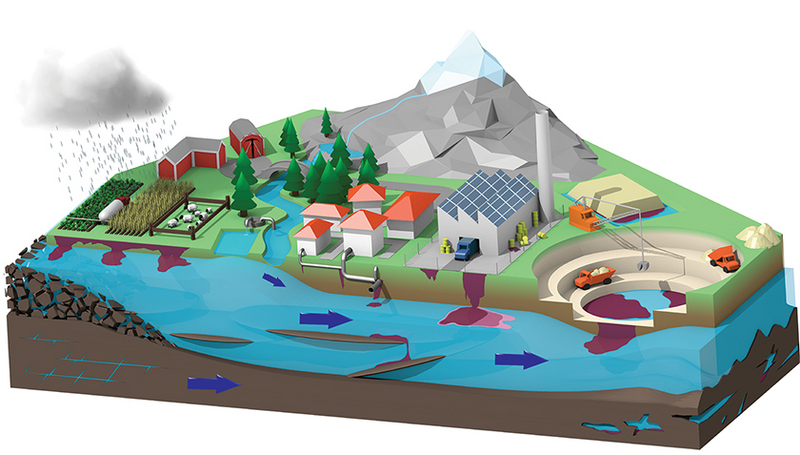
In einem Übersichtsartikel haben Forschende der Eawag die wichtigsten anthropogenen Schadstoffe, die ins Grundwasser gelangen sowie deren Hauptverursacher identifiziert. Intensive Landwirtschaft, Zersiedelung, die pharmazeutische Industrie, unzureichende Abwasserinfrastrukturen, mangelnde Daten zur Wasserqualität sowie das fehlende Bewusstsein über die Bedeutung des Grundwassers als erneuerbare Ressource gehören demnach zu den dringendsten Problemen. Weil Grundwasserleiter sehr unterschiedliche Eigenschaften aufweisen, sei es aber nach wie vor schwierig, den Transport der Schadstoffe zuverlässig zu verfolgen und ihre genaue Herkunft zu identifizieren, schreiben die Forschenden.

Im Artikel sind konkrete Fallstudien aufgeführt, um die Bedrohungen der globalen Grundwasserressourcen zu veranschaulichen – etwa die Nachwirkungen von Bergbau in Südafrika oder Nitratakkumulationen aufgrund intensiver Landwirtschaft in den USA.

Die Forschenden betonen die Wichtigkeit einer transdisziplinären Forschung und einer grenzüberschreitenden Kommunikation, um eine nachhaltige Grundwasserqualität weltweit zu gewährleisten.

Originalpublikation

Extbase Variable Dump
array(2 items)
   publications => '18918' (5 chars)
   libraryUrl => '' (0 chars)
Extbase Variable Dump
array(1 item)
   0 => Snowflake\Publications\Domain\Model\Publicationprototypepersistent entity (uid=18918, pid=124)
      originalId => protected18918 (integer)
      authors => protected'Burri, N. M.; Weatherl, R.; Moeck, C.; Schirmer, M.' (76 chars)
      title => protected'A review of threats to groundwater quality in the anthropocene' (62 chars)
      journal => protected'Science of the Total Environment' (32 chars)
      year => protected2019 (integer)
      volume => protected684 (integer)
      issue => protected'' (0 chars)
      startpage => protected'136' (3 chars)
      otherpage => protected'154' (3 chars)
      categories => protected'water resources; groundwater quality; anthropogenic activity; contamination;
          sustainable; transdisciplinary
' (107 chars) description => protected'Awareness concerning sustainable groundwater consumption under the context o
         f land use and climate change is gaining traction, raising the bar for adequ
         ate understanding of the complexities of natural and anthropogenic processes
          and how they affect groundwater quality. The heterogeneous characteristics
         of aquifers have hampered comprehensive source, transport and contaminant id
         entification. As questions remain about the behavior and prediction of well-
         known groundwater contaminants, new concerns around emerging contaminants ar
         e on the increase. This review highlights some of the key contaminants that
         originate from anthropogenic activities, organized based on land use categor
         ies namely agricultural, urban and industrial. It further highlights the ext
         ensive overlap, in terms of both provenance as well as contaminant type, bet
         ween the different land use sectors. A selection of case studies from litera
         ture that describe the continued concern of established contaminants, as wel
         l as new and emerging compounds, are presented to illustrate the many qualit
         ative threats to global groundwater resources. In some cases, the risk of gr
         oundwater contamination lacks adequate gravity, while in others the underlyi
         ng physical and societal processes are not fully understood and activities m
         ay commence without adequately considering potential impacts. In the agricul
         tural context, the historic and current application of fertilizers and plant
          protectants, use of veterinary pharmaceuticals and hormones, strives to saf
         eguard the growing food demands. In the context of a sprawling urban environ
         ment, waste, human pharmaceuticals, and urban pesticide outputs are increasi
         ng, with adequate runoff and sanitation infrastructure often lagging. Finall
         y, industrial activities are associated with accidental leaks and spills, wh
         ile the large-scale storage of industrial byproducts has led to legacy conta
         minants such as those stemming from raw mineral extraction. With this review
          paper, we aim to unders...
' (2202 chars) serialnumber => protected'0048-9697' (9 chars) doi => protected'10.1016/j.scitotenv.2019.05.236' (31 chars) uid => protected18918 (integer) _localizedUid => protected18918 (integer)modified _languageUid => protectedNULL _versionedUid => protected18918 (integer)modified pid => protected124 (integer)
Burri, N. M.; Weatherl, R.; Moeck, C.; Schirmer, M. (2019) A review of threats to groundwater quality in the anthropocene, Science of the Total Environment, 684, 136-154, doi:10.1016/j.scitotenv.2019.05.236, Institutional Repository