The latest news from Eawag

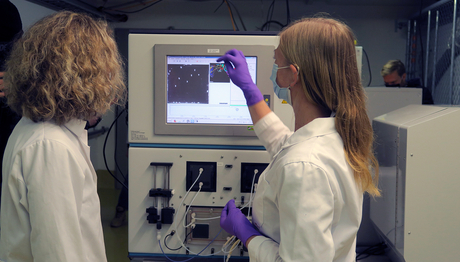
The majority of microplastics in wastewater are retained at wastewater treatment plants and incinerated along with the sewage sludge. Only a small proportion finds its way from the wastewater treatment plants into water bodies. (Photo: Eawag)
News
First nationwide measurements in Switzerland show low ...
September 10, 2026

Every year, Swiss wastewater treatment plants release around 5 tonnes of microplastics into the environment. That is relatively little: It is estimated that around twice as many microplastic enters Swiss water bodies via the atmosphere. These figures come from the largest nationwide investigation to date on ultrafine plastic particles in the air, water and soil, a joint project by Eawag, Empa and Agroscope. These figures were made possible thanks to a new approach to sampling that yields significantly more reliable results than previous processes.

Using rainwater to water the garden is a sensible idea. (Photo: Adobe Stock)
Background
Recycling water and nutrients? Yes, says the expert
July 21, 2026

When there is a prolonged dry spell and local authorities call on residents to save water, questions immediately arise as to whether it would make sense to reuse more water and collect rainwater. In light of recent events, here are some answers from Prof. Kai Udert, Head of the Process Engineering Department at Eawag.

The Hagneck power station, just before Lake Biel, has been regarded as exemplary in minimising the ecological impact of hydropower since it was re-licensed and attracts many visitors. Elsewhere, however, this modernisation is stalling. (Image: Tourism Biel Seeland, S. Weber)
News
A look back at water policy in 2025
July 6, 2026

The current heatwave makes it easy to forget that the first half of 2025 was already marked by severe drought and that snow reserves from the winter were low. A review of water policy developments in 2025 shows that, rather than the availability of water, the Federal Parliament once again focused on the use of hydropower. On the subject of water quality, discussions centred on setting limit values for PFAS and calls for a simplified authorisation process for pesticides.

Bengaluru, India – a city on the cusp of a sustainable water future. (Photo: Christian Binz)
News
Rethinking wastewater management
June 8, 2026

An Eawag project in Bengaluru, India, is opening up new ways to respond to droughts and water scarcity. The focus is on the decentralised reuse of treated wastewater. Technological solutions alone cannot resolve the complex water challenges. Social aspects must be considered, as well.