
Info Day
Eawag’s Info Day highlights once a year a current research topic. The Event is aimed at anyone who is interested in the subject, particularly professionals working in the field. Researchers from Eawag and external experts provide insights into their work and current developments. The event promotes exchange between research and practice and offers opportunities for discussion and conversation.
Info Day 2026
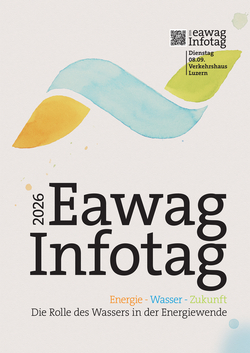
Flyer Info Day 2026 (german)
Energy - Water - Future
The Role of Water in the Energy Transition
Tuesday, 8 September 2026, Swiss Museum of Transport Lucerne
The energy transition aims to move away from fossil fuels. This involves expanding renewable energy sources, including hydropower. However, hydropower is already highly developed in Switzerland, and in addition to the climate crisis—the primary driver of the energy transition—we are also facing a biodiversity crisis. Addressing both challenges simultaneously leads to conflicts that are particularly pronounced in water bodies. Net-zero strategies, the extraction of raw materials critical to the transition, and the use of geothermal energy can also impact water. Eawag’s research helps to make these conflicting goals transparent and enables the development of fact-based solutions. It provides policymakers with a basis for making ecologically, economically, and socially sustainable decisions.
Program Info Day 2026
The language of each presentation is indicated: German (D), French (F)
| ab 9:00 | Registration, coffee and croissants |
| 09:30 | Welcome (D) Prof. Dr. Martin Ackermann, Director Eawag |
| 09:35 | Moderator (D) Dr. Manuel Fischer, Environmental Social Sciences Andri Bryner, Communications |
| 09:40 | The role of water in the energy transition (Introduction, D) Dr. Christian Stamm, Deputy Director of Eawag |
Research for the sustainable use of hydropower
| 10:00 | How fish overcome weirs and where they give up (D) Dr. Jakob Brodersen, Dr. Sara Süess, Dept. of Fish Ecology and Evolution Fish want to migrate to their spawning grounds or seek out cooler areas when the water gets too warm in summer. However, over 100,000 weirs and other transverse structures make this difficult in Swiss rivers. In the River Fish Migration project, Eawag is working with the Federal Office for the Environment and cantonal fisheries authorities to investigate fish movement patterns in the Aare-Rhine system. The presentation will outline initial findings on how such patterns are changing with climate change and what impact these artificial barriers have. |
| 10:20 | Smart site selection for hydropower plants can preserve habitats (D) Dr. Philipp Falke, Dr. Martin Schmid, Dr. Katharina Lange, Dept. of Surface Water Research and Management Power plants fragment water networks. However, there are sites that affect habitat connectivity more and others that affect it less. A new modelling approach to selecting power plant sites within a catchment area helps to find the best possible compromise between investment costs, energy production and regional ecological impacts. It can be applied both to the evaluation of new construction projects and to the prioritisation of decommissioning as an ecological compensation measure. |
| 10:30 | Networking coffee break with exhibition in the foyer |
| 11:15 | With a sharp pen: Intermezzo (D) Jonas Raeber, live cartoonist |
| 11:20 | Restless rivers: Frequency of run-of-river fluctuations is key (D) Dr. Nico Bätz, Dr. Christine Weber, Dept. of Surface Water Research and Management When hydropower is used for short-term regulation of supply and demand in the electricity market, this results in artificial fluctuations in discharge or run-of-river events in the watercourse. Anyone operating a power plant is legally obliged to manage the discharge in such a way that habitats and species are affected as little as possible. Until now, it was assumed that, during refurbishments, the rise and fall of discharge from the turbines must above all be slowed down in order to reduce the impact on ecosystems. New studies now show that the frequency of these rises and falls also plays a key role. |
| 11:40 | Residual water: Adequate or merely a remnant? (D) Nicole Bongni, Dr. Martin Schmid, Dr. Christine Weber, Dept. of Surface Water Research and Management Under the Constitution, the federal government is responsible for ensuring adequate residual water flows. However, the more water power stations have to release unused ‘downstream’ to protect water bodies, the fewer kilowatt-hours of electricity the turbines produce. It is therefore important to examine closely what is meant by the term ‘adequate’ and how residual water discharge must ultimately be structured so as not to ‘give the water the final blow’, but rather to guarantee its wide-ranging ecological functions. |
| 11:55 | Calculation of reduced production due to residual water (D) Dr. Tobias Wechsler, Swiss Federal Institute for Forest, Snow and Landscape Research WSL, Joint Initiative Speed2zero Previous estimates of the reduced production caused by the release of residual water are based on incomplete data and vary widely depending on the source and the energy policy situation. A team of researchers from WSL, the University of Bern and Eawag has now compiled legal, hydrological and technical data on 252 major hydropower plants. The database covers over 80% of domestic hydropower production. It enables the shortfall in production to be quantified more precisely in gigawatt-hours – both since the residual water regulations came into force until today, and also using various scenarios for the upcoming period up to 2050. |
12:15 | Lunch (and exhibition in the foyer) |
Pieces of the puzzle in the water-energy-climate triangle
| 13:20 | With a sharp pen: Intermesszo (D) Jonas Raeber, live cartoonist |
| 13:25 | CO2 storage: Looking to water for protection and control (F) Capucine Marion, Prof. Rolf Kipfer, Matthias Brennwald, Dept. Water Resources & Drinking Water Without negative emissions, climate targets will not be achievable. One possibility on this path is the permanent storage of CO2 underground. But what if the CO2 forced deep underground simply finds its way back to the surface, for example via the water, or if it displaces salt water, which in turn leads to groundwater contamination? Eawag can help clarify such questions with precise gas measurements taken directly on site. Tests have been and are being carried out in Iceland, the Valais and the Mont Terri rock laboratory in the Swiss Jura. |
| 13:40 | Groundwater and Heat: New Approaches in Deep Geothermal Energy (D) Dr. Jannis Epting, Prof. Oliver Schilling, Dept. of Water Resources & Drinking Water and University of Basel Geothermal energy is a pillar of sustainable heat supply. However, deep drilling is expensive and risky: often, heat is encountered but not water – or vice versa. Furthermore, the protection of sensitive groundwater resources requires care during every drilling operation. Instead of relying on high-risk strategies or expensive seismic surveys, 3D modelling enables hydrothermal groundwater flows to be located more precisely and drilled at more targeted locations. Regional tracer measurements support the validation of the models. The presentation will showcase results from the Brig pilot project in Valais. |
| 13:50 | Raw materials for the energy transition: Mining impacts water (F) Dr. Marc Müller, Dept. of Systems Analysis, Integrated Assessment and Modelling Minerals such as molybdenum, cobalt, nickel, lithium and rare earths are indispensable for modern batteries and infrastructure supporting the energy transition. However, their extraction regularly leads to the pollution of surface water and groundwater in the countries where the mines are located, for example because waste rock piles erode unchecked. A research project has developed a metric that allows these impacts to be compared and reveals how sustainable the use of these minerals ultimately is. |
| 14:00 | The Legionella dilemma (D) Dr. Frederik Hammes, Dept. of Environmental Microbiology Energy-saving measures in building services can lead to an increased presence of Legionella in water systems. A large-scale research project by Eawag, in collaboration with the Lucerne University of Applied Sciences and Arts, the Swiss Tropical and Public Health Institute and the Zurich Cantonal Laboratory, has investigated what measures can be taken to counter this. Generally speaking, it appears that climate change is leading to more cases of Legionnaires’ disease. |
| 14:15 | Networking coffee break with exhibition in the foyer |
Saving and avoiding rather than producing more
| 14:45 | Why a ‘sponge city’ is more than just green facades (D) Prof. João Leitão, Dept. of Urban Water Management With blue-green infrastructure, several objectives can be achieved simultaneously through clever application: water retention and the greening of urban spaces counteract heat islands, reduce damage caused by heavy rainfall and can improve recreational spaces for people and habitats for a wide variety of species. In many cases, this may also lead to energy savings, for example because fewer air conditioning systems need to be running or less water needs to be treated. And then there are also entirely new ideas, for example, on how rainwater retention basins could be turned into energy storage facilities. |
| 15:05 | Can we make things a little less comfortable? (D) Dr. Fabian Dvorak, Dr. Ivana Logar, Dept. of Environmental Social Sciences, Joint Initiative Scene As part of the ETH Board’s ‘Scene’ joint initiative project, researchers from Eawag and WSL have investigated the extent to which tenants are willing to accept targeted restrictions on their energy consumption and the key technologies in which property owners would be most likely to invest. |
| 15:15 | Towards a net-zero wastewater treatment plant (D) Simone Bützer, Zug Region Water Protection Association (GVRZ), Board Member of VSA The water and wastewater sector aims to contribute to Switzerland’s net-zero targets. With high electricity consumption for aeration and significant greenhouse gas emissions, wastewater treatment plants bear a particular responsibility among all municipal tasks. Not least for this reason, the Association of Swiss Water and Wastewater Protection Experts (VSA) has completely revised its guide ‘Energy in Wastewater Treatment’. |
15:30 |
What role does science play between firm faith in experts and business, between security of supply and concern for the environment? One representative, each from politics, the energy sector and research will discuss the questions raised during the information day from their respective perspectives. |
| 16:00 | With a sharp pen: Summary of the day (D) Jonas Raeber, live cartoonist |
| 16:10 | Closing remarks (D) Prof. Martin Ackermann, Director Eawag |
| 16:20 | Reception |
Info day archive
Here you will find the topics, the programme, the presentations and a picture gallery of the Info Days since 2011
The Info Day magazines of the last years
2025
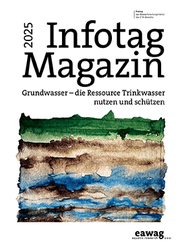
Info Day Magazine 2025: Groundwater – utilising and protecting the resource drinking water
2024
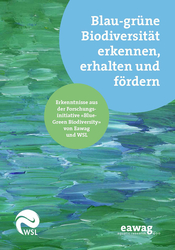
Info Day Magazine Special 2024: Recognising, conserving & promoting blue-green biodiversity
2023

Info Day Magazine 2023: Aquatic research for sustainable development
2022

Info Day Magazine 2022: Dynamics of water - new tools, new opportunities