
Art on the campus
The key features at Eawag’s two sites are undoubtedly the office and laboratory buildings as well as research facilities such as the ARA Eawag experimental hall and the experimental pond facility in Dübendorf, or the boathouse for research boats in Kastanienbaum. But if you look closely, you will discover some supporting attractions in, on and between the buildings – works of art, most of which were created as “art in construction” when erecting buildings. They enrich these science and technology-oriented locations with a creative perspective on the research topics or the history of the site and invite visitors to explore the area.
Water molecule
The most vital element at Eawag
When it came to designing the hall of the new Forum Chriesbach building in 2004, there were many different opinions. On the one hand, there were the purists who would have preferred to leave the atrium empty. Other envisioned a waterfall spanning five floors. Ultimately, it was the proposal from the team at Stauffenegger + Stutz (today Stauffenegger + Partner), that was able to meet all requirements. The huge, suspended model of a water molecule allows for multifunctional and unrestricted use of the hall in the Eawag main building. It also addresses the element of water in an unconventional yet unambiguous manner. The two hemispheres of the hydrogen molecules can be used as a communication medium thanks to integrated projectors.
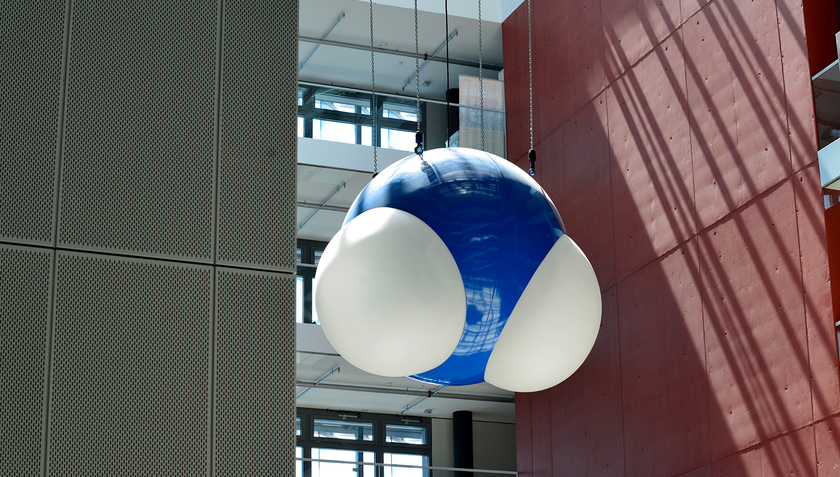
Artist/manufacturer: Stauffenegger + Stutz
Production period: 2004-2008
Location: Dübendorf, atrium of the Forum Chriesbach building
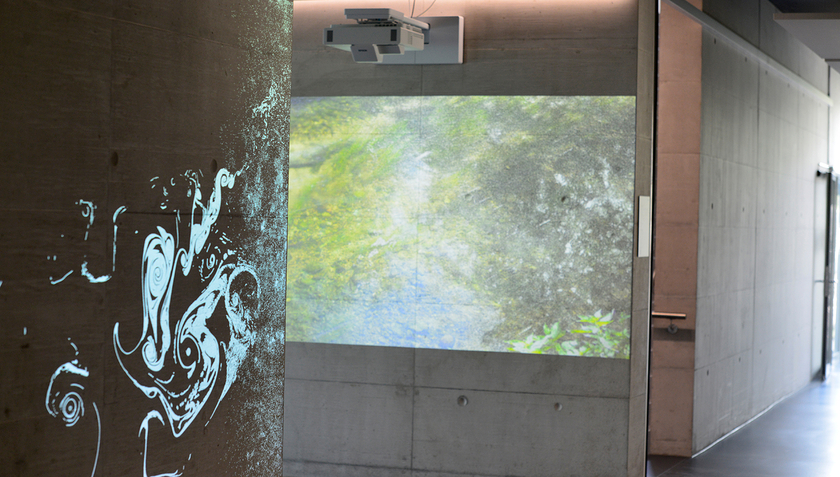
Artist/manufacturer: Ursula Damm and Felix Bonowski
Production period: 2021
Location: Dübendorf, entrance area of the FLUX building
Continuum
Two video projections that represent the Chriesbach stream
“Continuum” brings the outside to the inside, the water into the FLUX building, and the object of observation to the place of its examination. Real-time images from three different cameras overlooking the neighbouring Chriesbach stream result in two different projections on the walls of the FLUX building. They combine aspects of the visual appearance of the stream from various periods and perspectives. The black-and-white projection is a live simulation of a river. A number of parameters are used in the formulas that determine the dynamics of the simulation. These parameters are derived from real-time measurements of the physical properties of the water in the Chriesbach stream. On the right side of each projection, the visual logic of the other projection intersects, causing the colour data of the live stream and the patterns of the black-and-white simulation to overlap. The overlap makes it clear that no image and no “reality” stands alone and that there are multiple approaches to everything.
Globophonium
The visual-acoustic artwork of a former Empa employee
The colourful metal artwork was designed in the Empa workshops, which share the Dübendorf campus with Eawag. The Empa employee involved was Arthur Bechtiger, who later embarked on a career as a freelance artist under the name Giustino Corradini. In his written thoughts on the artwork, affectionately known as the “Empa Tinguely”, he noted at the time: “The Globophonium challenges us to participate with all our senses in the narrative of our generations.” And participating was meant literally: by turning the crank on the artwork itself, it is set in motion and plays music.
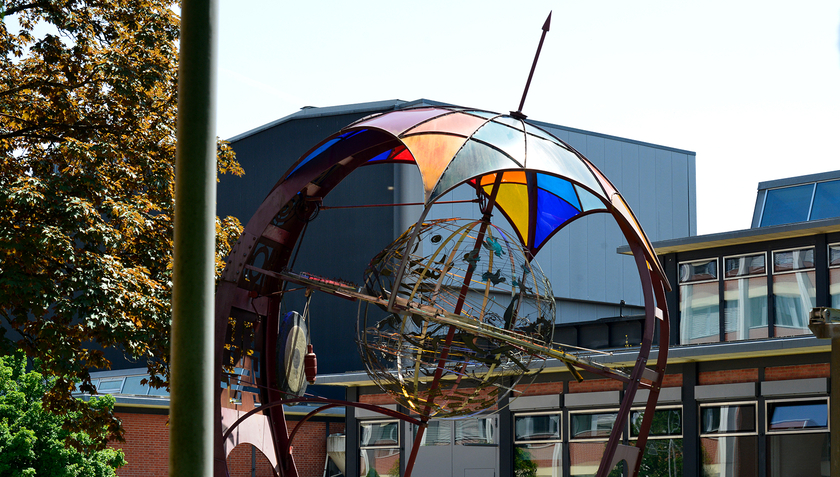
Artist/manufacturer: Arthur Bechtiger alias Giustino Corradini
Production period: 1992
Location: Dübendorf, on the green strip (“Grünes Band”) between Empa and Eawag
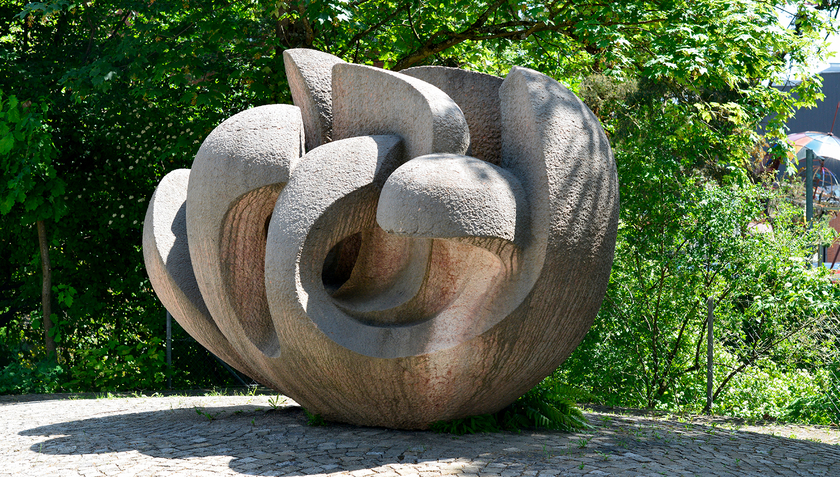
Artist/manufacturer: Robert Lienhard
Production period: 1972
Location: Dübendorf, on the square in front of the FLUX building
Nenuphar
A massive sculpture made of red Verona limestone
“Nenuphar” means water lily. And indeed, the massive stone sculpture on the cobblestone square in front of the FLUX building is reminiscent of a water lily. In around 1920, Robert Lienhard was one of the first artists in the region to turn to abstract art. However, moving Nenuphar from Italy to Switzerland proved to be quite a headache for the transporters: Lienhard had planned to do the detailed work in Switzerland after he had roughly carved the object in a quarry in Italy. But it got stuck on the Swiss-Italian border, because customs officers thought the roughly hewn block was already a work of art, until experts confirmed that it was still just a stone and not yet art.
Untitled
A sculpture bearing traces of human activity
Albert Rouiller was an artist from western Switzerland and co-founder of the Geneva Sculptors’ Professional Association. His work includes sculptures, public art, drawings and prints. Initially, Rouiller worked primarily with stone. After 1962, a phase began in which he worked with various metals. He often created sculptures such as “Untitled” on the Empa-Eawag campus from different materials – in this case, aluminium and concrete. His abstract sculptures are reminiscent of organic forms, and sometimes mechanical or surrealistic structures. Quote: “Humans leaves traces of their work on every material they touch”
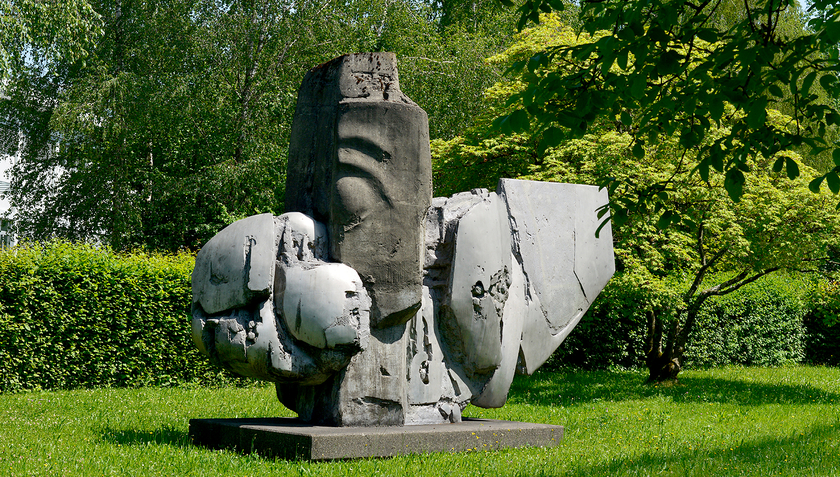
Artist/manufacturer: Albert Rouiller
Production period: 1963
Location: Dübendorf, on the green area behind the Empa Academy
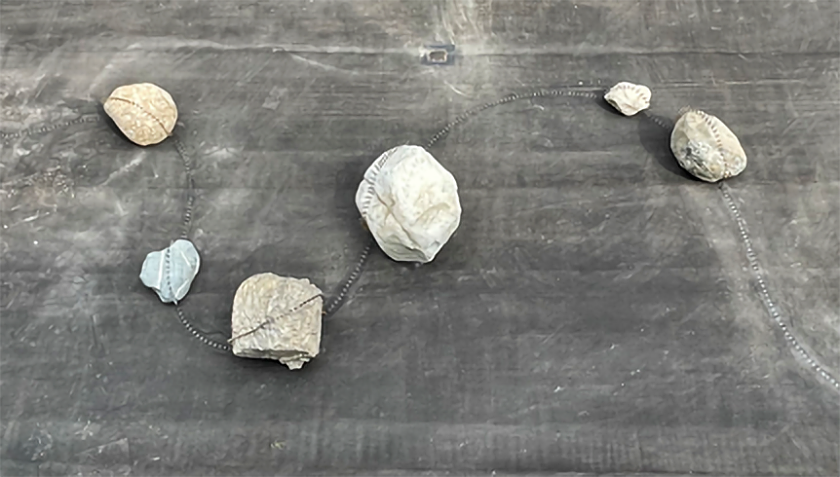
Artist/manufacturer: Julian Charrière
Production period: 2024
Location: Dübendorf, on the square between the NEST building and the Empa laboratory building
Not to Get Lost
Eight boulders and acupuncture transferred to physics
Swiss-French artist Julian Charrière combines research topics from various fields of natural science and cultural history in his works. His projects often arise from field research in remote locations such as ice fields or volcanoes. On the Empa-Eawag campus, Charrière has created an installation using boulders of different origins, sizes and compositions. The stones are connected by metal wedges, which the artist compares to “acupuncture transferred to physics”. The boulders with stone wedges stand in their material originality on the square between the NEST building and the 2024 Empa laboratory building, and they face the buildings where innovative materials and technologies are developed.
The legend of Kastanienbaum
A mural that tells the story of the place name
In 1992, local artist Marcel Nuber immortalised a scene from the legend of Kastanienbaum on the façade of the Eawag boathouse in Kastanienbaum. It recounts how the district got its name: according to this legend, a local farmer’s wife provided two Italian wanderers passing through with food and a roof over their heads. As a token of gratitude, they both gave her two chestnuts from their homeland, which the farmer’s wife grew into chestnut trees. Soon more and more of these trees appeared, so that at some point the locals named the place after them. Over the years, weather and humidity have taken their toll on the approximately 50 m2 mural. It was therefore extensively restored in 2025.
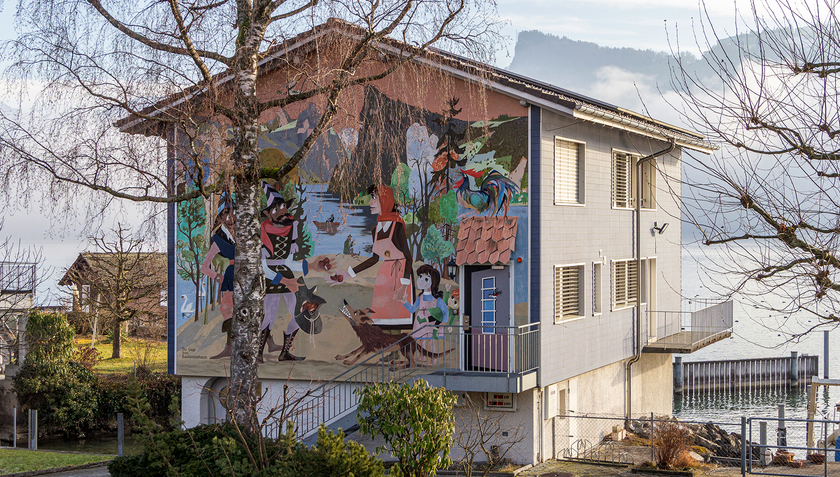
Artist/manufacturer: Marcel Nuber
Production period: 1992
Location: Kastanienbaum, boathouse