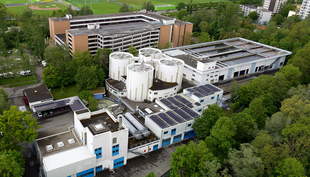
Department Process Engineering

Process Engineering

The research focus of the Process Engineering Department (ENG) ranges from current and future wastewater and drinking water treatment problems, as well as water pollution control and resource reuse. Our long-term goal is to develop sustainable concepts of the water and nutrient cycle in residential areas.

Read more

News

November 18, 2025 –

An Eawag toolbox provides an overview of technologies for decentralised sanitation systems, their respective advantages and examples of built systems.

An Eawag toolbox provides an overview of technologies for decentralised sanitation systems, their respective advantages and examples of built systems.

Read more
November 11, 2025 –

Sensorlab is celebrating. It keeps water research at the cutting edge with new measurement and automation solutions, data transmission and management.

Sensorlab is celebrating. It keeps water research at the cutting edge with new measurement and automation solutions, data transmission and management.

Read more
June 17, 2025 –

Researchers from the Ecotox Centre, Eawag and the University of Applied Sciences Northwestern Switzerland have tested combined biological and chemical online monitoring as an early warning system at a municipal wastewater...

Researchers from the Ecotox Centre, Eawag and the University of Applied Sciences Northwestern Switzerland have tested combined biological and chemical online monitoring as an early warning system at a municipal wastewater treatment plant. The system is able to detect peak loads of micropollutants in treated wastewater and identify toxic pollutants in real time. In this way, it can contribute to improving wastewater management.

Read more

Water Hub: new movie!

Publications

Hamilton, K. A., Quon, H., Ashbolt, N. J., Gurian, P. L., Reynaert, E., Haas, C. N., … Wilson, A. M. (2026). Making waves: Moving beyond the 1 in 10,000 benchmark in quantitative microbial risk assessment (QMRA) through evidence-informed risk approaches and systems decision-making. Water Research, 289, 124903 (8 pp.). doi:10.1016/j.watres.2025.124903, Institutional Repository
Pan, R., Zheng, Z. X., He, H., Zhang, T. Y., Zeng, C., Fu, Q., … Xu, B. (2026). Selective elimination of aniline contaminants induced by semiquinone radicals during peracetic acid oxidation of dihydroxybenzenes. Water Research, 289, 124840 (11 pp.). doi:10.1016/j.watres.2025.124840, Institutional Repository
Parniske, J., Froemelt, A., & Morck, T. (2026). Modelling competitive adsorption of organic micropollutants onto granular activated carbon in fixed-bed adsorbers for advanced wastewater treatment. Water Research, 288, 124631 (13 pp.). doi:10.1016/j.watres.2025.124631, Institutional Repository
Appiah-Twum, H., Van Winckel, T., Santolin, J., De Paepe, J., Hellweg, S., Larsen, T. A., … Spiller, M. (2025). Environmental impact of integrating decentralized urine treatment in the urban wastewater management system: a comparative life cycle assessment. Water Research, 282, 123630 (14 pp.). doi:10.1016/j.watres.2025.123630, Institutional Repository

Events

20.01.​2026,

Research Projects

Is a space research program, aiming to develop a bioregenerative life support system for long-term space missions and space habitations for example on Mars.
NEST building
Sustainable urban water and wastewater management applied and implemented in the modular NEST building.
Modelling of aerobic granular sludge (AGS) reactors
Many WWTPs are reaching their maximum treatment and clarification capacities, and solutions must be found to upgrade those existing plants.
Opportunities and risks of reusing treated wastewater in Switzerland
The Swiss Federal Council set the ambitious goal to reach net-zero greenhouse gas emissions by 2050.
Dynamic of greenhouse gas emissions in nutrient removing wastewater treatment plants
Systematic investigation of hybrid model approaches for the prediction of nitrous oxide emissions in biological wastewater treatment