Department Process Engineering

Software

ASIM

ASIM (Activated Sludge SIMulation Program) is a simulation program, which allows for the simulation of a variety of different biological wastewater treatment systems:
Activated sludge systems with up to 10 different reactors in series (aerobic, anoxic, anaerobic), including sludge return and internal recirculation streams, batch reactors, chemostat reactors, etc.

More information on ASIM

The program allows for the definition of process control loops (simple proportional controllers and on/off type binary controllers) and dynamic simulation of load variation (diurnal or seasonal load variation, temperature variation, variation of operational parameters such as aeration, excess sludge removal, recycle rates etc.).
Data analysis is supported by the possibility to compare observed data with simulation results in easy to use graphic support routines. Simulated results may be exported to spreadsheets for further treatment.
A menu driven user interface with context sensitive help information (by pressing F1 key), graphic support and simple file handling makes the program easy to use in class rooms, research and commercial applications.
The special feature of ASIM is that biokinetic models (the different materials or components used to characterize the wastewater and the transformation processes with relevant stoichiometry and kinetics) may be freely defined, stored and edited by the user. This allows the researcher to develop his own specific model and it allows the student to learn modelling by stepwise increase of model complexity. Simple as well as complex models are distributed together with the program in the model library. The distribution file includes copies of the Activated Sludge Model No.1 (adapted), No.2d as well as ASM3 as proposed by the IAWQ Task Group for Mathematical Modelling for Design and Operation of Biological Wastewater Treatment.

The teaching and research version of ASIM 5 is now available free of charge.

The commercial version of ASIM 5 is available for CHF 2000.

Publication

Extbase Variable Dump
array(2 items)
   publications => '9914,7304' (9 chars)
   libraryUrl => '' (0 chars)
Extbase Variable Dump
array(2 items)
   0 => Snowflake\Publications\Domain\Model\Publicationprototypepersistent entity (uid=9914, pid=124)
      originalId => protected9914 (integer)
      authors => protected'Canonica, S.; Wenk, J.; Laubscher, H.-U.' (55 chars)
      title => protected'Organic matter, light and contaminant degradation' (49 chars)
      journal => protected'Eawag News [engl. ed.]' (22 chars)
      year => protected2009 (integer)
      volume => protected66 (integer)
      issue => protected'' (0 chars)
      startpage => protected'16' (2 chars)
      otherpage => protected'18' (2 chars)
      categories => protected'' (0 chars)
      description => protected'Dissolved organic matter consists of organic compounds, mainly of natural or
         igin. Although it is only present in trace amounts in surface waters, organi
         c matter influences the fate of contaminants. Under the action of sunlight,
         it can either increase or decrease the rate at which contaminants are degrad
         ed.
' (307 chars) serialnumber => protected'1440-5289' (9 chars) doi => protected'' (0 chars) uid => protected9914 (integer) _localizedUid => protected9914 (integer)modified _languageUid => protectedNULL _versionedUid => protected9914 (integer)modified pid => protected124 (integer)
1 => Snowflake\Publications\Domain\Model\Publicationprototypepersistent entity (uid=7304, pid=124) originalId => protected7304 (integer) authors => protected'Cappelletti, F.; Fischer, M.; Sciarini, P.' (57 chars) title => protected''Let's talk cash': Cantons' interests and the reform of Swiss federalism' (72 chars) journal => protected'Regional and Federal Studies' (28 chars) year => protected2014 (integer) volume => protected24 (integer) issue => protected'1' (1 chars) startpage => protected'1' (1 chars) otherpage => protected'20' (2 chars) categories => protected'Switzerland; fiscal equalization; federalism; constitutional reform' (67 chars) description => protected'In 2004 the Swiss people accepted a new equalization scheme and a new distri
         bution of competences between the federal state and the cantons. It was argu
         ed that the reform was successful because of the capacity of veto-players to
          overcome their interests and adopt a 'problem-solving' interaction mode. We
          propose a different interpretation and argue that distributive issues and t
         he accommodation of actors' interests crucially mattered. We identify three
         mechanisms that contribute to a successful reform, i.e. package-deals, side-
         payments and the downsizing of the reform. Our in-depth, mainly qualitative
         study of both the content of the reform and related decision-making process
         supports the pertinence of these strategies for the explanation of the succe
         ssful reform of Swiss federalism.
' (793 chars) serialnumber => protected'1359-7566' (9 chars) doi => protected'10.1080/13597566.2013.808627' (28 chars) uid => protected7304 (integer) _localizedUid => protected7304 (integer)modified _languageUid => protectedNULL _versionedUid => protected7304 (integer)modified pid => protected124 (integer)
Canonica, S.; Wenk, J.; Laubscher, H.-U. (2009) Organic matter, light and contaminant degradation, Eawag News [engl. ed.], 66, 16-18, Institutional Repository
Cappelletti, F.; Fischer, M.; Sciarini, P. (2014) 'Let's talk cash': Cantons' interests and the reform of Swiss federalism, Regional and Federal Studies, 24(1), 1-20, doi:10.1080/13597566.2013.808627, Institutional Repository

Downloads

Description of the program ASIM

Dynamic Simulation Software for Biological Wastewater Treatment Modeling

ASIM 5 is a key design tool indispensable for  

  • engineering and consulting companies
  • sewage treatment plant operators
  • contractors
  • environmental authorities
  • Research and Development (R & D)
  • applications engineering  

and anyone who is engaged in construction, refurbishment, operation and optimation of biological sewage treatment plants.  

Features

  • analysis of the actual state
  • dynamic modeling
  • determination of load limits
  • simulation of specific operating conditions
  • examination of spare capacity
  • elaboration of control concepts
  • plant optimation

Biological Sewage Treatment - Marked by New Dynamics

Complex biotechnological processes are applied in current municipal domestic wastewater treatment. Dynamic simulation of critical process conditions can help to prevent operational failure or to determine load limits and spare capacity. Thus an optimal performance of these complex processes even under difficult circumstances can be ensured.

The common way of dimensioning biological wastewater treatment systems is to use static models and calculations. Rules of thumb along with calculations are applied to describe operational conditions that can be compared to real situations. However, these static models cannot cope with time variation. The effects of time-related phenomena can be described by dynamic simulation only. 

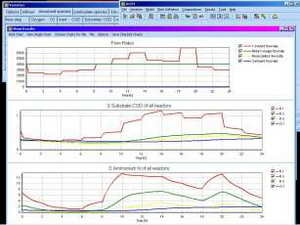
ASIM 5 allows for the dynamic simulation of diurnal load variation, peak loads, specific operating conditions, etc. The effects of such variations on any process parameter of the plant can be investigated. The simulation is based on the biokinetic model.
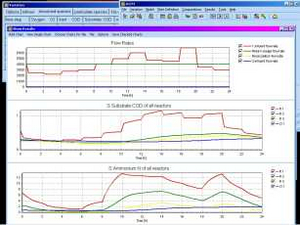
Diurnal load variation / related concentration plots for several system parameters

Both simple and complex models are issued in a model database that comes along with the program. The distributed version includes copies of the Activated Sludge Model No.1, No. 2, and No. 3, as proposed by the IAWQ Task Group for Mathematical Modeling for Design and Operation of Biological Wastewater Treatment. In addition, the model database contains versions of the IAWQ Models No. 2 and No. 3 that have been modified by EAWAG/ETH. The special feature of ASIM is that biokinetic models may be freely defined, stored and edited by the user.  

The program has been developed under the supervision of Prof. Willi Gujer at the Institute for Hydromechanics and Water Resources Management, ETH Zurich. The latest scientific insights and simulation models have been integrated in the current version ASIM 5.  

System requirements ASIM 5 English

Operating system: Windows® 95 or higher ; screen resolution: 800 x 600 VGA (opt. 1024 x 768); RAM > 32 MB; available hard-disk space approx. 5 MB

Parametrizing levels for process parameter input and data evaluation

Functional range of ASIM 5

  • dynamic simulation of load variation, process alteration and adjustment of operational parameters such as aeration, excess sludge removal, recycle rates, etc.
  • definition of control loops
  • data analysis facilitated by easy to use graphic support routines for comparison of observed data with simulation results
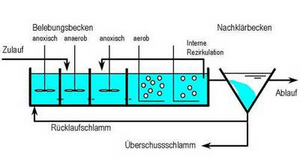
  • analysis and simulation of activated sludge systems with up to 10 different reactors in series, including biological phosphorus removal, return sludge, internal recirculation, batch reactors, chemostatic reactors, sequencing batch reactors, etc.
  • user-friendly interface on Windows® operating systems with numerous export functions
  • further treatment systems such as alternating/intermittent treatment and further biokinetic models such as anaerobic sludge digestion are currently being implemented
TEMPEST

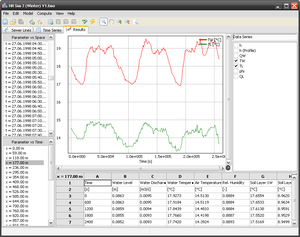
TEMPEST is a simulation program, which allows for the simulation of dynamics of the wastewater temperature in sewers in connection to heating with wastewater.

More information on TEMPEST

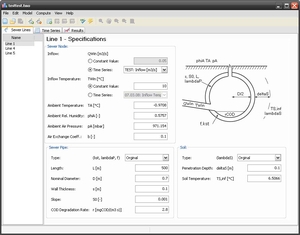
TEMPEST is an interactive simulation program for temperature estimation in sewers. It can be used to calculate the dynamics and longitudinal spatial profiles of the wastewater temperature in sewers. Applications range from simple steady state estimations of the changes of the wastewater temperature in a single sewer line to full scale simulations of the dynamics of the wastewater temperature in successive sewer lines with lateral inflows.

Program Availability

The current program version of TEMPEST is "Version 1.02". In order to receive the TEMPEST executable file, please fill out the download form.

Screenshots
References

Extbase Variable Dump
array(2 items)
   publications => '7461,12981,6098' (15 chars)
   libraryUrl => '' (0 chars)
Extbase Variable Dump
array(3 items)
   0 => Snowflake\Publications\Domain\Model\Publicationprototypepersistent entity (uid=7461, pid=124)
      originalId => protected7461 (integer)
      authors => protected'Dürrenmatt, D. J.; Wanner, O.' (45 chars)
      title => protected'A mathematical model to predict the effect of heat recovery on the wastewate
         r temperature in sewers
' (99 chars) journal => protected'Water Research' (14 chars) year => protected2014 (integer) volume => protected48 (integer) issue => protected'1' (1 chars) startpage => protected'548' (3 chars) otherpage => protected'558' (3 chars) categories => protected'sewer; modeling; wastewater temperature; heat transfer; heat recovery' (69 chars) description => protected'Raw wastewater contains considerable amounts of energy that can be recovered
          by means of a heat pump and a heat exchanger installed in the sewer. The te
         chnique is well established, and there are approximately 50 facilities in Sw
         itzerland, many of which have been successfully using this technique for yea
         rs. The planning of new facilities requires predictions of the effect of hea
         t recovery on the wastewater temperature in the sewer because altered wastew
         ater temperatures may cause problems for the biological processes used in wa
         stewater treatment plants and receiving waters. A mathematical model is pres
         ented that calculates the discharge in a sewer conduit and the spatial profi
         les and dynamics of the temperature in the wastewater, sewer headspace, pipe
         , and surrounding soil. The model was implemented in the simulation program
         TEMPEST and was used to evaluate measured time series of discharge and tempe
         ratures. It was found that the model adequately reproduces the measured data
          and that the temperature and thermal conductivity of the soil and the dista
         nce between the sewer pipe and undisturbed soil are the most sensitive model
          parameters. The temporary storage of heat in the pipe wall and the exchange
          of heat between wastewater and the pipe wall are the most important process
         es for heat transfer. The model can be used as a tool to determine the optim
         al site for heat recovery and the maximal amount of extractable heat.
' (1437 chars) serialnumber => protected'0043-1354' (9 chars) doi => protected'10.1016/j.watres.2013.10.017' (28 chars) uid => protected7461 (integer) _localizedUid => protected7461 (integer)modified _languageUid => protectedNULL _versionedUid => protected7461 (integer)modified pid => protected124 (integer)
1 => Snowflake\Publications\Domain\Model\Publicationprototypepersistent entity (uid=12981, pid=124) originalId => protected12981 (integer) authors => protected'Dürrenmatt, D. J.' (28 chars) title => protected'Berechnung des Verlaufs der Abwassertemperatur im Kanalisationsrohr' (67 chars) journal => protected'' (0 chars) year => protected2006 (integer) volume => protected0 (integer) issue => protected'' (0 chars) startpage => protected'91 p' (9 chars) otherpage => protected'' (0 chars) categories => protected'' (0 chars) description => protected'Ungereinigtes Abwasser steckt voller Energie. Diese Energie kann durch Wärm
         etauscher und Wärmepumpen zurückgewonnen und zur Raumheizung und Wassererw
         ärmung eingesetzt werden. Die optimale Standortwahl und die Auslegung der W
         ärmerückgewinnungsanlage hängt dabei von mehreren Faktoren ab. So ist die
          Nähe zum Verbraucher wichtig. Ein weiterer Faktor, der beachtet werden mus
         s, ist, dass der Volumenstrom des Abwassers im Allgemeinen mit dem Fliessweg
          in der Kanalisation zunimmt, die Temperatur aber absinkt. Zudem muss beacht
         et werden, dass die minimale Temperatur und die maximale Temperaturabsenkung
          im Zulauf der Abwasserreinigungsanlage vorgeschrieben sind, damit eine rele
         vante Beeinträchtigung der Reinigungsleistung durch die Abkühlung des Abwa
         ssers infolge Wärmeentnahme ausgeschlossen werden kann. Unter Einhaltung de
         r genannten Rahmenbedingungen ist zur optimalen Planung der Wärmerückgewin
         nungsanlage die Kenntnis des Verlaufs der Abwassertemperatur von der Wärmer
         ückgewinnungsanlage bis zur Abwasserreinigungsanlage unabdingbar.<br /> In
         der vorliegenden Arbeit wird ein Modell präsentiert, das die zeitliche und
         räumliche Veränderung der Temperaturen von Abwasser und Kanalluft sowie de
         r Wasserdampfbeladung in einem Kanalisationssystem beschreiben kann. Das Mod
         ell wurde so ausgelegt, dass Abschätzungen bereits mit gängigenMessgrösse
         n, wie Temperatur und Durchfluss sowie der Kenntnis der Topographie des Kana
         lisationssystems, durchgeführt werden können und auf komplizierte Messkamp
         agnen verzichtet werden kann.<br /> So kann die Luftströmung in der Kanalis
         ation aus der Abwasserströmung berechnet werden, wobei der Luftaustausch in
          jedem zur Atmosphäre offenen Schacht und Bauwerk separat gesteuert werden
         kann. Im Weiteren wurde ein Konzept entwickelt, um Kanalisationssysteme abzu
         bilden, die sich aus verschiedenen Leitungen, Schächten und anderen Bauwerk
         en zusammensetzen.<br /> Ein praxistaugliches Programm mit benutzerfreundlic
         her Excel-Oberfläche, d...
' (3001 chars) serialnumber => protected'' (0 chars) doi => protected'' (0 chars) uid => protected12981 (integer) _localizedUid => protected12981 (integer)modified _languageUid => protectedNULL _versionedUid => protected12981 (integer)modified pid => protected124 (integer)
2 => Snowflake\Publications\Domain\Model\Publicationprototypepersistent entity (uid=6098, pid=124) originalId => protected6098 (integer) authors => protected'Dürrenmatt,&nbsp;D.&nbsp;J.; Wanner,&nbsp;O.' (45 chars) title => protected'Simulation of the wastewater temperature in sewers with TEMPEST' (63 chars) journal => protected'Water Science and Technology' (28 chars) year => protected2008 (integer) volume => protected57 (integer) issue => protected'11' (2 chars) startpage => protected'1809' (4 chars) otherpage => protected'1815' (4 chars) categories => protected'heat recovery; sewer; simulation; software; temperature; TEMPEST; wastewater' (76 chars) description => protected'TEMPEST is a new interactive simulation program for the estimation of the wa
         stewater temperature in sewers. Intuitive graphical user interfaces assist t
         he user in managing data, performing calculations and plotting results. The
         program calculates the dynamics and longitudinal spatial profiles of the was
         tewater temperature in sewer lines. Interactions between wastewater, sewer a
         ir and surrounding soil are modeled in TEMPEST by mass balance equations, ra
         te expressions found in the literature and a new empirical model of the airf
         low in the sewer. TEMPEST was developed as a tool which can be applied in pr
         actice, i.e., it requires as few input data as possible. These data include
         the upstream wastewater discharge and temperature, geometric and hydraulic p
         arameters of the sewer, material properties of the sewer pipe and surroundin
         g soil, ambient conditions, and estimates of the capacity of openings for ai
         r exchange between sewer and environment. Based on a case study it is shown
         how TEMPEST can be applied to estimate the decrease of the downstream wastew
         ater temperature caused by heat recovery from the sewer. Because the efficie
         ncy of nitrification strongly depends on the wastewater temperature, this ap
         plication is of practical relevance for situations in which the sewer ends a
         t a nitrifying wastewater treatment plant.
' (1334 chars) serialnumber => protected'0273-1223' (9 chars) doi => protected'10.2166/wst.2008.291' (20 chars) uid => protected6098 (integer) _localizedUid => protected6098 (integer)modified _languageUid => protectedNULL _versionedUid => protected6098 (integer)modified pid => protected124 (integer)
Dürrenmatt, D. J.; Wanner, O. (2014) A mathematical model to predict the effect of heat recovery on the wastewater temperature in sewers, Water Research, 48(1), 548-558, doi:10.1016/j.watres.2013.10.017, Institutional Repository
Dürrenmatt, D. J. (2006) Berechnung des Verlaufs der Abwassertemperatur im Kanalisationsrohr, 91 p, Institutional Repository
Dürrenmatt, D. J.; Wanner, O. (2008) Simulation of the wastewater temperature in sewers with TEMPEST, Water Science and Technology, 57(11), 1809-1815, doi:10.2166/wst.2008.291, Institutional Repository

PeePyPoo and BioChemicalTreatment

PeePyPoo and BioChemicalTreatment are open-source software libraries for simulation of water systems in Python, resp. Julia. They allow to model and simulate combinations of reactors, processes, clarifiers together with the associated control loops.

For further informations project page "PeePyPoo / BioChemicalTreatment"

PeePyPoo: datinfo.gitlab.io/PeePyPoo

BioChemicalTreatment: datinfo.gitlab.io/BioChemicalTreatment.jl/dev/