Archive News

March 30, 2026

March 30, 2026The sanitation objective of Sustainable Development Goal 6, sanitation for all, is off-track and far from being completed by 2030. Vermifiltration could help address this gap: The nature-based sanitation management system shows increasing promise globally because of its low cost. Researchers at Eawag’s Sandec department visited vermifilter installations in India and Switzerland to examine how local differences influence their optimal design.

Read more
March 13, 2026

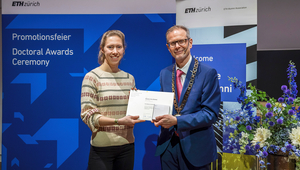
March 13, 2026Using isotope markers to break down food webs and track changes in them, as well as tracing the pathways and accumulation of pollutants in aquatic organisms – the Otto Jaag Water Protection Prize was awarded in 2025 for two exciting and highly topical doctoral theses.

Read more
February 24, 2026

February 24, 2026Estimates as to how much more electricity could be generated from hydropower in the absence of residual flow requirements vary widely, and they have previously been based on inadequate data. A team of researchers from WSL, the University of Bern and Eawag has now used a new database and simulations to show that, between now and 2050, the additional decrease in production due to residual flow requirements – amounting to barely 2% – is likely to be much lower than feared.

Read more
February 10, 2026

February 10, 2026An investigation in the canton of Zurich has shown that certain rare earth elements can enter bodies of water via wastewater treatment plants in concentrations that pose a risk to aquatic organisms. These elements are gadolinium, which comes from contrast agents used in healthcare facilities, as well as lanthanum and cerium, which are used in a number of wastewater treatment plants to remove phosphorus.

Read more
January 27, 2026

January 27, 2026WSL and Eawag join forces: the new WSL-Eawag Biodiversity Center links research on biodiversity on land and in water.

Read more
January 23, 2026

January 23, 2026To mark the 2026 World Economic Forum (WEF), the ETH Domain presented highlights from its research, demonstrating how artificial intelligence is paving the way for greater sustainability. Policymakers and business leaders learned about practical AI applications for the environment and society.

Read more
January 23, 2026

January 23, 2026Aquatic ecosystems are fragile. But just how fragile they are has been revealed in a new study by the Swiss Federal Institute of Aquatic Science and Technology (Eawag) and the University of Zurich. Researchers investigated how climate change is affecting amphipods by shifting the timing of leaf fall in autumn. These creatures feed on leaves and, as the base of the food chain, have an impact on the entire ecosystem.

Read more
January 15, 2026

January 15, 2026The insecticide fipronil has been detected in Swiss waterways in concentrations that are critical for aquatic life. It has not been permitted for use as a plant protection product for many years. A study involving Eawag now shows that the most likely source of contamination is flea and tick repellents for pets.

Read more
December 8, 2025

December 8, 2025A global shift to agriculture with no or fewer pesticides would have long-term ecological and economic benefits, according to a new study.

Read more
November 28, 2025

November 28, 2025James Runnalls, software engineer at the aquatic research institute Eawag, receives the National Prize for Open Research Data (ORD) for developing the interactive online platform alplakes for monitoring and forecasting alpine lakes.

Read more