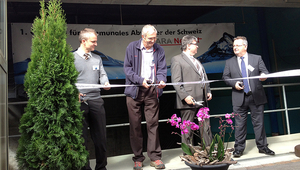
July 24, 2014Chemistry professor Andreas Fath from the Furtwangen University in Baden-Württemberg is looking for money for new analysis equipment and for water research at his institute. From 28 July to 24 August he will swim the entire Rhine for this purpose, from the mountains in Graubünden to Rotterdam, including Lake Constance!
May 8, 2014Ground breaking research by an international team of scientists has resulted in greater understanding of the effects of pesticides on aquatic invertebrates such as shrimps and snails.
April 14, 2014In the summer 2013, Eawag and the Swiss Federal Institute for NBC-Protection (LABORATORY SPIEZ) have withdrawn sediment cores from Lake Biel and examined the sediment layers for radioactivity.
April 4, 2014100 of the more than 700 Swiss wastewater treatment plants can be upgraded for the elimination of micropollutants, thanks to the positive decision of the Federal council.
March 5, 2014Swiss watercourses contain a whole cocktail of pesticides. Of the 300 or so permitted and detectable active substances, over 100 have been discovered in water samples taken during an extensive screening process.
February 25, 2014It has long been known that, in the form of free ions, silver particles can be highly toxic to aquatic organisms. Yet to this day, there is a lack of detailed knowledge about the doses required to trigger a response and how the organisms deal with this kind of stress.
January 8, 2014Natural wetlands are well-known for their large share in global methane emissions via biological processes but until now it has not been investigated if wetlands could also be important emitters of trace elements.
September 11, 2013The 6.5 million inhabitants of Vietnam’s capital, Hanoi, are facing a growing threat: as more and more water is pumped from a deep – previously uncontaminated – aquifer, arsenic‑laden water from shallow sediments is advancing towards the city’s wells..
September 3, 2013Dübendorf/Leipzig. Researchers at Eawag, the Swiss aquatic research institute and colleagues from Helmholtz Centre for Environmental Research (UFZ), have discovered a protein which transports chemicals out of the embryo of the zebrafish and in this way protects the embryo against toxic substances.