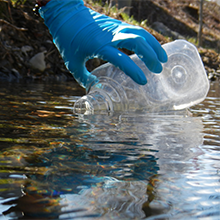
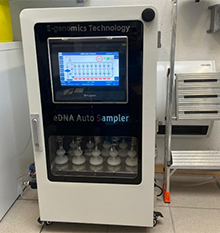
Alle Organismen hinterlassen DNA in ihrer Umgebung. Diese sogenannte Umwelt-DNA (eDNA) kann gesammelt und extrahiert werden. Mithilfe molekularer Verfahren sequenzieren wir eDNA, um Informationen über die Biodiversität zu gewinnen – von Mikroben bis zu Wirbeltieren – und so Organismengemeinschaften und gesamte Nahrungsnetze in aquatischen Ökosystemen zu charakterisieren.
Unsere Arbeit umfasst ein breites Spektrum der eDNA-Forschung, von der landesweiten Erkennung invasiver Arten über den Aufbau von Interaktionsnetzwerken bis hin zur Vorhersage der Biodiversität in Flussnetzen und der Erforschung schwer zu untersuchender Ökosysteme wie Grundwasser. Wir untersuchen grundlegende Fragen der eDNA, indem wir die Herkunft, den Transport und den Verbleib von DNA in großen Flussnetzen modellieren. Darüber hinaus integrieren wir neue Technologien für ein zukunftsfähiges Hochfrequenz-Biomonitoring, das Einblicke in die Dynamik der Biodiversität und die Struktur von Gemeinschaften liefert. Wir verknüpfen unsere Forschung eng mit bestehenden nationalen und kantonalen Programmen und setzen eDNA-Biodiversitätsdaten in Beziehung zu Chemie und Hydrologie.
Neben unseren gemeinsamen Forschungsinteressen spielen wir eine Schlüsselrolle bei der Entwicklung und Endanwenderakzeptanz von eDNA-Techniken. Durch die Zusammenarbeit auf lokaler, nationaler und internationaler Ebene haben wir zu nationalen Richtlinien und methodischen Handbüchern zur DNA beigetragen und Workshops durchgeführt, um Anleitung und Unterstützung bei der Implementierung von eDNA für Biomonitoring zu bieten.
Key Publications
Altermatt F, Couton, M, Carraro L, Keck F, Lawson-Handley L, Leese F, Zhang X, Zhang Y & Blackman RC (2025). Utilising aquatic environmental DNA to address global biodiversity targets. Nature Reviews Biodiversity 1: 332–346. https://doi.org/10.1038/s44358-025-00044-x
array(4 items)0 => Snowflake\Publications\Domain\Model\Publicationprototypepersistent entity (uid=32838, pid=124)originalId => protected32838 (integer)
authors => protected'Blackman, R.; Couton, M.; Keck, F.; Kirschner, D.; Carra ro, L.; Cereghetti, E.; Perrelet, K.; Bossart, R.; Brant schen, J.; Zhang, Y.; Altermatt, F.' (202 chars)
title => protected'Environmental DNA: the next chapter' (35 chars)
journal => protected'Molecular Ecology' (17 chars)
year => protected2024 (integer)
volume => protected33 (integer)
issue => protected'11' (2 chars)
startpage => protected'e17355 (17 pp.)' (15 chars)
otherpage => protected'' (0 chars)
categories => protected'biomonitoring; eDNA behaviour; primers; quantification; reference database; sampling' (84 chars)
description => protected'Molecular tools are an indispensable part of ecology and biodiversity scienc es and implemented across all biomes. About a decade ago, the use and implem entation of environmental DNA (eDNA) to detect biodiversity signals extracte d from environmental samples opened new avenues of research. Initial eDNA re search focused on understanding population dynamics of target species. Its s cope thereafter broadened, uncovering previously unrecorded biodiversity via metabarcoding in both well-studied and understudied ecosystems across all t axonomic groups. The application of eDNA rapidly became an established part of biodiversity research, and a research field by its own. Here, we revisit key expectations made in a land-mark special issue on eDNA in Molecular Ecol ogy in 2012 to frame the development in six key areas: (1) sample collection , (2) primer development, (3) biomonitoring, (4) quantification, (5) behavio ur of DNA in the environment and (6) reference database development. We pinp oint the success of eDNA, yet also discuss shortfalls and expectations not m et, highlighting areas of research priority and identify the unexpected deve lopments. In parallel, our retrospective couples a screening of the peer-rev iewed literature with a survey of eDNA users including academics, end-users and commercial providers, in which we address the priority areas to focus re search efforts to advance the field of eDNA. With the rapid and ever-increas ing pace of new technical advances, the future of eDNA looks bright, yet suc cessful applications and best practices must become more interdisciplinary t o reach its full potential. Our retrospect gives the tools and expectations towards concretely moving the field forward.' (1716 chars)
serialnumber => protected'0962-1083' (9 chars)
doi => protected'10.1111/mec.17355' (17 chars)
uid => protected32838 (integer)
_localizedUid => protected32838 (integer)modified_languageUid => protectedNULL
_versionedUid => protected32838 (integer)modifiedpid => protected124 (integer)1 => Snowflake\Publications\Domain\Model\Publicationprototypepersistent entity (uid=24714, pid=124)originalId => protected24714 (integer)
authors => protected'Blackman, R. C.; Ho, H. C.; Walser, J. C.; Alt ermatt, F.' (91 chars)
title => protected'Spatio-temporal patterns of multi-trophic biodiversity and food-web characte ristics uncovered across a river catchment using environmental DNA' (142 chars)
journal => protected'Communications Biology' (22 chars)
year => protected2022 (integer)
volume => protected5 (integer)
issue => protected'' (0 chars)
startpage => protected'259 (11 pp.)' (12 chars)
otherpage => protected'' (0 chars)
categories => protected'' (0 chars)
description => protected'Accurate characterisation of ecological communities with respect to their bi odiversity and food-web structure is essential for conservation. However, co mbined empirical study of biodiversity and multi-trophic food webs at a larg e spatial and temporal resolution has been prohibited by the lack of appropr iate access to such data from natural systems. Here, we assessed biodiversit y and food-web characteristics across a 700 km2 riverine network over season s using environmental DNA. We found contrasting biodiversity patterns betwee n major taxonomic groups. Local richness showed statistically significant, s eason-dependent increases and decreases towards downstream location within t he catchment for fish and bacteria, respectively. Meanwhile, invertebrate ri chness remained spatially unchanged but varied across seasons. The structure of local food webs, such as link density and nestedness, also varied across space and time. However, these patterns did not necessarily mirror those ob served for biodiversity and functional feeding characteristics. Our results suggest that biodiversity patterns and food-web dynamics are not directly sc alable to each other even at the same spatial and temporal scales. In order to conserve species diversity as well as the functional trophic integrity of communities, patterns of biodiversity and food-web characteristics must thu s be jointly studied.' (1389 chars)
serialnumber => protected'2399-3642' (9 chars)
doi => protected'10.1038/s42003-022-03216-z' (26 chars)
uid => protected24714 (integer)
_localizedUid => protected24714 (integer)modified_languageUid => protectedNULL
_versionedUid => protected24714 (integer)modifiedpid => protected124 (integer)2 => Snowflake\Publications\Domain\Model\Publicationprototypepersistent entity (uid=21047, pid=124)originalId => protected21047 (integer)
authors => protected'Carraro, L.; Mächler, E.; Wüthrich, R.; Altermatt, F.' (75 chars)
title => protected'Environmental DNA allows upscaling spatial patterns of biodiversity in fresh water ecosystems' (92 chars)
journal => protected'Nature Communications' (21 chars)
year => protected2020 (integer)
volume => protected11 (integer)
issue => protected'' (0 chars)
startpage => protected'3585 (12 pp.)' (13 chars)
otherpage => protected'' (0 chars)
categories => protected'' (0 chars)
description => protected'The alarming declines of freshwater biodiversity call for efficient biomonit oring at fine spatiotemporal scales, such that conservation measures be grou nded upon accurate biodiversity data. Here, we show that combining environme ntal DNA (eDNA) extracted from stream water samples with models based on hyd rological first principles allows upscaling biodiversity estimates for aquat ic insects at very high spatial resolution. Our model decouples the diverse upstream contributions to the eDNA data, enabling the reconstruction of taxa distribution patterns. Across a 740-km<sup>2</sup> basin, we obtain a space -filling biodiversity prediction at a grain size resolution of 1-km long str eam sections. The model’s accuracy in matching direct observations of aqua tic insects' local occurrence ranges between 57-100%. Our results demonstrat e how eDNA can be used for high-resolution biodiversity assessments in river s with minimal prior knowledge of the system. Our approach allows identifica tion of biodiversity hotspots that could be otherwise overlooked, enabling i mplementation of focused conservation strategies.' (1113 chars)
serialnumber => protected'' (0 chars)
doi => protected'10.1038/s41467-020-17337-8' (26 chars)
uid => protected21047 (integer)
_localizedUid => protected21047 (integer)modified_languageUid => protectedNULL
_versionedUid => protected21047 (integer)modifiedpid => protected124 (integer)3 => Snowflake\Publications\Domain\Model\Publicationprototypepersistent entity (uid=24429, pid=124)originalId => protected24429 (integer)
authors => protected'Keck, F.; Blackman, R. C.; Bossart, R.; Brantschen,  ;J.; Couton, M.; Hürlemann, S.; Kirschner, D.; Locher, N.; Zhang, H.; Altermatt, F.' (190 chars)
title => protected'Meta-analysis shows both congruence and complementarity of DNA and eDNA meta barcoding to traditional methods for biological community assessment' (144 chars)
journal => protected'Molecular Ecology' (17 chars)
year => protected2022 (integer)
volume => protected31 (integer)
issue => protected'6' (1 chars)
startpage => protected'1820' (4 chars)
otherpage => protected'1835' (4 chars)
categories => protected'diversity assessment; DNA; fish; invertebrates; meta-analysis; metabarcoding ; microorganisms' (92 chars)
description => protected'DNA metabarcoding is increasingly used for the assessment of aquatic communi ties, and numerous studies have investigated the consistency of this techniq ue with traditional morpho-taxonomic approaches. These individual studies ha ve used DNA metabarcoding to assess diversity and community structure of aqu atic organisms both in marine and freshwater systems globally over the last decade. However, a systematic analysis of the comparability and effectivenes s of DNA-based community assessment across all of these studies has hitherto been lacking. Here, we performed the first meta-analysis of available studi es comparing traditional methods and DNA metabarcoding to measure and assess biological diversity of key aquatic groups, including plankton, microphytob entos, macroinvertebrates, and fish. Across 215 data sets, we found that DNA metabarcoding provides richness estimates that are globally consistent to t hose obtained using traditional methods, both at local and regional scale. D NA metabarcoding also generates species inventories that are highly congruen t with traditional methods for fish. Contrastingly, species inventories of p lankton, microphytobenthos and macroinvertebrates obtained by DNA metabarcod ing showed pronounced differences to traditional methods, missing some taxa but at the same time detecting otherwise overseen diversity. The method is g enerally sufficiently advanced to study the composition of fish communities and replace more invasive traditional methods. For smaller organisms, like m acroinvertebrates, plankton and microphytobenthos, DNA metabarcoding may con tinue to give complementary rather than identical estimates compared to trad itional approaches. Systematic and comparable data collection will increase the understanding of different aspects of this complementarity, and increase the effectiveness of the method and adequate interpretation of the results.' (1900 chars)
serialnumber => protected'0962-1083' (9 chars)
doi => protected'10.1111/mec.16364' (17 chars)
uid => protected24429 (integer)
_localizedUid => protected24429 (integer)modified_languageUid => protectedNULL
_versionedUid => protected24429 (integer)modifiedpid => protected124 (integer)
Environmental DNA: the next chapter
Molecular tools are an indispensable part of ecology and biodiversity sciences and implemented across all biomes. About a decade ago, the use and implementation of environmental DNA (eDNA) to detect biodiversity signals extracted from environmental samples opened new avenues of research. Initial eDNA research focused on understanding population dynamics of target species. Its scope thereafter broadened, uncovering previously unrecorded biodiversity via metabarcoding in both well-studied and understudied ecosystems across all taxonomic groups. The application of eDNA rapidly became an established part of biodiversity research, and a research field by its own. Here, we revisit key expectations made in a land-mark special issue on eDNA in Molecular Ecology in 2012 to frame the development in six key areas: (1) sample collection, (2) primer development, (3) biomonitoring, (4) quantification, (5) behaviour of DNA in the environment and (6) reference database development. We pinpoint the success of eDNA, yet also discuss shortfalls and expectations not met, highlighting areas of research priority and identify the unexpected developments. In parallel, our retrospective couples a screening of the peer-reviewed literature with a survey of eDNA users including academics, end-users and commercial providers, in which we address the priority areas to focus research efforts to advance the field of eDNA. With the rapid and ever-increasing pace of new technical advances, the future of eDNA looks bright, yet successful applications and best practices must become more interdisciplinary to reach its full potential. Our retrospect gives the tools and expectations towards concretely moving the field forward.
Blackman, R.; Couton, M.; Keck, F.; Kirschner, D.; Carraro, L.; Cereghetti, E.; Perrelet, K.; Bossart, R.; Brantschen, J.; Zhang, Y.; Altermatt, F. (2024) Environmental DNA: the next chapter, Molecular Ecology, 33(11), e17355 (17 pp.), doi:10.1111/mec.17355, Institutional Repository
Spatio-temporal patterns of multi-trophic biodiversity and food-web characteristics uncovered across a river catchment using environmental DNA
Accurate characterisation of ecological communities with respect to their biodiversity and food-web structure is essential for conservation. However, combined empirical study of biodiversity and multi-trophic food webs at a large spatial and temporal resolution has been prohibited by the lack of appropriate access to such data from natural systems. Here, we assessed biodiversity and food-web characteristics across a 700 km2 riverine network over seasons using environmental DNA. We found contrasting biodiversity patterns between major taxonomic groups. Local richness showed statistically significant, season-dependent increases and decreases towards downstream location within the catchment for fish and bacteria, respectively. Meanwhile, invertebrate richness remained spatially unchanged but varied across seasons. The structure of local food webs, such as link density and nestedness, also varied across space and time. However, these patterns did not necessarily mirror those observed for biodiversity and functional feeding characteristics. Our results suggest that biodiversity patterns and food-web dynamics are not directly scalable to each other even at the same spatial and temporal scales. In order to conserve species diversity as well as the functional trophic integrity of communities, patterns of biodiversity and food-web characteristics must thus be jointly studied.
Blackman, R. C.; Ho, H. C.; Walser, J. C.; Altermatt, F. (2022) Spatio-temporal patterns of multi-trophic biodiversity and food-web characteristics uncovered across a river catchment using environmental DNA, Communications Biology, 5, 259 (11 pp.), doi:10.1038/s42003-022-03216-z, Institutional Repository
Environmental DNA allows upscaling spatial patterns of biodiversity in freshwater ecosystems
The alarming declines of freshwater biodiversity call for efficient biomonitoring at fine spatiotemporal scales, such that conservation measures be grounded upon accurate biodiversity data. Here, we show that combining environmental DNA (eDNA) extracted from stream water samples with models based on hydrological first principles allows upscaling biodiversity estimates for aquatic insects at very high spatial resolution. Our model decouples the diverse upstream contributions to the eDNA data, enabling the reconstruction of taxa distribution patterns. Across a 740-km2 basin, we obtain a space-filling biodiversity prediction at a grain size resolution of 1-km long stream sections. The model’s accuracy in matching direct observations of aquatic insects' local occurrence ranges between 57-100%. Our results demonstrate how eDNA can be used for high-resolution biodiversity assessments in rivers with minimal prior knowledge of the system. Our approach allows identification of biodiversity hotspots that could be otherwise overlooked, enabling implementation of focused conservation strategies.
Carraro, L.; Mächler, E.; Wüthrich, R.; Altermatt, F. (2020) Environmental DNA allows upscaling spatial patterns of biodiversity in freshwater ecosystems, Nature Communications, 11, 3585 (12 pp.), doi:10.1038/s41467-020-17337-8, Institutional Repository
Meta-analysis shows both congruence and complementarity of DNA and eDNA metabarcoding to traditional methods for biological community assessment
DNA metabarcoding is increasingly used for the assessment of aquatic communities, and numerous studies have investigated the consistency of this technique with traditional morpho-taxonomic approaches. These individual studies have used DNA metabarcoding to assess diversity and community structure of aquatic organisms both in marine and freshwater systems globally over the last decade. However, a systematic analysis of the comparability and effectiveness of DNA-based community assessment across all of these studies has hitherto been lacking. Here, we performed the first meta-analysis of available studies comparing traditional methods and DNA metabarcoding to measure and assess biological diversity of key aquatic groups, including plankton, microphytobentos, macroinvertebrates, and fish. Across 215 data sets, we found that DNA metabarcoding provides richness estimates that are globally consistent to those obtained using traditional methods, both at local and regional scale. DNA metabarcoding also generates species inventories that are highly congruent with traditional methods for fish. Contrastingly, species inventories of plankton, microphytobenthos and macroinvertebrates obtained by DNA metabarcoding showed pronounced differences to traditional methods, missing some taxa but at the same time detecting otherwise overseen diversity. The method is generally sufficiently advanced to study the composition of fish communities and replace more invasive traditional methods. For smaller organisms, like macroinvertebrates, plankton and microphytobenthos, DNA metabarcoding may continue to give complementary rather than identical estimates compared to traditional approaches. Systematic and comparable data collection will increase the understanding of different aspects of this complementarity, and increase the effectiveness of the method and adequate interpretation of the results.
Keck, F.; Blackman, R. C.; Bossart, R.; Brantschen, J.; Couton, M.; Hürlemann, S.; Kirschner, D.; Locher, N.; Zhang, H.; Altermatt, F. (2022) Meta-analysis shows both congruence and complementarity of DNA and eDNA metabarcoding to traditional methods for biological community assessment, Molecular Ecology, 31(6), 1820-1835, doi:10.1111/mec.16364, Institutional Repository