COMIX: Chancen und Herausforderungen modularer Wasserinfrastrukturen für die Schweiz
Das Comix-Projekt untersuchte die Chancen und Risiken modularer lnfrastruktursysteme für die Schweizer Wirtschaft und Gesellschaft. Die Frage wurde am Beispiel der Siedlungswasserwirtschaft durchgespielt.
Das Comix Projekt setzte sich zum Ziel die Chancen und Risiken modularer Technologien für die Gestaltung einer nachhaltigen Schweizer Wirtschaft zu erörtern, und wie diese die entsprechenden Infrastruktursektoren fundamental verändern könnten. Die Forschung fokussierte vor allem auf die Schweizerische Siedlungswasserwirtschaft, und die darin organisierten Industriebetriebe, Abwasserreinigungsorganisationen, Fachverbände und Regulatoren. Die Siedlungswasserwirtschaft ist besonders gut geeignet, diese Chancen und Risiken zu untersuchen, da sie starke Pfadabhängigkeiten aufweist und global eine zentral wichtige Rolle spielt, insbesondere zur nachhaltigen Entwicklung im Globalen Süden.
Die Siedlungswasserwirtschaft der Schweiz ist mit ihren zentralen Kläranlagen sehr gut vorbereitet, um die heutigen Probleme zu bewältigen. Es bleibt jedoch offen, ob dies auch in Zukunft noch der Fall sein wird angesichts der steigenden Herausforderungen etwa durch den Klimawandel, der mit steigender Häufigkeit extremer Hochwasser oder langer Dürreperioden, die heutigen Systeme an ihre Leistungsfähigkeit bringen könnte. Die zentrale Forschungsfrage des Comix-Projektes lautete deshalb, inwiefern modulare Technologien als Chance zur Bewältigung künftiger Herausforderungen der Siedlungswasserwirtschaft genutzt werden könnten, oder ob sie die heutigen Strukturen eher überfordern würden. Weiter zugespitzt formuliert: Kann die frühe Auseinandersetzung mit modularen Wassertechnologien sogar first mover advantages (Pioniervorteile) für die Schweizer Akteure abwerfen?
Projektstruktur
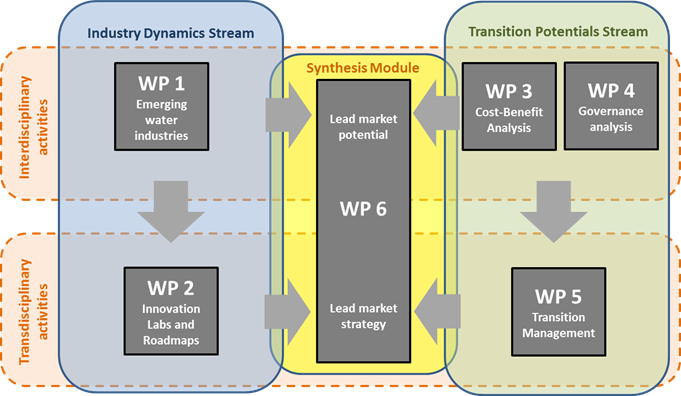
Das Projekt war in zwei Aktivitätsbereiche unterteilt, verbunden durch ein Synthesemodul. Der erste Bereich (blaue Säule) untersuchte die Chancen, die modulare Wassertechnologien für Schweizer Firmen darstellen. Dazu untersuchten wir im ersten Arbeitspaket (WP1) globale Industriedynamiken bei modularen Wassertechnologien, sowie die Position die Schweizer Akteure darin einnehmen. Wir fragten insbesondere in welchen Weltregionen der Wechsel von zentralen zu modularen Systemen besonders wahrscheinlich wäre, respektive wo wir ein erhöhtes Interesse für experimentelle Ansätze mit diesen Technologien erkennen können. Die Schweizer Initiativen untersuchten wir dahingehend, wie unterschiedliche Akteure sich in nationalen und internationalen Netzwerken bewegen und ob und wie sie dort Führungsrollen übernehmen. In einem zweiten Arbeitspaket (WP2) diskutierten wir die beobachteten globalen Trends mit privaten Akteuren, die sich in diesem Bereich engagieren, um mögliche erfolgreiche Strategien für die Schweizer Industrie zu bestimmen. Leider konnte dieser Teil wegen Covid nur eingeschränkt umgesetzt werden.
Der zweite Aktivitätsbereich (grün), befasste sich mit den Chancen und Herausforderungen, die modulare Systeme für die Betreiber und Regulatoren der Schweizer Siedlungswassersysteme darstellen. Zu diesem Zweck führte das Projektteam eine detaillierte Kostenanalyse durch (WP3) für den Übergang von einem weitgehend zentralen Abwassersystem hin zu einem hybriden mit einem kostenoptimalen Anteil künftiger modularer Systeme. Diese Abwägungen wurden auf der Basis realer Infrastrukturdaten in zwei Schweizer Gemeinden (Köniz und Schächental) durchgerechnet und es konnte gezeigt werden, dass unter realistischen Annahmen mit einem relativ bedeutenden Zuwachs (>20%) bis hin zu einem vollständigen (100%) Übergang zu modularen Systemen gerechnet werden muss. In einem weiteren Arbeitspaket (WP4) untersuchte das Projektteam mit welchen Betriebs- und Regulierungsansätzen eine grosse Anzahl modularer Systeme koordiniert und überwacht werden könnten. Beispiele aus dem Ausland dienten als Ausgangspunkt für die Entwicklung möglicher Organisationsformen in der Schweiz. Diese Erkenntnisse wurden in einer dreimal eintägigen Workshopreihe (zwischen Januar 2020 und September 2021) mit ausgewählten Vertreterinnen und Vertretern von Bund, Kantonen, Gemeinden, Planungsbüros und Fachverbänden diskutiert und auf ihre Auswirkungen auf die jeweiligen Strategien der Akteure untersucht (WP5). Dies mündete in die Ausformulierung ein Positionspapier, das den Umgang der Schweizer Akteure mit modularen Wassersystemen unter verschiedenen Rahmenbedingungen sowie noch zu klärende Fragen identifizierte. Das Synthesemodul (WP6) integrierte die verschiedenen Einsichten, die in den Arbeitspaketen erarbeitet worden waren, um allfällige Vorteile einer frühen Auseinandersetzung mit dem Thema in der Schweiz zu bestimmen.
Praktische Relevanz
Das Comix-Projekt war als inter- und transdisziplinäres Projekt konzipiert welches Forschungsteams aus unterschiedlichen Disziplinen zusammenbrachte: Betriebswirtschaft, Volkswirtschaft, Geographie, Politikwissenschaft und Ingenieurswissenschaften. Ferner wirkten Vertreterinnen und Vertreter aus der Industrie, von Versorgungsunternehmen, Verbänden, Behörden und Wissenschaft aktiv am Projekt mit.
array(2 items)0 => Snowflake\Publications\Domain\Model\Publicationprototypepersistent entity (uid=18753, pid=124)originalId => protected18753 (integer)
authors => protected'Mathys, N.; Pärli, R.; Fischer, M.; Lieberherr, E.' (71 chars)
title => protected'Eine globale Schweizer Wasserpolitik. Internationale Verhandlungen zum Nachh altigkeitsziel 6 und dessen Umsetzung im Ausland' (124 chars)
journal => protected'Aqua & Gas' (10 chars)
year => protected2019 (integer)
volume => protected99 (integer)
issue => protected'5' (1 chars)
startpage => protected'24' (2 chars)
otherpage => protected'28' (2 chars)
categories => protected'' (0 chars)
description => protected'Das Nachhaltigkeitsziel 6 (SDG 6) der Vereinten Nationen (Uno) verlangt die «Verfügbarkeit und nachhaltige Bewirtschaftung von Wasser und die Sicherst ellung sanitärer Einrichtungen für alle». Der Artikel analysiert, wieso d ie Schweiz bei den internationalen Verhandlungen um das SDG 6 eine wichtige Rolle spielen wollte und konnte. Seit der Verabschiedung setzen sich zwische n 50 und 100 Schweizer Akteure mit der Umsetzung des SDG 6 im globalen Süde n auseinander. Wie vernetzt sie sind, und welche Herausforderungen dabei bes tehen, wird ebenfalls nachfolgend aufgezeigt.' (577 chars)
serialnumber => protected'2235-5197' (9 chars)
doi => protected'' (0 chars)
uid => protected18753 (integer)
_localizedUid => protected18753 (integer)modified_languageUid => protectedNULL
_versionedUid => protected18753 (integer)modifiedpid => protected124 (integer)1 => Snowflake\Publications\Domain\Model\Publicationprototypepersistent entity (uid=25703, pid=124)originalId => protected25703 (integer)
authors => protected'Truffer, B.; Maurer, M.; Heiberg, J.' (51 chars)
title => protected'Modulare Wasserinfrastrukturen. Optionen für eine Zukunftsfähige Siedlungs wasserwirtschaft' (92 chars)
journal => protected'Aqua & Gas' (10 chars)
year => protected2022 (integer)
volume => protected102 (integer)
issue => protected'9' (1 chars)
startpage => protected'60' (2 chars)
otherpage => protected'65' (2 chars)
categories => protected'' (0 chars)
description => protected'Modulare Systeme ermöglichen eine dezentralere und damit flexiblere Gestalt ung der Siedlungswasserwirtschaft. Im Rahmen des Nationalen Forschungsprogra mms 73 «Nachhaltige Wirtschaft» untersuchte das Forschungsteam des Projekt s COMIX die zu erwartenden Chancen und Risiken, die sich aus diesen Entwickl ungen für einen nachhaltigeren Umgang mit der Ressource Wasser in der Schwe iz ergeben könnten.' (400 chars)
serialnumber => protected'2235-5197' (9 chars)
doi => protected'' (0 chars)
uid => protected25703 (integer)
_localizedUid => protected25703 (integer)modified_languageUid => protectedNULL
_versionedUid => protected25703 (integer)modifiedpid => protected124 (integer)
Eine globale Schweizer Wasserpolitik. Internationale Verhandlungen zum Nachhaltigkeitsziel 6 und dessen Umsetzung im Ausland
Das Nachhaltigkeitsziel 6 (SDG 6) der Vereinten Nationen (Uno) verlangt die «Verfügbarkeit und nachhaltige Bewirtschaftung von Wasser und die Sicherstellung sanitärer Einrichtungen für alle». Der Artikel analysiert, wieso die Schweiz bei den internationalen Verhandlungen um das SDG 6 eine wichtige Rolle spielen wollte und konnte. Seit der Verabschiedung setzen sich zwischen 50 und 100 Schweizer Akteure mit der Umsetzung des SDG 6 im globalen Süden auseinander. Wie vernetzt sie sind, und welche Herausforderungen dabei bestehen, wird ebenfalls nachfolgend aufgezeigt.
Mathys, N.; Pärli, R.; Fischer, M.; Lieberherr, E. (2019) Eine globale Schweizer Wasserpolitik. Internationale Verhandlungen zum Nachhaltigkeitsziel 6 und dessen Umsetzung im Ausland, Aqua & Gas, 99(5), 24-28, Institutional Repository
Modulare Wasserinfrastrukturen. Optionen für eine Zukunftsfähige Siedlungswasserwirtschaft
Modulare Systeme ermöglichen eine dezentralere und damit flexiblere Gestaltung der Siedlungswasserwirtschaft. Im Rahmen des Nationalen Forschungsprogramms 73 «Nachhaltige Wirtschaft» untersuchte das Forschungsteam des Projekts COMIX die zu erwartenden Chancen und Risiken, die sich aus diesen Entwicklungen für einen nachhaltigeren Umgang mit der Ressource Wasser in der Schweiz ergeben könnten.
Truffer, B.; Maurer, M.; Heiberg, J. (2022) Modulare Wasserinfrastrukturen. Optionen für eine Zukunftsfähige Siedlungswasserwirtschaft, Aqua & Gas, 102(9), 60-65, Institutional Repository
array(6 items)0 => Snowflake\Publications\Domain\Model\Publicationprototypepersistent entity (uid=23625, pid=124)originalId => protected23625 (integer)
authors => protected'Heiberg, J.; Truffer, B.; Binz, C.' (49 chars)
title => protected'Assessing transitions through socio-technical configuration analysis – a m ethodological framework and a case study in the water sector' (136 chars)
journal => protected'Research Policy' (15 chars)
year => protected2022 (integer)
volume => protected51 (integer)
issue => protected'1' (1 chars)
startpage => protected'104363 (19 pp.)' (15 chars)
otherpage => protected'' (0 chars)
categories => protected'socio-technical configuration analysis; geography of transitions; socio-tech nical alignments; discourse; modular water technologies' (131 chars)
description => protected'Classic accounts of transitions research have predominantly built on reconst ructions of historical transition processes and in-depth case studies to ide ntify and conceptualize socio-technical change. While such approaches have s ubstantively improved our understanding of transitions, they often suffer fr om methodological nationalism and a lack of generalizability beyond spatial and sectoral boundaries. To address this gap, we propose a novel methodology – socio-technical configuration analysis (STCA) – to map and measure so cio-technical alignment processes across time and space. STCA provides a con figurational and dynamic perspective on how social and technical elements ge t aligned into "configurations that work", allowing for the identification o f differentiated transition trajectories at and across spatial and sectoral contexts. The methodology's value is illustrated with the empirical case of an ongoing shift from centralized to more modular infrastructure configurati ons in the global water sector. Building on this illustration, we outline po tential contributions of STCA to configurational theorizing in transition st udies, sketching the contours of what we believe could become a generative e pistemological approach for this field.' (1255 chars)
serialnumber => protected'0048-7333' (9 chars)
doi => protected'10.1016/j.respol.2021.104363' (28 chars)
uid => protected23625 (integer)
_localizedUid => protected23625 (integer)modified_languageUid => protectedNULL
_versionedUid => protected23625 (integer)modifiedpid => protected124 (integer)1 => Snowflake\Publications\Domain\Model\Publicationprototypepersistent entity (uid=22334, pid=124)originalId => protected22334 (integer)
authors => protected'Heiberg, J.; Binz, C.; Truffer, B.' (49 chars)
title => protected'The Geography of technology legitimation: how multiscalar institutional dyna mics matter for path creation in emerging industries' (128 chars)
journal => protected'Economic Geography' (18 chars)
year => protected2020 (integer)
volume => protected96 (integer)
issue => protected'5' (1 chars)
startpage => protected'470' (3 chars)
otherpage => protected'498' (3 chars)
categories => protected'evolutionary economic geography; institutional dynamics; legitimation; modul ar water technologies; multiscalarity; path creation' (128 chars)
description => protected'Research in economic geography has recently been challenged to adopt more in stitutional and multiscalar perspectives on industrial path development. Thi s article contributes to this debate by integrating insights from (evolution ary) economic geography as well as transition and innovation studies into a conceptual framework of how path creation in emerging industries depends on the availability of both knowledge and legitimacy. Unlike the extant literat ure, we argue here that not only the former but also the latter may substant ially depend on nonlocal sources. Conceptually, we distinguish between multi scalar export, attraction, and absorption of legitimacy. Coupled with conven tional knowledge indicators, this approach enables us to reconstruct how not only external knowledge sourcing but also multiscalar institutional dynamic s contribute to a region or country’s ability to leverage its potential fo r path creation in an emerging industry. Methodologically, we develop legiti mation indicators from a global media database, which was built around the c ase of modular water technologies. Cross-comparing the evidence from six key countries (India, Israel, Singapore, South Africa, the UK, the US) with dif fering path creation constellations for this emerging industry, allows us to hypothesize how multiscalar legitimation influences a country’s prospects for creating a radically new industrial path.' (1414 chars)
serialnumber => protected'0013-0095' (9 chars)
doi => protected'10.1080/00130095.2020.1842189' (29 chars)
uid => protected22334 (integer)
_localizedUid => protected22334 (integer)modified_languageUid => protectedNULL
_versionedUid => protected22334 (integer)modifiedpid => protected124 (integer)2 => Snowflake\Publications\Domain\Model\Publicationprototypepersistent entity (uid=24447, pid=124)originalId => protected24447 (integer)
authors => protected'Heiberg, J.; Truffer, B.' (34 chars)
title => protected'Overcoming the harmony fallacy: how values shape the course of innovation sy stems' (81 chars)
journal => protected'Environmental Innovation and Societal Transitions' (49 chars)
year => protected2022 (integer)
volume => protected42 (integer)
issue => protected'' (0 chars)
startpage => protected'411' (3 chars)
otherpage => protected'428' (3 chars)
categories => protected'technological innovation systems (TIS); values; institutional logics; socio- technical configuration analysis; geography of transitions; modular water te chnologies' (162 chars)
description => protected'The technological innovation systems (TIS) framework is one of the dominant perspectives in transitions studies to analyze success conditions and system failures of newly emerging technologies and industries. So far, TIS studies mostly adopted a rather harmonious view on the values of actors and by this were unable to address competition, conflicts and, in particular, battles o ver diverging directionalities within the system. To empirically assess this potential “harmony fallacy”, we identify values as part of underlying i nstitutional logics of major organizations in the field of modular water tec hnologies in Switzerland by means of 26 expert interviews. We show how logic s may condition collaboration patterns and technological preferences. This a nalysis inspires key conceptual tasks of innovation system analysis, like th e identification of system failures, the setting of appropriate system bound aries and the formulation of better policy recommendations.' (971 chars)
serialnumber => protected'2210-4224' (9 chars)
doi => protected'10.1016/j.eist.2022.01.012' (26 chars)
uid => protected24447 (integer)
_localizedUid => protected24447 (integer)modified_languageUid => protectedNULL
_versionedUid => protected24447 (integer)modifiedpid => protected124 (integer)3 => Snowflake\Publications\Domain\Model\Publicationprototypepersistent entity (uid=24883, pid=124)originalId => protected24883 (integer)
authors => protected'Heiberg, J.; Truffer, B.' (34 chars)
title => protected'The emergence of a global innovation system – A case study from the urban water sector' (88 chars)
journal => protected'Environmental Innovation and Societal Transitions' (49 chars)
year => protected2022 (integer)
volume => protected43 (integer)
issue => protected'' (0 chars)
startpage => protected'270' (3 chars)
otherpage => protected'288' (3 chars)
categories => protected'global innovation systems (GIS); multi-scalar resource flows; systemic inter mediaries; geography of transitions; modular water technologies' (139 chars)
description => protected'Innovation studies is increasingly acknowledging the multi-scalar nature of the systemic contexts, in which innovations are being developed and deployed . This paper builds on and further develops a recently proposed framework fo r studying global innovation systems (GIS). It aims at explaining the emerge nce of a GIS by outlining the specific local resource-related conditions tha t lead to the creation of structural couplings, i.e. actors, networks and in stitutions that allow for multi-scalar resource flows. Deploying a qualitati ve case study, the paper investigates the interrelated developments of eight demonstration sites of innovative wastewater treatment technology in North- Western Europe. It shows how resource-related deficits lead actors to draw o n resources generated outside of their local context. The paper contributes to the literature on the Geography of Transitions by highlighting the import ance of resource complementarities among different local contexts, as well a s the crucial role of trans-local systemic intermediaries in shaping an emer gent GIS.' (1073 chars)
serialnumber => protected'2210-4224' (9 chars)
doi => protected'10.1016/j.eist.2022.04.007' (26 chars)
uid => protected24883 (integer)
_localizedUid => protected24883 (integer)modified_languageUid => protectedNULL
_versionedUid => protected24883 (integer)modifiedpid => protected124 (integer)4 => Snowflake\Publications\Domain\Model\Publicationprototypepersistent entity (uid=20568, pid=124)originalId => protected20568 (integer)
authors => protected'Hoffmann, S.; Feldmann, U.; Bach, P. M.; Binz, C.; Farrelly, M.; Frantzeskaki, N.; Hiessl, H.; Inauen, J.; Larsen, T. A.; Lienert, J.; Londong, J.; Lüthi, C. ; Maurer, M.; Mitchell, C.; Morgenroth, E.; Nelson, K.&n bsp;L.; Scholten, L.; Truffer, B.; Udert, K. M.' (371 chars)
title => protected'A research agenda for the future of urban water management: exploring the po tential of non-grid, small-grid, and hybrid solutions' (129 chars)
journal => protected'Environmental Science and Technology' (36 chars)
year => protected2020 (integer)
volume => protected54 (integer)
issue => protected'9' (1 chars)
startpage => protected'5312' (4 chars)
otherpage => protected'5322' (4 chars)
categories => protected'urban water management; non-grid systems; small-grid systems; hybrid systems ; research agenda; transdisciplinary integration' (124 chars)
description => protected'Recent developments in high- and middle-income countries have exhibited a sh ift from conventional urban water systems to alternative solutions that are more diverse in source separation, decentralization, and modularization. The se solutions include non-grid, small-grid, and hybrid systems to address suc h pressing global challenges as climate change, eutrophication, and rapid ur banization. They close loops, recover valuable resources, and adapt quickly to changing boundary conditions such as population size. Moving to such alte rnative solutions requires both technical and social innovations to co-evolv e over time into integrated socio-technical urban water systems. Current imp lementations of alternative systems in high- and middle-income countries are promising, but they also underline the need for research questions to be ad dressed from technical, social, and transformative perspectives. Future rese arch should apply a transdisciplinary research approach through socio-techni cal "lighthouse" projects that apply alternative urban water systems at scal e. Such research should leverage experience from lighthouse projects in a ra nge of socio-economic contexts, identify their potentials and limitations fr om an integrated perspective, and share their successes and failures across the urban water sector.' (1315 chars)
serialnumber => protected'0013-936X' (9 chars)
doi => protected'10.1021/acs.est.9b05222' (23 chars)
uid => protected20568 (integer)
_localizedUid => protected20568 (integer)modified_languageUid => protectedNULL
_versionedUid => protected20568 (integer)modifiedpid => protected124 (integer)5 => Snowflake\Publications\Domain\Model\Publicationprototypepersistent entity (uid=19943, pid=124)originalId => protected19943 (integer)
authors => protected'Pakizer, K.; Fischer, M.; Lieberherr, E.' (55 chars)
title => protected'Policy instrument mixes for operating modular technology within hybrid water systems' (84 chars)
journal => protected'Environmental Science and Policy' (32 chars)
year => protected2020 (integer)
volume => protected105 (integer)
issue => protected'' (0 chars)
startpage => protected'120' (3 chars)
otherpage => protected'133' (3 chars)
categories => protected'water governance; modular water technology; hybrid water systems; policy ins truments; QCA' (89 chars)
description => protected'Water systems are experiencing dynamic societal demands and extreme environm ental changes. The integration of modular water systems into existing centra lized infrastructures, creating hybrid systems, could mitigate these challen ges by enabling more resilient water management. However, the existence of t echnological alternatives has not changed the continuous reliance on central ized water infrastructure. Supportive policy instruments are key to foster t he operation of modular technology within hybrid water systems. This article focuses on the role of substantive and procedural policy instruments for th e successful operation of modular water systems within a hybrid water infras tructure. Based on Qualitative Comparative Analysis (QCA), we can confirm th e claim in the literature that relying on regulatory instruments is relevant for operating modular technology within hybrid systems. However, we also fi nd combinations of policy instruments where regulatory instruments do not ma tter. Furthermore, we find that procedural instruments emphasizing stakehold er participation interplay with different substantive policy instruments to support the successful operation of modular systems.' (1192 chars)
serialnumber => protected'1462-9011' (9 chars)
doi => protected'10.1016/j.envsci.2019.12.009' (28 chars)
uid => protected19943 (integer)
_localizedUid => protected19943 (integer)modified_languageUid => protectedNULL
_versionedUid => protected19943 (integer)modifiedpid => protected124 (integer)
Assessing transitions through socio-technical configuration analysis – a methodological framework and a case study in the water sector
Classic accounts of transitions research have predominantly built on reconstructions of historical transition processes and in-depth case studies to identify and conceptualize socio-technical change. While such approaches have substantively improved our understanding of transitions, they often suffer from methodological nationalism and a lack of generalizability beyond spatial and sectoral boundaries. To address this gap, we propose a novel methodology – socio-technical configuration analysis (STCA) – to map and measure socio-technical alignment processes across time and space. STCA provides a configurational and dynamic perspective on how social and technical elements get aligned into "configurations that work", allowing for the identification of differentiated transition trajectories at and across spatial and sectoral contexts. The methodology's value is illustrated with the empirical case of an ongoing shift from centralized to more modular infrastructure configurations in the global water sector. Building on this illustration, we outline potential contributions of STCA to configurational theorizing in transition studies, sketching the contours of what we believe could become a generative epistemological approach for this field.
Heiberg, J.; Truffer, B.; Binz, C. (2022) Assessing transitions through socio-technical configuration analysis – a methodological framework and a case study in the water sector, Research Policy, 51(1), 104363 (19 pp.), doi:10.1016/j.respol.2021.104363, Institutional Repository
The Geography of technology legitimation: how multiscalar institutional dynamics matter for path creation in emerging industries
Research in economic geography has recently been challenged to adopt more institutional and multiscalar perspectives on industrial path development. This article contributes to this debate by integrating insights from (evolutionary) economic geography as well as transition and innovation studies into a conceptual framework of how path creation in emerging industries depends on the availability of both knowledge and legitimacy. Unlike the extant literature, we argue here that not only the former but also the latter may substantially depend on nonlocal sources. Conceptually, we distinguish between multiscalar export, attraction, and absorption of legitimacy. Coupled with conventional knowledge indicators, this approach enables us to reconstruct how not only external knowledge sourcing but also multiscalar institutional dynamics contribute to a region or country’s ability to leverage its potential for path creation in an emerging industry. Methodologically, we develop legitimation indicators from a global media database, which was built around the case of modular water technologies. Cross-comparing the evidence from six key countries (India, Israel, Singapore, South Africa, the UK, the US) with differing path creation constellations for this emerging industry, allows us to hypothesize how multiscalar legitimation influences a country’s prospects for creating a radically new industrial path.
Heiberg, J.; Binz, C.; Truffer, B. (2020) The Geography of technology legitimation: how multiscalar institutional dynamics matter for path creation in emerging industries, Economic Geography, 96(5), 470-498, doi:10.1080/00130095.2020.1842189, Institutional Repository
Overcoming the harmony fallacy: how values shape the course of innovation systems
The technological innovation systems (TIS) framework is one of the dominant perspectives in transitions studies to analyze success conditions and system failures of newly emerging technologies and industries. So far, TIS studies mostly adopted a rather harmonious view on the values of actors and by this were unable to address competition, conflicts and, in particular, battles over diverging directionalities within the system. To empirically assess this potential “harmony fallacy”, we identify values as part of underlying institutional logics of major organizations in the field of modular water technologies in Switzerland by means of 26 expert interviews. We show how logics may condition collaboration patterns and technological preferences. This analysis inspires key conceptual tasks of innovation system analysis, like the identification of system failures, the setting of appropriate system boundaries and the formulation of better policy recommendations.
Heiberg, J.; Truffer, B. (2022) Overcoming the harmony fallacy: how values shape the course of innovation systems, Environmental Innovation and Societal Transitions, 42, 411-428, doi:10.1016/j.eist.2022.01.012, Institutional Repository
The emergence of a global innovation system – A case study from the urban water sector
Innovation studies is increasingly acknowledging the multi-scalar nature of the systemic contexts, in which innovations are being developed and deployed. This paper builds on and further develops a recently proposed framework for studying global innovation systems (GIS). It aims at explaining the emergence of a GIS by outlining the specific local resource-related conditions that lead to the creation of structural couplings, i.e. actors, networks and institutions that allow for multi-scalar resource flows. Deploying a qualitative case study, the paper investigates the interrelated developments of eight demonstration sites of innovative wastewater treatment technology in North-Western Europe. It shows how resource-related deficits lead actors to draw on resources generated outside of their local context. The paper contributes to the literature on the Geography of Transitions by highlighting the importance of resource complementarities among different local contexts, as well as the crucial role of trans-local systemic intermediaries in shaping an emergent GIS.
Heiberg, J.; Truffer, B. (2022) The emergence of a global innovation system – A case study from the urban water sector, Environmental Innovation and Societal Transitions, 43, 270-288, doi:10.1016/j.eist.2022.04.007, Institutional Repository
A research agenda for the future of urban water management: exploring the potential of non-grid, small-grid, and hybrid solutions
Recent developments in high- and middle-income countries have exhibited a shift from conventional urban water systems to alternative solutions that are more diverse in source separation, decentralization, and modularization. These solutions include non-grid, small-grid, and hybrid systems to address such pressing global challenges as climate change, eutrophication, and rapid urbanization. They close loops, recover valuable resources, and adapt quickly to changing boundary conditions such as population size. Moving to such alternative solutions requires both technical and social innovations to co-evolve over time into integrated socio-technical urban water systems. Current implementations of alternative systems in high- and middle-income countries are promising, but they also underline the need for research questions to be addressed from technical, social, and transformative perspectives. Future research should apply a transdisciplinary research approach through socio-technical "lighthouse" projects that apply alternative urban water systems at scale. Such research should leverage experience from lighthouse projects in a range of socio-economic contexts, identify their potentials and limitations from an integrated perspective, and share their successes and failures across the urban water sector.
Hoffmann, S.; Feldmann, U.; Bach, P. M.; Binz, C.; Farrelly, M.; Frantzeskaki, N.; Hiessl, H.; Inauen, J.; Larsen, T. A.; Lienert, J.; Londong, J.; Lüthi, C.; Maurer, M.; Mitchell, C.; Morgenroth, E.; Nelson, K. L.; Scholten, L.; Truffer, B.; Udert, K. M. (2020) A research agenda for the future of urban water management: exploring the potential of non-grid, small-grid, and hybrid solutions, Environmental Science and Technology, 54(9), 5312-5322, doi:10.1021/acs.est.9b05222, Institutional Repository
Policy instrument mixes for operating modular technology within hybrid water systems
Water systems are experiencing dynamic societal demands and extreme environmental changes. The integration of modular water systems into existing centralized infrastructures, creating hybrid systems, could mitigate these challenges by enabling more resilient water management. However, the existence of technological alternatives has not changed the continuous reliance on centralized water infrastructure. Supportive policy instruments are key to foster the operation of modular technology within hybrid water systems. This article focuses on the role of substantive and procedural policy instruments for the successful operation of modular water systems within a hybrid water infrastructure. Based on Qualitative Comparative Analysis (QCA), we can confirm the claim in the literature that relying on regulatory instruments is relevant for operating modular technology within hybrid systems. However, we also find combinations of policy instruments where regulatory instruments do not matter. Furthermore, we find that procedural instruments emphasizing stakeholder participation interplay with different substantive policy instruments to support the successful operation of modular systems.
Pakizer, K.; Fischer, M.; Lieberherr, E. (2020) Policy instrument mixes for operating modular technology within hybrid water systems, Environmental Science and Policy, 105, 120-133, doi:10.1016/j.envsci.2019.12.009, Institutional Repository
Pakizer, Katrin; Lieberherr, Eva (05.12.2018), Alternative governance arrangements for modular water infrastructure: An exploratory review, in Competition and Regulation in Network Industries, 19(1-2), 53 - 68, DOI: 10.1177/1783591718814426
Condividere la pagina tramite
Attivare i pulsanti dei social media
Attivando i pulsanti dei social media, è possibile che i dati vengano trasmessi alle reti.