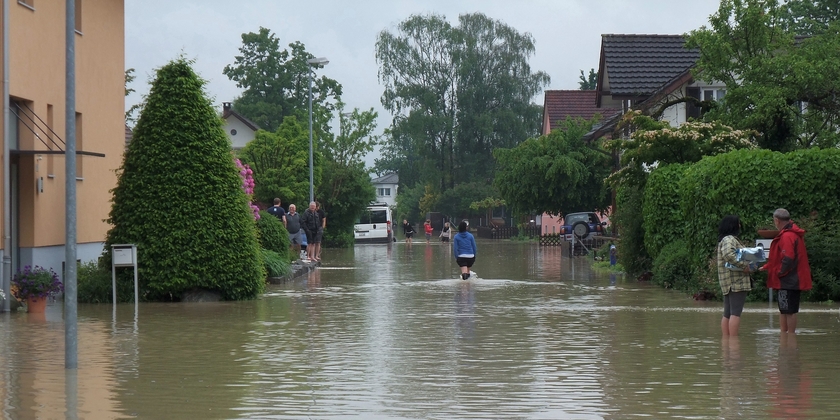
Dieses Projekt befasst sich mit der Forschungsfrage, wie lokale Strategien zur Anpassung an den Klimawandel entworfen werden und sich entwickeln können. Wir konzentrieren uns dabei stark auf die Auswirkungen extremer Ereignisse auf die Gestaltung (Design) und Politikformulierung von Anpassungsmassnahmen, die Akzeptanz neuer Anpassungsstrategien an Extremereignisse und der Anpassungsfähigkeit der bestehenden Gesetze an den Klimawandel. Die Anpassung an den Klimawandel ist heutzutage besonders wichtig für die Ressource Wasser, vor allem im Zusammenhang mit den Grundsätzen des integrierten Wasserressourcenmanagements (IWRM). IWRM stellt sich der Herausforderung der Koordination der Nutzung, des Schutzes vor und des Schutzes von Wasser. Der Schutz vor der Ressource Wasser stellt eine direkte Verbindung zu Hochwasserereignissen und Naturkatastrophen dar, die durch den globalen Klimawandel beeinflusst werden können. Darüber hinaus kann die Integration von Akteuren verschiedener Sektoren, politischer Entitäten und Entscheidungsebenen als Weg gesehen werden, um die Anpassungsfähigkeit des Wassersektors zu verbessern. IWRM stellt daher eine grosse Herausforderung der gegenwärtigen und zukünftigen Generationen dar, wenn es darum geht, nachhaltige Antworten auf die Auswirkungen des Klimawandels zu finden. Wir analysieren dementsprechend Anpassungen an den Klimawandel im Fall des Hochwasserschutzes und vergleichen Präferenzen diverser Akteure für Massnahmen und Massnahmenmixe mit den aktuell umgesetzten Massnahmen als Beitrag zu IWRM.
array(4 items)0 => Snowflake\Publications\Domain\Model\Publicationprototypepersistent entity (uid=20570, pid=124)originalId => protected20570 (integer)
authors => protected'Ingold, K.; Gavilano, A.' (34 chars)
title => protected'Under what conditions does an extreme event deploy its focal power? Toward c ollaborative governance in Swiss flood risk management' (130 chars)
journal => protected'In: Bynander, F.; Nohrstedt, D. (Eds.), Collaborative crisis manag ement. Inter-organizational approaches to extreme events' (132 chars)
year => protected2020 (integer)
volume => protected0 (integer)
issue => protected'' (0 chars)
startpage => protected'132' (3 chars)
otherpage => protected'147' (3 chars)
categories => protected'' (0 chars)
description => protected'In this chapter we study the longer-term response of a national government t o natural disasters. We are interested in when and how collaborative governa nce arrangements spark new national flood prevention policies. Our understan ding of collaborative governance not only includes public and private actors that are involved in a complex network (see Nohrstedt 2015) but also the la rger institutional setting as well as regulations in the domain of flood ris k management. In other words, we conceive the full range from politics and p olity to policies when defining collaborative risk management (see also Drie ssen et al. 2012). For national flood prevention this concretely means that decision making and implementation processes are designed multilevel and cro ss-sectoral, that competences and responsibilities are shared between differ ent jurisdictions and policy subsystems, and that policies and regulations r eflect this horizontal and vertical integration of actors and institutions ( Ingold et al. 2018; Ingold 2017). [...]' (1027 chars)
serialnumber => protected'' (0 chars)
doi => protected'10.4324/9780429244308-11' (24 chars)
uid => protected20570 (integer)
_localizedUid => protected20570 (integer)modified_languageUid => protectedNULL
_versionedUid => protected20570 (integer)modifiedpid => protected124 (integer)1 => Snowflake\Publications\Domain\Model\Publicationprototypepersistent entity (uid=10591, pid=124)originalId => protected10591 (integer)
authors => protected'Ingold, K.' (15 chars)
title => protected'How to create and preserve social capital in climate adaptation policies: a network approach' (92 chars)
journal => protected'Ecological Economics' (20 chars)
year => protected2017 (integer)
volume => protected131 (integer)
issue => protected'' (0 chars)
startpage => protected'414' (3 chars)
otherpage => protected'424' (3 chars)
categories => protected'social capital; climate change adaptation; policy analysis; social network a nalysis' (83 chars)
description => protected'The processes and impacts of climate change require adaptation through what can be described as horizontal and vertical structures of actors' integratio n. In climate adaptation and natural resource management literature, this st ructural component is often related to social capital, which is defined in v arious ways but usually refers to a public good that is built and fostered w ithin a network of social relations. While hypotheses about social capital i n networks are well studied in network literature, here, I argue that they s hould be reflected and tested in the particular context of climate change ad aptation policy. I ask: how do communities affected by climate change and th e broad range of actors involved in the design of climate adaptation policie s build social relationships? And, how do they manage to maintain those rela tions over time?<BR/> To answer these questions, climate adaptation policies in six Swiss mountain regions are investigated via social network analysis. Hypotheses about the creation and preservation of weak versus strong ties u nder the particular setting of Swiss federalism and climate-affected local c ommunities are tested. Results confirm that the creation of weak ties, such as one-way information transfer, can lead to the establishment of mutual col laboration relations over time. Such mutual and reciprocal relations can the n more easily be activated by local communities to produce both short-term r esponses and long-term solutions to climate change impacts.' (1503 chars)
serialnumber => protected'0921-8009' (9 chars)
doi => protected'10.1016/j.ecolecon.2016.08.033' (30 chars)
uid => protected10591 (integer)
_localizedUid => protected10591 (integer)modified_languageUid => protectedNULL
_versionedUid => protected10591 (integer)modifiedpid => protected124 (integer)2 => Snowflake\Publications\Domain\Model\Publicationprototypepersistent entity (uid=10646, pid=124)originalId => protected10646 (integer)
authors => protected'Balsiger, J.; Ingold, K.' (34 chars)
title => protected'In the Eye of the Beholder: network location and sustainability perception i n flood prevention' (94 chars)
journal => protected'Environmental Policy and Governance' (35 chars)
year => protected2016 (integer)
volume => protected26 (integer)
issue => protected'4' (1 chars)
startpage => protected'242' (3 chars)
otherpage => protected'256' (3 chars)
categories => protected'collaborative flood management; situated knowledge; social network analysis ; sustainable development perceptions; Switzerland' (126 chars)
description => protected'The aim of this paper is to investigate how sustainability perceptions are e mergent properties of collaborative networks in flood governance in Switzerl and. In recent decades, the impact of global warming and multiple stresses o n water regimes has influenced the design of new approaches to flood risk ma nagement, especially in Western Europe. The use of non-structural measures s uch as planning tools and watershed campaigns indicates a change from techno cratic to more integrated flood governance perspectives. Flood governance is increasingly influenced by the principle of sustainability, understood as s tronger horizontal integration of its social, economic and environmental dim ensions. The paper examines the integration of sustainability in the design of flood prevention and policies, suggesting that integration relates to par ticipating actors’ perceptions of sustainability and that these perception s are reflected in network structures. Focusing on four regional case studie s, we use survey data and social network analysis to investigate how actors relate to each other and how they rank sustainability indicators. Results sh ow that sustainability perceptions differ strongly across cases, and tend to be more balanced (assigning equal importance to environmental, economic and social indicators) within and sometimes even across actor types and sectors . We find that while actors in central network positions tend to have more b alanced sustainability perceptions, context- and project-specific factors im pact sustainability perceptions even more.' (1562 chars)
serialnumber => protected'1756-932X' (9 chars)
doi => protected'10.1002/eet.1715' (16 chars)
uid => protected10646 (integer)
_localizedUid => protected10646 (integer)modified_languageUid => protectedNULL
_versionedUid => protected10646 (integer)modifiedpid => protected124 (integer)3 => Snowflake\Publications\Domain\Model\Publicationprototypepersistent entity (uid=7603, pid=124)originalId => protected7603 (integer)
authors => protected'Ingold, K.' (15 chars)
title => protected'How involved are they really? A comparative network analysis of the institut ional drivers of local actor inclusion' (114 chars)
journal => protected'Land Use Policy' (15 chars)
year => protected2014 (integer)
volume => protected39 (integer)
issue => protected'' (0 chars)
startpage => protected'376' (3 chars)
otherpage => protected'387' (3 chars)
categories => protected'land use change; collaborative policy networks; mountain regions; local comm unities; social network analysis' (108 chars)
description => protected'Different socio-economic and environmental drivers lead local communities in mountain regions to adapt land use practices and engage in protection polic ies. The political system also has to develop new approaches to adapt to tho se drivers. Local actors are the target group of those policy approaches, an d the question arises of if and how much those actors are consulted or even integrated into the design of local land use and protection policies. This a rticle addresses this question by comparing seven different case studies in Swiss mountain regions. Through a formal social network analysis, the inclus ion of local actors in collaborative policy networks is investigated and com pared to the involvement of other stakeholders representing the next higher sub-national or national decisional levels. Results show that there is a sig nificant difference (1) in how local actors are embedded compared to other s takeholders; and (2) between top-down versus bottom-up designed policy proce sses.' (993 chars)
serialnumber => protected'0264-8377' (9 chars)
doi => protected'10.1016/j.landusepol.2014.01.013' (32 chars)
uid => protected7603 (integer)
_localizedUid => protected7603 (integer)modified_languageUid => protectedNULL
_versionedUid => protected7603 (integer)modifiedpid => protected124 (integer)
Under what conditions does an extreme event deploy its focal power? Toward collaborative governance in Swiss flood risk management
In this chapter we study the longer-term response of a national government to natural disasters. We are interested in when and how collaborative governance arrangements spark new national flood prevention policies. Our understanding of collaborative governance not only includes public and private actors that are involved in a complex network (see Nohrstedt 2015) but also the larger institutional setting as well as regulations in the domain of flood risk management. In other words, we conceive the full range from politics and polity to policies when defining collaborative risk management (see also Driessen et al. 2012). For national flood prevention this concretely means that decision making and implementation processes are designed multilevel and cross-sectoral, that competences and responsibilities are shared between different jurisdictions and policy subsystems, and that policies and regulations reflect this horizontal and vertical integration of actors and institutions (Ingold et al. 2018; Ingold 2017). [...]
Ingold, K.; Gavilano, A. (2020) Under what conditions does an extreme event deploy its focal power? Toward collaborative governance in Swiss flood risk management, In: Bynander, F.; Nohrstedt, D. (Eds.), Collaborative crisis management. Inter-organizational approaches to extreme events, 132-147, doi:10.4324/9780429244308-11, Institutional Repository
How to create and preserve social capital in climate adaptation policies: a network approach
The processes and impacts of climate change require adaptation through what can be described as horizontal and vertical structures of actors' integration. In climate adaptation and natural resource management literature, this structural component is often related to social capital, which is defined in various ways but usually refers to a public good that is built and fostered within a network of social relations. While hypotheses about social capital in networks are well studied in network literature, here, I argue that they should be reflected and tested in the particular context of climate change adaptation policy. I ask: how do communities affected by climate change and the broad range of actors involved in the design of climate adaptation policies build social relationships? And, how do they manage to maintain those relations over time? To answer these questions, climate adaptation policies in six Swiss mountain regions are investigated via social network analysis. Hypotheses about the creation and preservation of weak versus strong ties under the particular setting of Swiss federalism and climate-affected local communities are tested. Results confirm that the creation of weak ties, such as one-way information transfer, can lead to the establishment of mutual collaboration relations over time. Such mutual and reciprocal relations can then more easily be activated by local communities to produce both short-term responses and long-term solutions to climate change impacts.
In the Eye of the Beholder: network location and sustainability perception in flood prevention
The aim of this paper is to investigate how sustainability perceptions are emergent properties of collaborative networks in flood governance in Switzerland. In recent decades, the impact of global warming and multiple stresses on water regimes has influenced the design of new approaches to flood risk management, especially in Western Europe. The use of non-structural measures such as planning tools and watershed campaigns indicates a change from technocratic to more integrated flood governance perspectives. Flood governance is increasingly influenced by the principle of sustainability, understood as stronger horizontal integration of its social, economic and environmental dimensions. The paper examines the integration of sustainability in the design of flood prevention and policies, suggesting that integration relates to participating actors’ perceptions of sustainability and that these perceptions are reflected in network structures. Focusing on four regional case studies, we use survey data and social network analysis to investigate how actors relate to each other and how they rank sustainability indicators. Results show that sustainability perceptions differ strongly across cases, and tend to be more balanced (assigning equal importance to environmental, economic and social indicators) within and sometimes even across actor types and sectors. We find that while actors in central network positions tend to have more balanced sustainability perceptions, context- and project-specific factors impact sustainability perceptions even more.
Balsiger, J.; Ingold, K. (2016) In the Eye of the Beholder: network location and sustainability perception in flood prevention, Environmental Policy and Governance, 26(4), 242-256, doi:10.1002/eet.1715, Institutional Repository
How involved are they really? A comparative network analysis of the institutional drivers of local actor inclusion
Different socio-economic and environmental drivers lead local communities in mountain regions to adapt land use practices and engage in protection policies. The political system also has to develop new approaches to adapt to those drivers. Local actors are the target group of those policy approaches, and the question arises of if and how much those actors are consulted or even integrated into the design of local land use and protection policies. This article addresses this question by comparing seven different case studies in Swiss mountain regions. Through a formal social network analysis, the inclusion of local actors in collaborative policy networks is investigated and compared to the involvement of other stakeholders representing the next higher sub-national or national decisional levels. Results show that there is a significant difference (1) in how local actors are embedded compared to other stakeholders; and (2) between top-down versus bottom-up designed policy processes.
Metz, F.; Glaus, A. (2019). Integrated Water Resources Management and Policy Integration: Lessons from 169 Years of Flood Policies in Switzerland. Water, 11(6), 1173. DOI: 10.3390/w11061173.
Ingold, K.; Zimmermann, W. (2011) How and why forest managers adapt to socio-economic changes: a case study analysis in Swiss forest enterprises. Forest Policy and Economics 13: 97-103. DOI:10.1016/j.forpol.2010.06.003.
Ingold, K.; Balsiger, J.; Hirschi, C. (2010) Climate change in Mountain Regions: How local communities adapt to extreme events. Local Environment 15(7), 651-661. DOI:10.1080/13549839.2010.498811.