Abteilung Siedlungshygiene und Wasser für Entwicklung
Nachhaltige Lösungen für Forschung, Wissen und Expertise
Das WABES-Programm ist eine Initiative für ergebnisorientierte Forschung und Wissenstransfer im Bereich Wasser, Sanitärversorgung und Hygiene und der Abfallwirtschaft. Sie wird von der Schweizer Direktion für Entwicklung und Zusammenarbeit (DEZA) gefördert und von der Eawag zusammen mit diversem Partner umgesetzt. Im Fokus stehen Innovation und das Testen praxisnaher Instrumente sowie der Aufbau fachlicher Kapazitäten, um eine gerechte und klimaresiliente Wasser- und Sanitärversorgung in Ländern des globalen Südens zu fördern.
WABES leistet einen direkten Beitrag zum Globalen Programm Wasser der DEZA, indem es sich mit der Basisversorgung in Kleinstädten, der Abfallwirtschaft, der Trinkwasseraufbereitung, der Behandlung von Fäkalschlamm sowie der Qualität von Grundwasser befasst.
Ergebnis 1 – Nachhaltiger Zugang zu sauberem Wasser
Outcome 1 is advancing safe drinking‑water services through applied research, evaluations and the development of analytical planning tools.
Key Activities
- Evaluating solutions for providing safe drinking water at the point of consumption are evaluated
- Developing and testing a methodology for a water flow diagram
- Assessing the optimal degree of treatment decentralization for rural and small-town piped supplies
- Understanding is enhanced on the association of community inclusion with successful establishment and sustainable operation of water treatment facilities
- Providing recommendations for effective interventions for mitigating the effects of source switching on water supply functionality
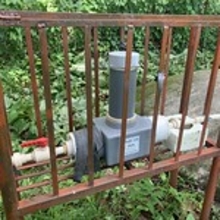
Learn more: Optimizing Chlorination Arrangements for Piped Water Supplies in Rural Nepal
Ergebnis 2 - Nachhaltiger Zugang zu Siedlungshygiene
Outcome 2 is advancing faecal sludge management, sanitation technology performance and behaviour‑change strategies for solid waste management.
Key Activities
- Exploring solutions for the dynamic operation of faecal sludge treatment with available resources.
- Testing post-dewatering supernatant treatment technologies for dense urban areas.
- Validating, documenting and disseminating prediction modelling of faecal sludge qualities and quantities (Q&Q)
- Developing, validating, documenting and disseminating an approach for initiating and sustaining waste segregation developed, validated, documented and disseminated
Ergebnis 3- Integrierte und inklusive Planung für Kleinstädte in Afrika
Outcome 3 is building integrated, inclusive planning approaches for small towns, with a major focus on Uganda.
Key Activities
- Analysing successful and unsuccessful examples of previous systematic attempts to plan WASH/SWM and other interacting sectors
- Analysing existing barriers and enablers to integrated planning from a technical and political economy perspective in a specific context
- Conducting a study baseline assessment with modelling of potential integration outcomes
- Providing overview of existing planning and programming approaches and tools in WaSH/SWM and its applicability on integration in local contexts
- Creating an integrated planning approach that combines WaSH/SWM including planning tool development
- Validating a planning process application in small town context
Ergebnis 4 – Wissen und Expertise wird nachgefragt
Outcome 4 is supporting professional training, digital learning innovation and the dissemination of research outputs to practitioners and institutions.
Key Activities
- Expansion and updating of the global WASH MOOC series and measuring the impact of MOOCs. This includes a refresh of the Water and Solid Waste Management MOOCS.
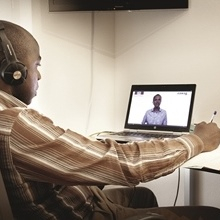
- Supporting capacity development initiatives of partners in Somalia, Uganda, Ethiopia, Malawi and Sierra Leone, including university lectures, professional short courses and blended online–offline learning.
- Developing and testing learning formats for development and humanitarian contexts such as AI‑generated subtitles, micro‑learning videos and offline-access content using BeekeeBox devices.
- Developing and improving knowledge materials and their access for practitioners
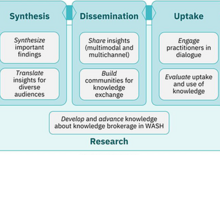
- Supporting knowledge brokerage through network development and targeted outreach
Learn more: WASH Learning Lab
Learn more: Knowledge Brokerage
Wo WABES tätig ist
WABES konzentriert sich insbesondere auf zwei Kleinstädte in Uganda: Wobulenzi und Kakooge. WABES arbeitet auch in:
- Wasserqualität und Grundwasser: Ghana, Uganda, Demokratische Republik Kongo, Senegal, Philippinen, Nepal
- Sanitäre Versorgung und Fäkalienschlammmanagement: Uganda, Sambia, Libanon
- Abfallwirtschaft: Elfenbeinküste, Uganda, Vietnam
Publikationen und Ressourcen (in Englisch)
Wissensprodukte
1. Improved and Equitable Access to Safely Managed Water
Advancing water governance in the Lake of Palmas River Basin (Brazil). Policy Brief. 2025
2. Improved and Equitable Access to Safely Managed Environmental Sanitation
Science-based policy recommendations for non-sewered sanitation in urban areas. Policy Brief. 2025
3. Integrated, Inclusive Planning for Small Town Water, Sanitation and Waste Services
Integrated Sensitisation Campaign for Water, Sanitation and Solid Waste - Key Messages and Guidance
Overview of Existing Planning & Programming Approaches and Tools. Summary Review. 2023
Integrated Planning Framework for water, sanitation and solid waste management. Learning Guide. 2026
4. Knowledge and Expertise Used in Practice
Supporting knowledge transfer in a changing sector. Reflection. 2025
Fortbildung
Further info about the MOOC series “Sanitation, Water and Solid Waste for Development” www.eawag.ch/mooc and links to the courses: