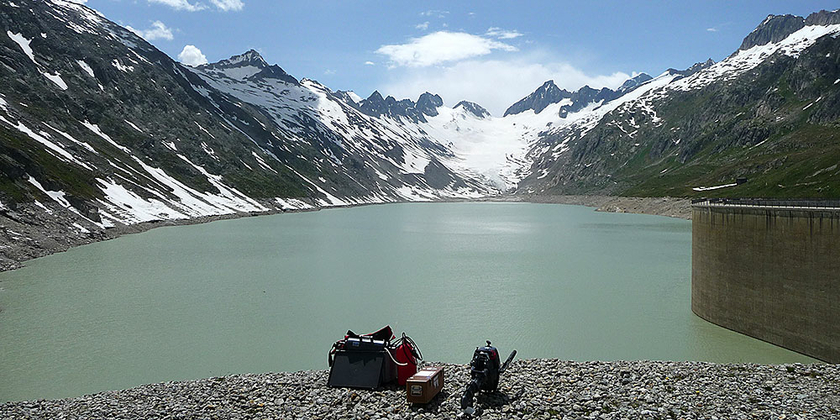
Wasserkraft ist die wichtigste Energiequelle für die Stromerzeugung in der Schweiz. Wir untersuchen die Auswirkungen dieser Wasserkraftproduktion auf die physikalischen Eigenschaften, wie Temperatur, Schichtung oder Partikelkonzentration der unterliegenden Flüsse und Seen.
Gemäss der Energiestrategie 2050 wird die Bedeutung der Wasserkraft in Zukunft aufgrund des Ausstiegs aus der Kernenergie in der Schweiz weiter zunehmen. Im Rahmen des Swiss Competence Center for Energy Research - Supply of Electricity SCCER-SoE untersuchten wir die Auswirkungen der durch die Energiestrategie bedingten Veränderungen in der Wasserkraftproduktion auf die Flussökosysteme und entwickelten Methoden, um diese Auswirkungen zu reduzieren.
Seen und Stauseen werden auch zunehmend zur Speicherung von Strom mit Pumpspeicherkraftwerken genutzt. Wir untersuchen die Auswirkungen solcher Pumpspeicherkraftwerke auf die Temperatur und Schichtung in den betroffenen Seen und Stauseen.
array(4 items)0 => Snowflake\Publications\Domain\Model\Publicationprototypepersistent entity (uid=22019, pid=124)originalId => protected22019 (integer)
authors => protected'Aksamit, C. K.; Carolli, M.; Vanzo, D.; Weber, C.; Schmid, M.' (91 chars)
title => protected'Macroinvertebrate recovery to varying hydropeaking frequency: a small hydrop ower plant experiment' (97 chars)
journal => protected'Frontiers in Environmental Science' (34 chars)
year => protected2021 (integer)
volume => protected8 (integer)
issue => protected'' (0 chars)
startpage => protected'602374 (16 pp.)' (15 chars)
otherpage => protected'' (0 chars)
categories => protected'field experiment; macroinvertebrate drift; flexible power production; physic al habitat; pool; riffle' (100 chars)
description => protected'As the demand for hydroelectricity progresses worldwide, small hydropower op erators are increasingly examining the feasibility of using existing infrast ructure (e.g., settling basins) in run-of-the-river schemes for intermittent power production. Such flexible production causes short-term discharge fluc tuations (hydropeaking) in downstream reaches with potential adverse effects for the sensitive fauna and flora in alpine streams. In an experimental fie ld study on a previously unregulated section of the upper Rhone River (Switz erland), we measured density and composition of macroinvertebrate drift in t wo habitats (riffle, pool) following a 15-minute hydropeaking wave. The expe rimental hydropeaking was replicated five times over 14 days with decreasin g recovery times between peaks (8, 3, 2 days, and 24 h), and drift measure ments were compared with kick samples for the benthic community. Results fro m the kick sampling showed that benthic macroinvertebrate abundance and comp osition did not significantly change between the experimental peaks. There w ere habitat specific reactions in macroinvertebrate drift to hydropeaking, w ith the pool experiencing more pronounced drift abundances than the riffle. Overall, drift abundance was not significantly correlated with recovery time , but results indicate taxa-specific differences. This research advocates fo r the importance of completing more <em>in-situ</em> field experiments in or der to better understand the ecological impact of flexible power production in small hydropower plants.' (1547 chars)
serialnumber => protected'' (0 chars)
doi => protected'10.3389/fenvs.2020.602374' (25 chars)
uid => protected22019 (integer)
_localizedUid => protected22019 (integer)modified_languageUid => protectedNULL
_versionedUid => protected22019 (integer)modifiedpid => protected124 (integer)1 => Snowflake\Publications\Domain\Model\Publicationprototypepersistent entity (uid=22548, pid=124)originalId => protected22548 (integer)
authors => protected'Calamita, E.; Vanzo, D.; Wehrli, B.; Schmid, M.' (67 chars)
title => protected'Lake modeling reveals management opportunities for improving water quality d ownstream of transboundary tropical dams' (116 chars)
journal => protected'Water Resources Research' (24 chars)
year => protected2021 (integer)
volume => protected57 (integer)
issue => protected'4' (1 chars)
startpage => protected'e2020WR027465 (20 pp.)' (22 chars)
otherpage => protected'' (0 chars)
categories => protected'' (0 chars)
description => protected'Water quality in tropical rivers is changing rapidly. The ongoing boom of da m construction for hydropower is one of the drivers for this change. In part icular, the stratification in tropical reservoirs induces oxygen deficits in their deep waters and warmer surface water temperatures, which often transl ate into altered thermal and oxygen regimes of downstream river systems, wit h cascading consequences for the entire aquatic ecosystem. Operation rules o f reservoirs, involving water intakes at different levels, could mitigate th e consequences for downstream water quality. However, optimized water manage ment of deep reservoirs relies on predictive models for water quality, but s uch predictive capability is often lacking for tropical dams. Here we focus on the Zambezi River Basin (southern Africa) to address this gap. Using the one-dimensional General Lake Model, we reproduced the internal dynamics of t he transboundary Lake Kariba, the world’s largest artificial lake by volum e, created by damming the Zambezi River at the border between Zambia and Zim babwe. Through this modeling approach, we assessed and quantified the therma l and oxygen alteration in the Zambezi River downstream of the reservoir. Re sults suggest that these alterations depend directly on Kariba’s stratific ation dynamics, its water level and the transboundary policies for water wit hdrawal from the reservoir. Scenario calculations indicate a large potential for mitigating downstream water quality alterations by implementing a hypot hetical selective withdrawal technology. However, we show that a different a nd cooperative management of the existing infrastructure of Kariba Dam has t he potential to mitigate most of the actual water quality alterations.' (1742 chars)
serialnumber => protected'0043-1397' (9 chars)
doi => protected'10.1029/2020WR027465' (20 chars)
uid => protected22548 (integer)
_localizedUid => protected22548 (integer)modified_languageUid => protectedNULL
_versionedUid => protected22548 (integer)modifiedpid => protected124 (integer)2 => Snowflake\Publications\Domain\Model\Publicationprototypepersistent entity (uid=17061, pid=124)originalId => protected17061 (integer)
authors => protected'Kobler, U. G.; Wüest, A.; Schmid, M.' (57 chars)
title => protected'Effects of lake – reservoir pumped-storage operations on temperature and w ater quality' (88 chars)
journal => protected'Sustainability' (14 chars)
year => protected2018 (integer)
volume => protected10 (integer)
issue => protected'6' (1 chars)
startpage => protected'1968 (15 pp.)' (13 chars)
otherpage => protected'' (0 chars)
categories => protected'hydropower; stratification; reservoir modeling; recommissioning' (63 chars)
description => protected'Pumped-storage (PS) hydropower plants are expected to make an important cont ribution to energy storage in the next decades with growing market shares of new renewable electricity. PS operations affect the water quality of the co nnected water bodies by exchanging water between them but also by deep water withdrawal from the upper water body. Here, we assess the importance of the se two processes in the context of recommissioning a PS hydropower plant by simulating different scenarios with the numerical hydrodynamic and water qua lity model CE-QUAL-W2. For extended PS operations, the results show signific ant impacts of the water exchange between the two water bodies on the season al dynamics of temperatures, stratification, nutrients, and ice cover, espec ially in the smaller upper reservoir. Deep water withdrawal was shown to str ongly decrease the strength of summer stratification in the upper reservoir, shortening its duration by ~1.5 months, consequently improving oxygen avail ability, and reducing the accumulation of nutrients in the hypolimnion. Thes e findings highlight the importance of assessing the effects of different op tions for water withdrawal depths in the design of PS hydropower plants, as well as the relevance of defining a reference state when a PS facility is to be recommissioned.' (1311 chars)
serialnumber => protected'' (0 chars)
doi => protected'10.3390/su10061968' (18 chars)
uid => protected17061 (integer)
_localizedUid => protected17061 (integer)modified_languageUid => protectedNULL
_versionedUid => protected17061 (integer)modifiedpid => protected124 (integer)3 => Snowflake\Publications\Domain\Model\Publicationprototypepersistent entity (uid=17067, pid=124)originalId => protected17067 (integer)
authors => protected'Lange, K.; Meier, P.; Trautwein, C.; Schmid, M.; Robinso n, C. T.; Weber, C.; Brodersen, J.' (130 chars)
title => protected'Basin-scale effects of small hydropower on biodiversity dynamics' (64 chars)
journal => protected'Frontiers in Ecology and the Environment' (40 chars)
year => protected2018 (integer)
volume => protected16 (integer)
issue => protected'7' (1 chars)
startpage => protected'397' (3 chars)
otherpage => protected'404' (3 chars)
categories => protected'' (0 chars)
description => protected'Construction of small hydropower plants (<10 megawatts) is booming worldwide , exacerbating ongoing habitat fragmentation and degradation, and further fu eling biodiversity loss. A systematic approach for selecting hydropower site s within river networks may help to minimize the detrimental effects of smal l hydropower on biodiversity. In addition, a better understanding of reach-a nd basin-scale impacts is key for designing planning tools. We synthesize th e available information about (1) reach-scale and (2) basin-scale impacts of small hydropower plants on biodiversity and ecosystem function, and (3) int eractions with other anthropogenic stressors. We then discuss state-of-the-a rt, spatially explicit planning tools and suggest how improved knowledge of the ecological and evolutionary impacts of hydropower can be incorporated in to project development. Such tools can be used to balance the benefits of hy dropower production with the maintenance of ecosystem services and biodivers ity conservation. Adequate planning tools that consider basin-scale effects and interactions with other stressors, such as climate change, can maximize long-term conservation.' (1163 chars)
serialnumber => protected'1540-9295' (9 chars)
doi => protected'10.1002/fee.1823' (16 chars)
uid => protected17067 (integer)
_localizedUid => protected17067 (integer)modified_languageUid => protectedNULL
_versionedUid => protected17067 (integer)modifiedpid => protected124 (integer)
Macroinvertebrate recovery to varying hydropeaking frequency: a small hydropower plant experiment
As the demand for hydroelectricity progresses worldwide, small hydropower operators are increasingly examining the feasibility of using existing infrastructure (e.g., settling basins) in run-of-the-river schemes for intermittent power production. Such flexible production causes short-term discharge fluctuations (hydropeaking) in downstream reaches with potential adverse effects for the sensitive fauna and flora in alpine streams. In an experimental field study on a previously unregulated section of the upper Rhone River (Switzerland), we measured density and composition of macroinvertebrate drift in two habitats (riffle, pool) following a 15-minute hydropeaking wave. The experimental hydropeaking was replicated five times over 14 days with decreasing recovery times between peaks (8, 3, 2 days, and 24 h), and drift measurements were compared with kick samples for the benthic community. Results from the kick sampling showed that benthic macroinvertebrate abundance and composition did not significantly change between the experimental peaks. There were habitat specific reactions in macroinvertebrate drift to hydropeaking, with the pool experiencing more pronounced drift abundances than the riffle. Overall, drift abundance was not significantly correlated with recovery time, but results indicate taxa-specific differences. This research advocates for the importance of completing more in-situ field experiments in order to better understand the ecological impact of flexible power production in small hydropower plants.
Aksamit, C. K.; Carolli, M.; Vanzo, D.; Weber, C.; Schmid, M. (2021) Macroinvertebrate recovery to varying hydropeaking frequency: a small hydropower plant experiment, Frontiers in Environmental Science, 8, 602374 (16 pp.), doi:10.3389/fenvs.2020.602374, Institutional Repository
Lake modeling reveals management opportunities for improving water quality downstream of transboundary tropical dams
Water quality in tropical rivers is changing rapidly. The ongoing boom of dam construction for hydropower is one of the drivers for this change. In particular, the stratification in tropical reservoirs induces oxygen deficits in their deep waters and warmer surface water temperatures, which often translate into altered thermal and oxygen regimes of downstream river systems, with cascading consequences for the entire aquatic ecosystem. Operation rules of reservoirs, involving water intakes at different levels, could mitigate the consequences for downstream water quality. However, optimized water management of deep reservoirs relies on predictive models for water quality, but such predictive capability is often lacking for tropical dams. Here we focus on the Zambezi River Basin (southern Africa) to address this gap. Using the one-dimensional General Lake Model, we reproduced the internal dynamics of the transboundary Lake Kariba, the world’s largest artificial lake by volume, created by damming the Zambezi River at the border between Zambia and Zimbabwe. Through this modeling approach, we assessed and quantified the thermal and oxygen alteration in the Zambezi River downstream of the reservoir. Results suggest that these alterations depend directly on Kariba’s stratification dynamics, its water level and the transboundary policies for water withdrawal from the reservoir. Scenario calculations indicate a large potential for mitigating downstream water quality alterations by implementing a hypothetical selective withdrawal technology. However, we show that a different and cooperative management of the existing infrastructure of Kariba Dam has the potential to mitigate most of the actual water quality alterations.
Calamita, E.; Vanzo, D.; Wehrli, B.; Schmid, M. (2021) Lake modeling reveals management opportunities for improving water quality downstream of transboundary tropical dams, Water Resources Research, 57(4), e2020WR027465 (20 pp.), doi:10.1029/2020WR027465, Institutional Repository
Effects of lake – reservoir pumped-storage operations on temperature and water quality
Pumped-storage (PS) hydropower plants are expected to make an important contribution to energy storage in the next decades with growing market shares of new renewable electricity. PS operations affect the water quality of the connected water bodies by exchanging water between them but also by deep water withdrawal from the upper water body. Here, we assess the importance of these two processes in the context of recommissioning a PS hydropower plant by simulating different scenarios with the numerical hydrodynamic and water quality model CE-QUAL-W2. For extended PS operations, the results show significant impacts of the water exchange between the two water bodies on the seasonal dynamics of temperatures, stratification, nutrients, and ice cover, especially in the smaller upper reservoir. Deep water withdrawal was shown to strongly decrease the strength of summer stratification in the upper reservoir, shortening its duration by ~1.5 months, consequently improving oxygen availability, and reducing the accumulation of nutrients in the hypolimnion. These findings highlight the importance of assessing the effects of different options for water withdrawal depths in the design of PS hydropower plants, as well as the relevance of defining a reference state when a PS facility is to be recommissioned.
Kobler, U. G.; Wüest, A.; Schmid, M. (2018) Effects of lake – reservoir pumped-storage operations on temperature and water quality, Sustainability, 10(6), 1968 (15 pp.), doi:10.3390/su10061968, Institutional Repository
Basin-scale effects of small hydropower on biodiversity dynamics
Construction of small hydropower plants (<10 megawatts) is booming worldwide, exacerbating ongoing habitat fragmentation and degradation, and further fueling biodiversity loss. A systematic approach for selecting hydropower sites within river networks may help to minimize the detrimental effects of small hydropower on biodiversity. In addition, a better understanding of reach-and basin-scale impacts is key for designing planning tools. We synthesize the available information about (1) reach-scale and (2) basin-scale impacts of small hydropower plants on biodiversity and ecosystem function, and (3) interactions with other anthropogenic stressors. We then discuss state-of-the-art, spatially explicit planning tools and suggest how improved knowledge of the ecological and evolutionary impacts of hydropower can be incorporated into project development. Such tools can be used to balance the benefits of hydropower production with the maintenance of ecosystem services and biodiversity conservation. Adequate planning tools that consider basin-scale effects and interactions with other stressors, such as climate change, can maximize long-term conservation.
Lange, K.; Meier, P.; Trautwein, C.; Schmid, M.; Robinson, C. T.; Weber, C.; Brodersen, J. (2018) Basin-scale effects of small hydropower on biodiversity dynamics, Frontiers in Ecology and the Environment, 16(7), 397-404, doi:10.1002/fee.1823, Institutional Repository