array (4 items)
0 => (uid=22551, pid=124)
originalId => protected 22551 (integer)
authors => protected 'Niederdorfer, R.; Fragner, L.; Yuan, L.; Hausherr, D.; W ei, J.; Magyar, P.; Joss, A.; Lehmann, M. F.; Ju,&n bsp;F.; Bürgmann, H. ' (178 chars)
title => protected 'Distinct growth stages controlled by the interplay of deterministic and stoc hastic processes in functional anammox biofilms ' (123 chars)
journal => protected 'Water Research ' (14 chars)
year => protected 2021 (integer)
volume => protected 200 (integer)
issue => protected ' ' (0 chars)
startpage => protected '117225 (14 pp.) ' (15 chars)
otherpage => protected ' ' (0 chars)
categories => protected 'mainstream anammox; biofilm succession; FISH; amplicon sequencing; sequencin g; batch reactor; biofilm structure ' (111 chars)
description => protected 'Mainstream anaerobic ammonium oxidation (anammox) represents one of the most promising energy-efficient mechanisms of fixed nitrogen elimination from wa stewaters. However, little is known about the exact processes and drivers of microbial community assembly within the complex microbial biofilms that sup port anammox in engineered ecosystems. Here, we followed anammox biofilm dev elopment on fresh carriers in an established 8m<sup>3</sup> mainstream anamm ox reactor that is exposed to seasonal temperature changes (∼25-12°C) and varying NH<sub>4</sub><sup>+</sup> concentrations (5-25 mg/L). We use fluor escence in situ hybridization and 16S rRNA gene sequencing to show that thre e distinct stages of biofilm development emerge naturally from microbial com munity composition and biofilm structure. Neutral modelling and network anal ysis are employed to elucidate the relative importance of stochastic versus deterministic processes and synergistic and antagonistic interactions in the biofilms during their development. We find that the different phases are ch aracterized by a dynamic succession and an interplay of both stochastic and deterministic processes. The observed growth stages (<em>Colonization, Succe ssion and Maturation</em>) appear to be the prerequisite for the anticipated growth of anammox bacteria and for reaching a biofilm community structure t hat supports the desired metabolic and functional capacities observed for bi ofilm carriers already present in the system (∼100g<sub>NH4-N</sub> m<sup> 3</sup> d<sup>-1</sup>). We discuss the relevance of this improved understan ding of anammox-community ecology and biofilm development in the context of its practical application in the start-up, configuration, and optimization o f anammox biofilm reactors. ' (1775 chars)
serialnumber => protected '0043-1354 ' (9 chars)
doi => protected '10.1016/j.watres.2021.117225 ' (28 chars)
uid => protected 22551 (integer)
_localizedUid => protected 22551 (integer)modified
_languageUid => protected NULL
_versionedUid => protected 22551 (integer)modified
pid => protected 124 (integer)
1 => (uid=22399, pid=124)
originalId => protected 22399 (integer)
authors => protected 'Gruber, W.; Niederdorfer, R.; Ringwald, J.; Morgenroth, E.; Bürgmann, H.; Joss, A. ' (113 chars)
title => protected 'Linking seasonal N<sub>2</sub>O emissions and nitrification failures to micr obial dynamics in a SBR wastewater treatment plant ' (126 chars)
journal => protected 'Water Research X ' (16 chars)
year => protected 2021 (integer)
volume => protected 11 (integer)
issue => protected ' ' (0 chars)
startpage => protected '100098 (13 pp.) ' (15 chars)
otherpage => protected ' ' (0 chars)
categories => protected 'nitrification; denitrification; activated sludge microbiome; physico-chemica l monitoring; amplicon sequencing ' (109 chars)
description => protected 'Nitrous oxide (N<sub>2</sub>O) is a strong greenhouse gas and causal for str atospheric ozone depletion. During biological nitrogen removal in wastewater treatment plants (WWTP), high N<sub>2</sub>O fluxes to the atmosphere can o ccur, typically exhibiting a seasonal emission pattern. Attempts to explain the peak emission phases in winter and spring using physico-chemical process data from WWTP were so far unsuccessful and new approaches are required. Th e complex and diverse microbial community of activated sludge used in biolog ical treatment systems also exhibit substantial seasonal patterns. However, a potentially causal link between the seasonal patterns of microbial diversi ty and N<sub>2</sub>O emissions has not yet been investigated. Here we show that in a full-scale WWTP nitrification failure and N<sub>2</sub>O peak emis sions, bad settleability of the activated sludge and a turbid effluent stron gly correlate with a significant reduction in the microbial community divers ity and shifts in community composition. During episodes of impaired perform ance, we observed a significant reduction in abundance for filamentous and n itrite oxidizing bacteria in all affected reactors. In some reactors that di d not exhibit nitrification and settling failures, we observed a stable micr obial community and no drastic loss of species. Standard engineering approac hes to stabilize nitrification, such as increasing the aerobic sludge age an d oxygen availability failed to improve the plant performance on this partic ular WWTP and replacing the activated sludge was the only measure applied by the operators to recover treatment performance in affected reactors. Our re sults demonstrate that disturbances of the sludge microbiome affect key stru ctural and functional microbial groups, which lead to seasonal N<sub>2</sub> O emission patterns. To reduce N<sub>2</sub>O emissions from WWTP, it is the refore crucial to understand the drivers that lead to the microbial populati on dynamics in the activ... ' (2012 chars)
serialnumber => protected '2589-9147 ' (9 chars)
doi => protected '10.1016/j.wroa.2021.100098 ' (26 chars)
uid => protected 22399 (integer)
_localizedUid => protected 22399 (integer)modified
_languageUid => protected NULL
_versionedUid => protected 22399 (integer)modified
pid => protected 124 (integer)
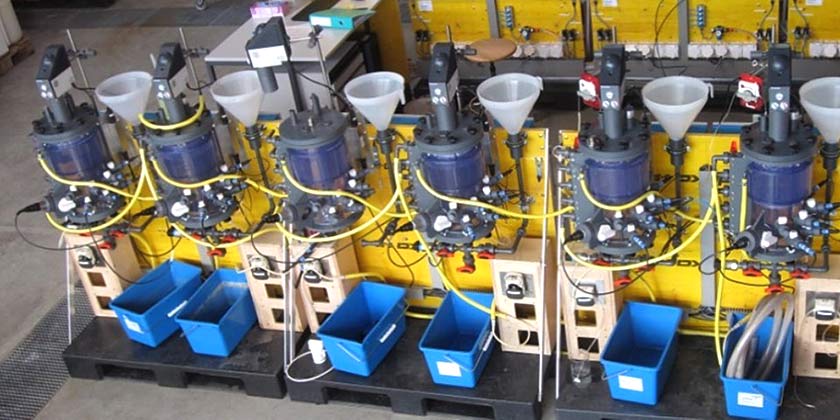
2 => (uid=22407, pid=124)
originalId => protected 22407 (integer)
authors => protected 'Magyar, P. M.; Hausherr, D.; Niederdorfer, R.; Stöcklin , N.; Wei, J.; Mohn, J.; Bürgmann, H.; Joss, A.; L ehmann, M. F. ' (175 chars)
title => protected 'Nitrogen isotope effects can be used to diagnose N transformations in wastew ater anammox systems ' (96 chars)
journal => protected 'Scientific Reports ' (18 chars)
year => protected 2021 (integer)
volume => protected 11 (integer)
issue => protected '1 ' (1 chars)
startpage => protected '7850 (12 pp.) ' (13 chars)
otherpage => protected ' ' (0 chars)
categories => protected ' ' (0 chars)
description => protected 'Anaerobic ammonium oxidation (anammox) plays an important role in aquatic sy stems as a sink of bioavailable nitrogen (N), and in engineered processes by removing ammonium from wastewater. The isotope effects anammox imparts in t he N isotope signatures (<sup>15</sup>N/<sup>14</sup>N) of ammonium, nitrite , and nitrate can be used to estimate its role in environmental settings, to describe physiological and ecological variations in the anammox process, an d possibly to optimize anammox-based wastewater treatment. We measured the s table N-isotope composition of ammonium, nitrite, and nitrate in wastewater cultivations of anammox bacteria. We find that the N isotope enrichment fact or <sup>15</sup>ε for the reduction of nitrite to N<sub>2</sub> is consiste nt across all experimental conditions (13.5‰ ± 3.7‰), suggesting it reflects the composition of the anammox bacteria community. Values of <sup> 15</sup>ε for the oxidation of nitrite to nitrate (inverse isotope effect, - 16 to - 43‰) and for the reduction of ammonium to N<sub>2</sub> (nor mal isotope effect, 19-32‰) are more variable, and likely controlled by ex perimental conditions. We argue that the variations in the isotope effects c an be tied to the metabolism and physiology of anammox bacteria, and that th e broad range of isotope effects observed for anammox introduces complicatio ns for analyzing N-isotope mass balances in natural systems. ' (1428 chars)
serialnumber => protected '2045-2322 ' (9 chars)
doi => protected '10.1038/s41598-021-87184-0 ' (26 chars)
uid => protected 22407 (integer)
_localizedUid => protected 22407 (integer)modified
_languageUid => protected NULL
_versionedUid => protected 22407 (integer)modified
pid => protected 124 (integer)
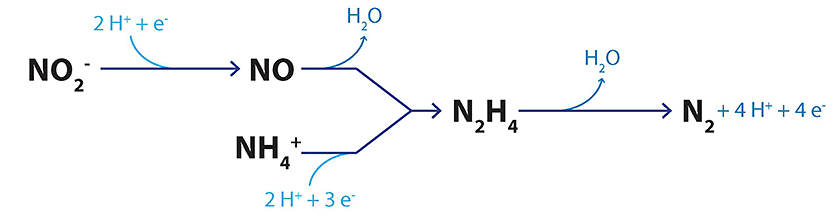
3 => (uid=22013, pid=124)
originalId => protected 22013 (integer)
authors => protected 'Niederdorfer, R.; Hausherr, D.; Palomo, A.; Wei, J.; Mag yar, P.; Smets, B. F.; Joss, A.; Bürgmann, H. ' (147 chars)
title => protected 'Temperature modulates stress response in mainstream anammox reactors ' (68 chars)
journal => protected 'Communications Biology ' (22 chars)
year => protected 2021 (integer)
volume => protected 4 (integer)
issue => protected '1 ' (1 chars)
startpage => protected '23 (12 pp.) ' (11 chars)
otherpage => protected ' ' (0 chars)
categories => protected ' ' (0 chars)
description => protected 'Autotrophic nitrogen removal by anaerobic ammonium oxidizing (anammox) bacte ria is an energy-efficient nitrogen removal process in wastewater treatment. However, full-scale deployment under mainstream conditions remains challeng ing for practitioners due to the high stress susceptibility of anammox bacte ria towards fluctuations in dissolved oxygen (DO) and temperature. Here, we investigated the response of microbial biofilms with verified anammox activi ty to DO shocks under 20 °C and 14 °C. While pulse disturbances of 0.3 mg L<sup>−1</sup> DO prompted only moderate declines in the NH<sub>4</sub><su p>+</sup> removal rates, 1.0 mg L<sup>−1</sup> DO led to complete but reve rsible inhibition of the NH<sub>4</sub><sup>+</sup> removal activity in all reactors. Genome-centric metagenomics and metatranscriptomics were used to i nvestigate the stress response on various biological levels. We show that te mperature regime and strength of DO perturbations induced divergent response s from the process level down to the transcriptional profile of individual t axa. Community-wide gene expression differed significantly depending on the temperature regime in all reactors, and we found a noticeable impact of DO d isturbances on genes involved in transcription, translation, replication and posttranslational modification at 20 °C but not 14 °C. Genome-centric ana lysis revealed that different anammox species and other key biofilm taxa dif fered in their transcriptional responses to distinct temperature regimes and DO disturbances. ' (1537 chars)
serialnumber => protected '2399-3642 ' (9 chars)
doi => protected '10.1038/s42003-020-01534-8 ' (26 chars)
uid => protected 22013 (integer)
_localizedUid => protected 22013 (integer)modified
_languageUid => protected NULL
_versionedUid => protected 22013 (integer)modified
pid => protected 124 (integer)