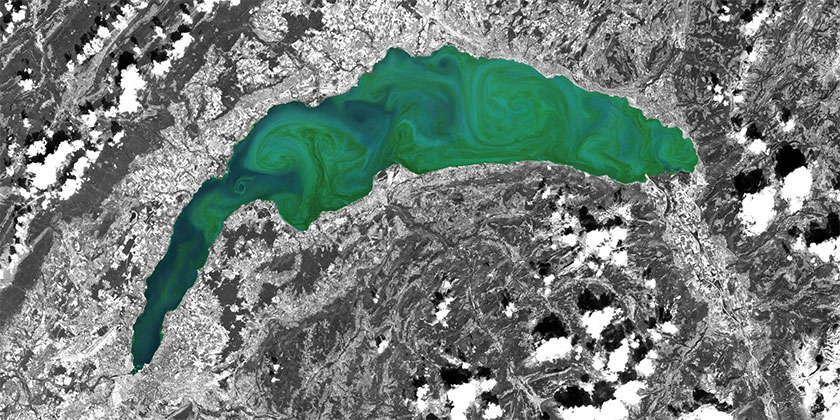
Die Produktion von Biomasse aus Nährstoffen und Licht oder chemischer Energie durch Algen und Cyanobakterien wird Primärproduktion genannt. Sie steigt mit der Menge verfügbarer Nährstoffe, in anderen Worten mit der Eutrophierung von Gewässern. Das Wachstum der Biomasse bindet Kohlenstoff, allerdings verbraucht ihr Abbau den Sauerstoff im Tiefenwasser. Die Primärproduktion ist somit einer der grundlegendsten und kritischsten Prozesse in Seen. Ihre direkte Messung ist jedoch mit grossem Aufwand verbunden. Deshalb greift man in der Praxis auf Ersatzgrössen zurück, beispielsweise Biomasse oder Chlorophyll-Konzentration.
Alternativ kann die Primärproduktion aufgrund des verfügbaren Lichts und der Absorption dieses Lichts durch Algenpigmente geschätzt werden. Beide Grössen lassen sich einerseits aus optischen Satellitendaten, andererseits aus Messungen der LéXPLORE Plattform im Genfersee bestimmen. Auf der Grundlage dieser Daten entwickeln wir Methoden, die die Bestimmung der täglichen und jährlichen Primärproduktion in grossen Schweizer Seen erlauben. Dabei verwenden wir neuartige Hyperspektraldaten, die seit Januar 2014 im Rahmen der NASA PACE Mission verfügbar wurden.
array(3 items)0 => Snowflake\Publications\Domain\Model\Publicationprototypepersistent entity (uid=32797, pid=124)originalId => protected32797 (integer)
authors => protected'Irani Rahaghi, A.; Odermatt, D.; Anneville, O.; Sepúlveda St einer, O.; Reiss, R. S.; Amadori, M.; Toffolon, M.; Jacquet, S.; Harmel, T.; Werther, M.; Soulignac, F.; Da mbrine, E.; Jézéquel, D.; Hatté, C.; Tran-Khac, V.; R asconi, S.; Rimet, F.; Bouffard, D.' (354 chars)
title => protected'Combined Earth observations reveal the sequence of conditions leading to a l arge algal bloom in Lake Geneva' (107 chars)
journal => protected'Communications Earth & Environment' (34 chars)
year => protected2024 (integer)
volume => protected5 (integer)
issue => protected'1' (1 chars)
startpage => protected'229 (12 pp.)' (12 chars)
otherpage => protected'' (0 chars)
categories => protected'' (0 chars)
description => protected'Freshwater algae exhibit complex dynamics, particularly in meso-oligotrophic lakes with sudden and dramatic increases in algal biomass following long pe riods of low background concentration. While the fundamental prerequisites f or algal blooms, namely light and nutrient availability, are well-known, the ir specific causation involves an intricate chain of conditions. Here we exa mine a recent massive Uroglena bloom in Lake Geneva (Switzerland/France). We show that a certain sequence of meteorological conditions triggered this sp ecific algal bloom event: heavy rainfall promoting excessive organic matter and nutrients loading, followed by wind-induced coastal upwelling, and a pro longed period of warm, calm weather. The combination of satellite remote sen sing, in-situ measurements, ad-hoc biogeochemical analyses, and three-dimens ional modeling proved invaluable in unraveling the complex dynamics of algal blooms highlighting the substantial role of littoral-pelagic connectivities in large low-nutrient lakes. These findings underscore the advantages of st ate-of-the-art multidisciplinary approaches for an improved understanding of dynamic systems as a whole.' (1168 chars)
serialnumber => protected'' (0 chars)
doi => protected'10.1038/s43247-024-01351-5' (26 chars)
uid => protected32797 (integer)
_localizedUid => protected32797 (integer)modified_languageUid => protectedNULL
_versionedUid => protected32797 (integer)modifiedpid => protected124 (integer)1 => Snowflake\Publications\Domain\Model\Publicationprototypepersistent entity (uid=33251, pid=124)originalId => protected33251 (integer)
authors => protected'Saranathan, A. M.; Werther, M.; Balasubramanian, S.  ;V.; Odermatt, D.; Pahlevan, N.' (117 chars)
title => protected'Assessment of advanced neural networks for the dual estimation of water qual ity indicators and their uncertainties' (114 chars)
journal => protected'Frontiers in Remote Sensing' (27 chars)
year => protected2024 (integer)
volume => protected5 (integer)
issue => protected'' (0 chars)
startpage => protected'1383147 (23 pp.)' (16 chars)
otherpage => protected'' (0 chars)
categories => protected'water quality indicators (WQIs); optical remote sensing; advanced neural net works; uncertainty estimation; multispectral and hyperspectral sensors' (146 chars)
description => protected'Given the use of machine learning-based tools for monitoring the Water Quali ty Indicators (WQIs) over lakes and coastal waters, understanding the proper ties of such models, including the uncertainties inherent in their predictio ns is essential. This has led to the development of two probabilistic NN-alg orithms: Mixture Density Network (MDN) and Bayesian Neural Network via Monte Carlo Dropout (BNN-MCD). These NNs are complex, featuring thousands of trai nable parameters and modifiable hyper-parameters, and have been independentl y trained and tested. The model uncertainty metric captures the uncertainty present in each prediction based on the properties of the model—namely, th e model architecture and the training data distribution. We conduct an analy sis of MDN and BNN-MCD under near-identical conditions of model architecture , training, and test sets, etc., to retrieve the concentration of chlorophyl l-a pigments (Chl a), total suspended solids (TSS), and the absorption by co lored dissolved organic matter at 440 nm (a<sub>cdom</sub> (440)). The spec tral resolutions considered correspond to the Hyperspectral Imager for the C oastal Ocean (HICO), PRecursore IperSpettrale della Missione Applicativa (PR ISMA), Ocean Colour and Land Imager (OLCI), and MultiSpectral Instrument (MS I). The model performances are tested in terms of both predictive residuals and predictive uncertainty metric quality. We also compared the simultaneous WQI retrievals against a single-parameter retrieval framework (for Chla). U ltimately, the models’ real-world applicability was investigated using a M SI satellite-matchup dataset (<em>N</em> = 3'053) of Chla and TSS. Experimen ts show that both models exhibit comparable estimation performance. Specific ally, the median symmetric accuracy (MdSA) on the test set for the different parameters in both algorithms range from 30% to 60%. The uncertainty estima tes, on the other hand, differ strongly. MDN’s uncertainty estimate is ∼ 50%, encompassing estima...' (2619 chars)
serialnumber => protected'' (0 chars)
doi => protected'10.3389/frsen.2024.1383147' (26 chars)
uid => protected33251 (integer)
_localizedUid => protected33251 (integer)modified_languageUid => protectedNULL
_versionedUid => protected33251 (integer)modifiedpid => protected124 (integer)2 => Snowflake\Publications\Domain\Model\Publicationprototypepersistent entity (uid=32073, pid=124)originalId => protected32073 (integer)
authors => protected'Werther, M.; Burggraaff, O.' (37 chars)
title => protected'Dive into the unknown: Embracing uncertainty to advance aquatic remote sensi ng' (78 chars)
journal => protected'Journal of Remote Sensing' (25 chars)
year => protected2023 (integer)
volume => protected3 (integer)
issue => protected'' (0 chars)
startpage => protected'0070 (7 pp.)' (12 chars)
otherpage => protected'' (0 chars)
categories => protected'' (0 chars)
description => protected'Uncertainty is an inherent aspect of aquatic remote sensing, originating fro m sources such as sensor noise, atmospheric variability, and human error. Al though many studies have advanced the understanding of uncertainty, it is st ill not incorporated routinely into aquatic remote sensing research. Neglect ing uncertainty can lead to misinterpretations of results, missed opportunit ies for innovative research, and a limited understanding of complex aquatic systems. In this article, we demonstrate how working with uncertainty can ad vance remote sensing through three examples: validation and match-up analysi s, targeted improvement of data products, and decision-making based on infor mation acquired through remote sensing. We advocate for a change of perspect ive: the uncertainty inherent in aquatic remote sensing should be embraced, rather than viewed as a limitation. Focusing on uncertainty not only leads t o more accurate and reliable results but also paves the way for innovation t hrough novel insights, product improvements, and more informed decision-maki ng in the management and preservation of aquatic ecosystems.' (1124 chars)
serialnumber => protected'' (0 chars)
doi => protected'10.34133/remotesensing.0070' (27 chars)
uid => protected32073 (integer)
_localizedUid => protected32073 (integer)modified_languageUid => protectedNULL
_versionedUid => protected32073 (integer)modifiedpid => protected124 (integer)
Combined Earth observations reveal the sequence of conditions leading to a large algal bloom in Lake Geneva
Freshwater algae exhibit complex dynamics, particularly in meso-oligotrophic lakes with sudden and dramatic increases in algal biomass following long periods of low background concentration. While the fundamental prerequisites for algal blooms, namely light and nutrient availability, are well-known, their specific causation involves an intricate chain of conditions. Here we examine a recent massive Uroglena bloom in Lake Geneva (Switzerland/France). We show that a certain sequence of meteorological conditions triggered this specific algal bloom event: heavy rainfall promoting excessive organic matter and nutrients loading, followed by wind-induced coastal upwelling, and a prolonged period of warm, calm weather. The combination of satellite remote sensing, in-situ measurements, ad-hoc biogeochemical analyses, and three-dimensional modeling proved invaluable in unraveling the complex dynamics of algal blooms highlighting the substantial role of littoral-pelagic connectivities in large low-nutrient lakes. These findings underscore the advantages of state-of-the-art multidisciplinary approaches for an improved understanding of dynamic systems as a whole.
Irani Rahaghi, A.; Odermatt, D.; Anneville, O.; Sepúlveda Steiner, O.; Reiss, R. S.; Amadori, M.; Toffolon, M.; Jacquet, S.; Harmel, T.; Werther, M.; Soulignac, F.; Dambrine, E.; Jézéquel, D.; Hatté, C.; Tran-Khac, V.; Rasconi, S.; Rimet, F.; Bouffard, D. (2024) Combined Earth observations reveal the sequence of conditions leading to a large algal bloom in Lake Geneva, Communications Earth & Environment, 5(1), 229 (12 pp.), doi:10.1038/s43247-024-01351-5, Institutional Repository
Assessment of advanced neural networks for the dual estimation of water quality indicators and their uncertainties
Given the use of machine learning-based tools for monitoring the Water Quality Indicators (WQIs) over lakes and coastal waters, understanding the properties of such models, including the uncertainties inherent in their predictions is essential. This has led to the development of two probabilistic NN-algorithms: Mixture Density Network (MDN) and Bayesian Neural Network via Monte Carlo Dropout (BNN-MCD). These NNs are complex, featuring thousands of trainable parameters and modifiable hyper-parameters, and have been independently trained and tested. The model uncertainty metric captures the uncertainty present in each prediction based on the properties of the model—namely, the model architecture and the training data distribution. We conduct an analysis of MDN and BNN-MCD under near-identical conditions of model architecture, training, and test sets, etc., to retrieve the concentration of chlorophyll-a pigments (Chl a), total suspended solids (TSS), and the absorption by colored dissolved organic matter at 440 nm (acdom (440)). The spectral resolutions considered correspond to the Hyperspectral Imager for the Coastal Ocean (HICO), PRecursore IperSpettrale della Missione Applicativa (PRISMA), Ocean Colour and Land Imager (OLCI), and MultiSpectral Instrument (MSI). The model performances are tested in terms of both predictive residuals and predictive uncertainty metric quality. We also compared the simultaneous WQI retrievals against a single-parameter retrieval framework (for Chla). Ultimately, the models’ real-world applicability was investigated using a MSI satellite-matchup dataset (N = 3'053) of Chla and TSS. Experiments show that both models exhibit comparable estimation performance. Specifically, the median symmetric accuracy (MdSA) on the test set for the different parameters in both algorithms range from 30% to 60%. The uncertainty estimates, on the other hand, differ strongly. MDN’s uncertainty estimate is ∼50%, encompassing estimation residuals for 75% of test samples, whereas BNN-MCD’s average uncertainty estimate is ∼25%, encompassing the residuals for 50% of samples. Our analysis also revealed that simultaneous estimation results in improvements in both predictive performance and uncertainty metric quality. Interestingly, the trends mentioned above hold across different sensor resolutions, as well as experimental regimes. This disparity calls for additional research to determine whether such trends in model uncertainty are inherent to specific models or can be more broadly generalized across different algorithms and sensor setups.
Saranathan, A. M.; Werther, M.; Balasubramanian, S. V.; Odermatt, D.; Pahlevan, N. (2024) Assessment of advanced neural networks for the dual estimation of water quality indicators and their uncertainties, Frontiers in Remote Sensing, 5, 1383147 (23 pp.), doi:10.3389/frsen.2024.1383147, Institutional Repository
Dive into the unknown: Embracing uncertainty to advance aquatic remote sensing
Uncertainty is an inherent aspect of aquatic remote sensing, originating from sources such as sensor noise, atmospheric variability, and human error. Although many studies have advanced the understanding of uncertainty, it is still not incorporated routinely into aquatic remote sensing research. Neglecting uncertainty can lead to misinterpretations of results, missed opportunities for innovative research, and a limited understanding of complex aquatic systems. In this article, we demonstrate how working with uncertainty can advance remote sensing through three examples: validation and match-up analysis, targeted improvement of data products, and decision-making based on information acquired through remote sensing. We advocate for a change of perspective: the uncertainty inherent in aquatic remote sensing should be embraced, rather than viewed as a limitation. Focusing on uncertainty not only leads to more accurate and reliable results but also paves the way for innovation through novel insights, product improvements, and more informed decision-making in the management and preservation of aquatic ecosystems.