Abteilung Oberflächengewässer

Sichere Optionen im Management von Wasserressourcen
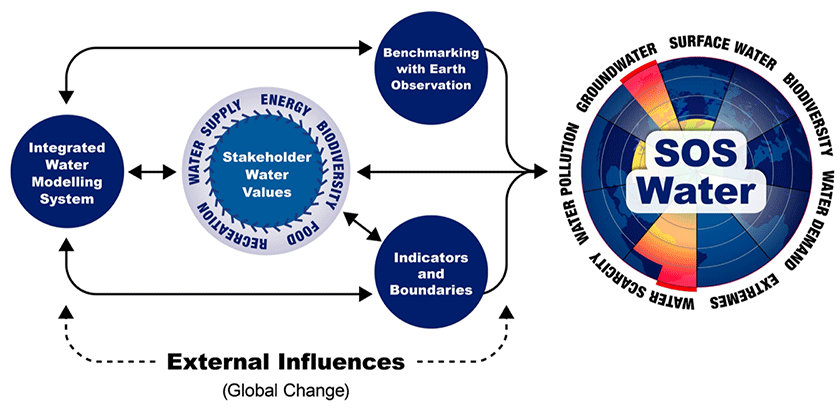

Natürliche Wasserressourcen werden vielfältig genutzt. Die Versorgung von Haushalten, Landwirtschaft, Industrie, Energiewirtschaft, Tourismus oder Ökosystemen unterscheidet sich regional sehr stark. Dadurch können unterschiedliche Engpässe und Nutzungskonflikte entstehen. Der Klimawandel verstärkt dieses Konfliktpotential, weil er auch die langfristige Verfügbarkeit von Wasserressourcen verändert. 

Das Konzept der gesicherten Handlungsoptionen (engl.: Safe Operating Space) ermöglicht die Erkennung und das Abwägen von solchen Engpässen und Nutzungskonflikten. Dazu werden hydrologische Modelle, Umweltdaten und Szenarien für die regionale Entwicklung von Wasserverbrauch und -verfügbarkeit benötigt. Die Modellsimulationen ermöglichen schliesslich optimale Kompromisse für das zukünftige Ressourcenmanagement. 

Das Projekt SOS-Water demonstriert die Abschätzung des Safe Operating Space in den Einzugsgebieten der Donau, des Rheins, des Jucar und des Mekong. Die Eawag entwickelt neue Umweltinformationen aus Satellitendaten, mit denen die Modellsimulationen möglichst realistisch angepasst werden. Dazu gehören beispielsweise die Temperaturen, die Eisbedeckung oder der Schwebstoffgehalt von Oberflächengewässern.

Publikation

Extbase Variable Dump
array(2 items)
   publications => '32633' (5 chars)
   libraryUrl => '' (0 chars)
Extbase Variable Dump
array(1 item)
   0 => Snowflake\Publications\Domain\Model\Publicationprototypepersistent entity (uid=32633, pid=124)
      originalId => protected32633 (integer)
      authors => protected'Calamita, E.; Lever, J. J.; Albergel, C.; Woolway, 
         R. I.; Odermatt, D.
' (105 chars) title => protected'Detecting climate‐related shifts in lakes: a review of the use of satellit
         e Earth Observation
' (95 chars) journal => protected'Limnology and Oceanography' (26 chars) year => protected2024 (integer) volume => protected69 (integer) issue => protected'4' (1 chars) startpage => protected'723' (3 chars) otherpage => protected'741' (3 chars) categories => protected'' (0 chars) description => protected'Climate change exerts a profound impact on lakes, eliciting responses that r
         ange from gradual to abrupt transitions. When reaching critical tipping poin
         ts, the established lake dynamics stand to undergo substantial modifications
         , setting off a chain reaction that reverberates through the entire ecosyste
         m. This lake shift ripples into related ecosystem services and even influenc
         es the well-being of human communities. Despite the importance of lake shift
         s, we lack a systematic overview of their occurrence, mainly due to the lack
          of systematic data at the global scale. We reviewed the literature focusing
          on climate-related lake shifts and assessed how satellite Earth Observation
          (EO) has contributed to the research topic, and what we can unlock from thi
         s novel data. Our results show that EO data are used in only 9% of studies o
         n lake shifts, although this fraction has increased since 2012. EO data is m
         ost commonly used to assess shifts in surface extent, ice coverage, or phyto
         plankton phenology. These variables are directly observable and the spatio-t
         emporal resolution of EO satellites is of great advantage. But lake shifts c
         an also be identified indirectly from EO data, as in the example of the vert
         ical mixing of lake water, which can be described on the basis of surface pa
         tterns. In all possible applications, we expect increasing use of EO satelli
         tes in the future, including the development of early warning systems that p
         romise to provide timely alerts regarding impending lake shifts, thus servin
         g as a vanguard against abrupt alterations that could ripple through interco
         nnected ecosystem services.
' (1623 chars) serialnumber => protected'0024-3590' (9 chars) doi => protected'10.1002/lno.12498' (17 chars) uid => protected32633 (integer) _localizedUid => protected32633 (integer)modified _languageUid => protectedNULL _versionedUid => protected32633 (integer)modified pid => protected124 (integer)
Calamita, E.; Lever, J. J.; Albergel, C.; Woolway, R. I.; Odermatt, D. (2024) Detecting climate‐related shifts in lakes: a review of the use of satellite Earth Observation, Limnology and Oceanography, 69(4), 723-741, doi:10.1002/lno.12498, Institutional Repository

Kontakt

Michael Brechbühler Wissenschaftlicher Mitarbeitender Tel. +41 58 765 6785 Inviare e-mail

Zusammenarbeit