Abteilung Umweltchemie

Bioakkumulation in chemischer Risikoanalyse
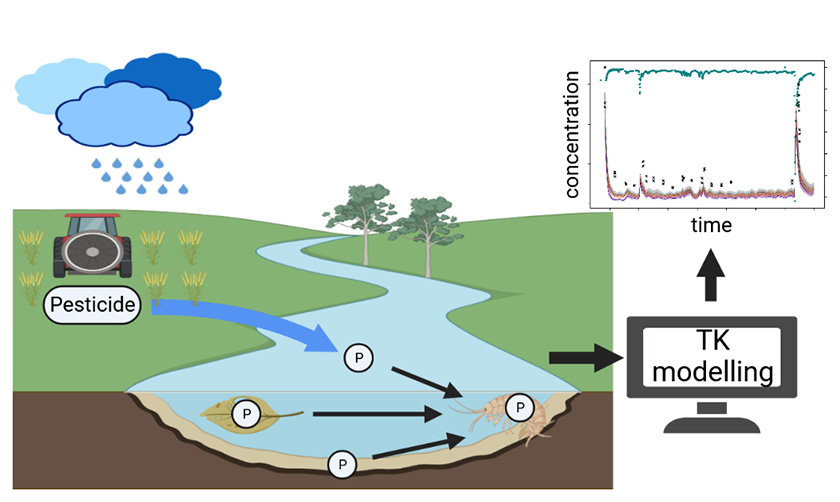
Interne Schadstoff Konzentrationen sind die Ursache für toxikologische Effekte auf Organismen. Vorhergehende Mikroverunreinigungs Monitoring-Studien mit aquatischen Invertebraten zeigen, dass die Gewebekonzentrationen vieler Schadstoffe wesentlich höher sind als anhand von Modellen, basierend auf Laborstudien, vorhergesagt. Dies ist insbesondere bei (semi-) polaren Verbindungen, einschließlich Pharmazeutika und systemischer Pestiziden der Fall. Solche Abweichungen können zu Unterschätzungen in der Umweltrisikoanalyse führen.

In diesem Projekt werden Prozesse welche die Bioakkumulation in Feld erhöhen können untersucht. Mittels einer Feldkampagne und Toxikokinetikmodellen wird die Applikation der Labordaten auf die Realität im Feld am Beispiel der Gammarus Spezies untersucht. Im Detail werden folgende Aspekte getestet:

  • Aufnahmepfad Nahrung
  • Aufnahmepfad Partikel
  • Unterschied in Biotransformation

Publikationen

Extbase Variable Dump
array(2 items)
   publications => '24072' (5 chars)
   libraryUrl => '' (0 chars)
Extbase Variable Dump
array(1 item)
   0 => Snowflake\Publications\Domain\Model\Publicationprototypepersistent entity (uid=24072, pid=124)
      originalId => protected24072 (integer)
      authors => protected'Lauper, B. B.; Anthamatten, E.; Raths, J.; Arlos, M
         .; Hollender, J.
' (97 chars) title => protected'Systematic underestimation of pesticide burden for invertebrates under field
          conditions: comparing the influence of dietary uptake and aquatic exposure
         dynamics
' (160 chars) journal => protected'ACS Environmental Au' (20 chars) year => protected2022 (integer) volume => protected2 (integer) issue => protected'2' (1 chars) startpage => protected'166' (3 chars) otherpage => protected'175' (3 chars) categories => protected'aquatic invertebrates; gammarids; pesticides; toxicokinetics; bioaccumulatio
         n; field study; dietary uptake; modeling
' (116 chars) description => protected'Pesticides used in agriculture can end up in nearby streams and can have a n
         egative impact on nontarget organisms such as aquatic invertebrates. During
         registration, bioaccumulation potential is often investigated using laborato
         ry tests only. Recent studies showed that the magnitude of bioaccumulation i
         n the field substantially differs from laboratory conditions. To investigate
          this discrepancy, we conducted a field bioaccumulation study in a stream kn
         own to receive pollutant loadings from agriculture. Our work incorporates me
         asurements of stream pesticide concentrations at high temporal resolution (e
         very 20 min), as well as sediment, leaves, and caged gammarid analyses (ever
         y 2-24 h) over several weeks. Of 49 investigated pesticides, 14 were detecte
         d in gammarids with highly variable concentrations of up to 140 ± 28 ng/g<s
         ub>ww</sub>. Toxicokinetic modeling using laboratory-derived uptake and depu
         ration rate constants for azoxystrobin, cyprodinil, and fluopyram showed tha
         t despite the highly resolved water concentrations measured, the pesticide b
         urden on gammarids remains underestimated by a factor of 1.9 ± 0.1 to 31 ±
          3.0, with the highest underestimations occurring after rain events. Includi
         ng dietary uptake from polluted detritus leaves and sediment in the model ex
         plained this underestimation only to a minor proportion. However, suspended
         solids analyzed during rain events had high pesticide concentrations, and up
         take from them could partially explain the underestimation after rain events
         . Additional comparison between the measured and modeled data showed that th
         e pesticide depuration in gammarids is slower in the field. This observation
          suggests that several unknown mechanisms may play a role, including lowered
          enzyme expression and mixture effects. Thus, it is important to conduct suc
         h retrospective risk assessments based on field investigations and adapt the
          registration accordingly.
' (1926 chars) serialnumber => protected'' (0 chars) doi => protected'10.1021/acsenvironau.1c00023' (28 chars) uid => protected24072 (integer) _localizedUid => protected24072 (integer)modified _languageUid => protectedNULL _versionedUid => protected24072 (integer)modified pid => protected124 (integer)
Lauper, B. B.; Anthamatten, E.; Raths, J.; Arlos, M.; Hollender, J. (2022) Systematic underestimation of pesticide burden for invertebrates under field conditions: comparing the influence of dietary uptake and aquatic exposure dynamics, ACS Environmental Au, 2(2), 166-175, doi:10.1021/acsenvironau.1c00023, Institutional Repository