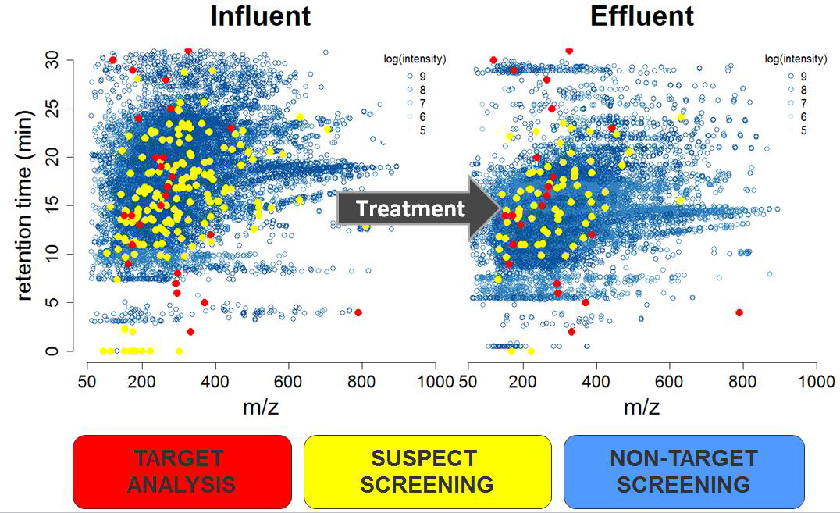
Charakterisierung der Abwasserbehandlung mit suspect und non-target Screening zur Verfahrensevaluation Ozonung und Aktivkohlebehandlung (SCREEN-O3TP)
In diesem Projekt wird die non-target Analytik angewandt, um das Verhalten der Gesamtheit von Stoffen im Abwasser über die verschiedenen Stufen der Abwasserbehandlung inklusive erweiterter Abwasserbehandlung mit Ozon und/oder Aktivkohle zu charakterisieren. Als Schwerpunkt werden dabei Standorte mit einer gewissen industriellen Belastung untersucht: ARA Glarnerland (Glarnerland Projekt), ARA ProRheno (ProRheno, AktiFilt Plus Projekt) und ARA Altenrhein (AVA). Des Weiteren wird gezielt mit einem Suspect Screening nach Transformationsprodukten der Ozonung (OTP) gesucht und deren Verhalten in der nachfolgenden Behandlung mit Aktivkohle untersucht. Ergänzend werden Biotest zur Beurteilung der Wasserqualität herangezogen. Die Resultate leisten einen Beitrag zur Verfahrensevaluation der erweiterten Abwasserbehandlung, insbesondere in Bezug auf die Bildung von OTPs und deren Elimination in einer nachfolgenden Aktivkohlebehandlung.
array(3 items)0 => Snowflake\Publications\Domain\Model\Publicationprototypepersistent entity (uid=22575, pid=124)originalId => protected22575 (integer)
authors => protected'Schollée, J. E.; Hollender, J.; McArdell, C. S.' (73 chars)
title => protected'Characterization of advanced wastewater treatment with ozone and activated c arbon using LC-HRMS based non-target screening with automated trend assignme nt' (154 chars)
journal => protected'Water Research' (14 chars)
year => protected2021 (integer)
volume => protected200 (integer)
issue => protected'' (0 chars)
startpage => protected'117209 (13 pp.)' (15 chars)
otherpage => protected'' (0 chars)
categories => protected'ozonation; micropollutants; non-target analysis; transformation product; ind ustrial wastewater' (94 chars)
description => protected'Advanced treatment is increasingly being applied to improve abatement of mic ropollutants in wastewater effluent and reduce their load to surface waters. In this study, non-target screening of high-resolution mass spectrometry (H RMS) data, collected at three Swiss wastewater treatment plants (WWTPs), was used to evaluate different advanced wastewater treatment setups, including (1) granular activated carbon (GAC) filtration alone, (2) pre-ozonation foll owed by GAC filtration, and (3) pre-ozonation followed by powdered activated carbon (PAC) dosed onto a sand filter. Samples were collected at each treat ment step of the WWTP and analyzed with reverse-phase liquid chromatography coupled to HRMS. Each WWTP received a portion of industrial wastewater and a prioritization method was applied to select non-target features potentially resulting from industrial activities. Approximately 37,000 non-target featu res were found in the influents of the WWTPs. A number of non-target feature s (1207) were prioritized as likely of industrial origin and 54 were identif ied through database spectral matching. The fates of all detected non-target features were assessed through a novel automated trend assignment method. A trend was assigned to each non-target feature based on the normalized inten sity profile for each sampling date. Results showed that 73±4% of influent non-target features and the majority of industrial features (89%) were well- removed (<em>i.e.</em>, >80% intensity reduction) during biological treat ment in all three WWTPs. Advanced treatment removed, on average, an addition al 11% of influent non-target features, with no significant differences obse rved among the different advanced treatment settings. In contrast, when cons idering a subset of 66 known micropollutants, advanced treatment was necessa ry to adequately abate these compounds and higher abatement was observed in fresh GAC (7,000-8,000 bed volumes (BVs)) compared to older GAC (18,000-48,0 00 BVs) (80% vs 56% of m...' (2615 chars)
serialnumber => protected'0043-1354' (9 chars)
doi => protected'10.1016/j.watres.2021.117209' (28 chars)
uid => protected22575 (integer)
_localizedUid => protected22575 (integer)modified_languageUid => protectedNULL
_versionedUid => protected22575 (integer)modifiedpid => protected124 (integer)1 => Snowflake\Publications\Domain\Model\Publicationprototypepersistent entity (uid=22653, pid=124)originalId => protected22653 (integer)
authors => protected'Gulde, R.; Rutsch, M.; Clerc, B.; Schollée, J. E.; von Gunten, U.; McArdell, C. S.' (123 chars)
title => protected'Formation of transformation products during ozonation of secondary wastewate r effluent and their fate in post-treatment: from laboratory- to full-scale' (151 chars)
journal => protected'Water Research' (14 chars)
year => protected2021 (integer)
volume => protected200 (integer)
issue => protected'' (0 chars)
startpage => protected'117200 (16 pp.)' (15 chars)
otherpage => protected'' (0 chars)
categories => protected'ozone; granular activated carbon; powdered activated carbon; sand filter; mi cropollutants; structure elucidation' (112 chars)
description => protected'Ozonation is increasingly applied in water and wastewater treatment for the abatement of micropollutants (MPs). However, the transformation products for med during ozonation (OTPs) and their fate in biological or sorptive post-tr eatments is largely unknown. In this project, a high-throughput approach, co mbining laboratory ozonation experiments and detection by liquid chromatogra phy high-resolution mass spectrometry (LC-HR-MS/MS), was developed and appli ed to identify OTPs formed during ozonation of wastewater effluent for a lar ge number of relevant MPs (total 87). For the laboratory ozonation experimen ts, a simplified experimental solution, consisting of surrogate organic matt er (methanol and acetate), was created, which produced ozonation conditions similar to realistic conditions in terms of ozone and hydroxyl radical expos ures. The 87 selected parent MPs were divided into 19 mixtures, which enable d the identification of OTPs with an optimized number of experiments. The fo llowing two approaches were considered to identify OTPs. (1) A screening of LC-HR-MS signal formation in these experiments was performed and revealed a list of 1749 potential OTP candidate signals associated to 70 parent MPs. Th is list can be used in future suspect screening studies. (2) A screening was performed for signals that were formed in both batch experiments and in sam ples of wastewater treatment plants (WWTPs). This second approach was ultima tely more time-efficient and was applied to four different WWTPs with ozonat ion (specific ozone doses in the range 0.23-0.55 gO<sub>3</sub>/gDOC), leadi ng to the identification of 84 relevant OTPs of 40 parent MPs in wastewater effluent. Chemical structures could be proposed for 83 OTPs through the inte rpretation of MS/MS spectra and expert knowledge in ozone chemistry. Forty-e ight OTPs (58%) have not been reported previously. The fate of the verified OTPs was studied in different post-treatment steps. During sand filtration, 87-89% of the OTPs were ...' (2420 chars)
serialnumber => protected'0043-1354' (9 chars)
doi => protected'10.1016/j.watres.2021.117200' (28 chars)
uid => protected22653 (integer)
_localizedUid => protected22653 (integer)modified_languageUid => protectedNULL
_versionedUid => protected22653 (integer)modifiedpid => protected124 (integer)2 => Snowflake\Publications\Domain\Model\Publicationprototypepersistent entity (uid=17022, pid=124)originalId => protected17022 (integer)
authors => protected'Schollée, J. E.; Bourgin, M.; von Gunten, U.; McArdell, C. S.; Hollender, J.' (112 chars)
title => protected'Non-target screening to trace ozonation transformation products in a wastewa ter treatment train including different post-treatments' (131 chars)
journal => protected'Water Research' (14 chars)
year => protected2018 (integer)
volume => protected142 (integer)
issue => protected'' (0 chars)
startpage => protected'267' (3 chars)
otherpage => protected'278' (3 chars)
categories => protected'advanced wastewater treatment; ozonation; non-target screening; transformati on products; micropollutants' (104 chars)
description => protected'Ozonation and subsequent post-treatments are increasingly implemented in was tewater treatment plants (WWTPs) for enhanced micropollutant abatement. Whil e this technology is effective, micropollutant oxidation leads to the format ion of ozonation transformation products (OTPs). Target and suspect screenin g provide information about known parent compounds and known OTPs, but for a more comprehensive picture, non-target screening is needed. Here, sampling was conducted at a full-scale WWTP to investigate OTP formation at four ozon e doses (2, 3, 4, and 5 mg/L, ranging from 0.3 to 1.0 gO<sub>3</sub>/gDOC) and subsequent changes during five post-treatment steps (<i>i.e.</i>, sand filter, fixed bed bioreactor, moving bed bioreactor, and two granular activa ted carbon (GAC) filters, relatively fresh and pre-loaded). Samples were mea sured with online solid-phase extraction coupled to liquid chromatography hi gh-resolution tandem mass spectrometry (LC-HRMS/MS) using electrospray ioniz ation (ESI) in positive and negative mode. Existing non-target screening wor kflows were adapted to (1) examine the formation of potential OTPs at four o zone doses and (2) compare the removal of OTPs among five post-treatments. I n (1), data processing included principal component analysis (PCA) and chemi cal knowledge on 31 possible oxidation reactions to prioritize non-target fe atures likely to be OTPs. Between 394 and 1328 unique potential OTPs were de tected in positive ESI for the four ozone doses tested; between 12 and 324 u nique potential OTPs were detected in negative ESI. At a specific ozone dose of 0.5 gO<sub>3</sub>/gDOC, 27 parent compounds were identified and were re lated to 69 non-target features selected as potential OTPs. Two OTPs were co nfirmed with reference standards (venlafaxine <i>N</i>-oxide and chlorothiaz ide); 34 other potential OTPs were in agreement with literature data and/or reaction mechanisms. In (2), hierarchical cluster analysis (HCA) was applied on profiles detected in...' (2489 chars)
serialnumber => protected'0043-1354' (9 chars)
doi => protected'10.1016/j.watres.2018.05.045' (28 chars)
uid => protected17022 (integer)
_localizedUid => protected17022 (integer)modified_languageUid => protectedNULL
_versionedUid => protected17022 (integer)modifiedpid => protected124 (integer)
Characterization of advanced wastewater treatment with ozone and activated carbon using LC-HRMS based non-target screening with automated trend assignment
Advanced treatment is increasingly being applied to improve abatement of micropollutants in wastewater effluent and reduce their load to surface waters. In this study, non-target screening of high-resolution mass spectrometry (HRMS) data, collected at three Swiss wastewater treatment plants (WWTPs), was used to evaluate different advanced wastewater treatment setups, including (1) granular activated carbon (GAC) filtration alone, (2) pre-ozonation followed by GAC filtration, and (3) pre-ozonation followed by powdered activated carbon (PAC) dosed onto a sand filter. Samples were collected at each treatment step of the WWTP and analyzed with reverse-phase liquid chromatography coupled to HRMS. Each WWTP received a portion of industrial wastewater and a prioritization method was applied to select non-target features potentially resulting from industrial activities. Approximately 37,000 non-target features were found in the influents of the WWTPs. A number of non-target features (1207) were prioritized as likely of industrial origin and 54 were identified through database spectral matching. The fates of all detected non-target features were assessed through a novel automated trend assignment method. A trend was assigned to each non-target feature based on the normalized intensity profile for each sampling date. Results showed that 73±4% of influent non-target features and the majority of industrial features (89%) were well-removed (i.e., >80% intensity reduction) during biological treatment in all three WWTPs. Advanced treatment removed, on average, an additional 11% of influent non-target features, with no significant differences observed among the different advanced treatment settings. In contrast, when considering a subset of 66 known micropollutants, advanced treatment was necessary to adequately abate these compounds and higher abatement was observed in fresh GAC (7,000-8,000 bed volumes (BVs)) compared to older GAC (18,000-48,000 BVs) (80% vs 56% of micropollutants were well-removed, respectively). Approximately half of the features detected in the WWTP effluents were features newly formed during the various treatment steps. In ozonation, between 1108-3579 features were classified as potential non-target ozonation transformation products (OTPs). No difference could be observed for their removal in GAC filters at the BVs investigated (70% of OTPs were well-removed on average). Similar amounts (67%) was observed with PAC (7.7-13.6 mg/L) dosed onto a sand filter, demonstrating that a post-treatment with activated carbon is efficient for the removal of OTPs.
Schollée, J. E.; Hollender, J.; McArdell, C. S. (2021) Characterization of advanced wastewater treatment with ozone and activated carbon using LC-HRMS based non-target screening with automated trend assignment, Water Research, 200, 117209 (13 pp.), doi:10.1016/j.watres.2021.117209, Institutional Repository
Formation of transformation products during ozonation of secondary wastewater effluent and their fate in post-treatment: from laboratory- to full-scale
Ozonation is increasingly applied in water and wastewater treatment for the abatement of micropollutants (MPs). However, the transformation products formed during ozonation (OTPs) and their fate in biological or sorptive post-treatments is largely unknown. In this project, a high-throughput approach, combining laboratory ozonation experiments and detection by liquid chromatography high-resolution mass spectrometry (LC-HR-MS/MS), was developed and applied to identify OTPs formed during ozonation of wastewater effluent for a large number of relevant MPs (total 87). For the laboratory ozonation experiments, a simplified experimental solution, consisting of surrogate organic matter (methanol and acetate), was created, which produced ozonation conditions similar to realistic conditions in terms of ozone and hydroxyl radical exposures. The 87 selected parent MPs were divided into 19 mixtures, which enabled the identification of OTPs with an optimized number of experiments. The following two approaches were considered to identify OTPs. (1) A screening of LC-HR-MS signal formation in these experiments was performed and revealed a list of 1749 potential OTP candidate signals associated to 70 parent MPs. This list can be used in future suspect screening studies. (2) A screening was performed for signals that were formed in both batch experiments and in samples of wastewater treatment plants (WWTPs). This second approach was ultimately more time-efficient and was applied to four different WWTPs with ozonation (specific ozone doses in the range 0.23-0.55 gO3/gDOC), leading to the identification of 84 relevant OTPs of 40 parent MPs in wastewater effluent. Chemical structures could be proposed for 83 OTPs through the interpretation of MS/MS spectra and expert knowledge in ozone chemistry. Forty-eight OTPs (58%) have not been reported previously. The fate of the verified OTPs was studied in different post-treatment steps. During sand filtration, 87-89% of the OTPs were stable. In granular activated carbon (GAC) filters, OTPs were abated with decreasing efficiency with increasing run times of the filters. For example, in a GAC filter with 16,000 bed volumes, 53% of the OTPs were abated, while in a GAC filter with 35,000 bed volumes, 40% of the OTPs were abated. The highest abatement (87% of OTPs) was observed when 13 mg/L powdered activated carbon (PAC) was dosed onto a sand filter.
Gulde, R.; Rutsch, M.; Clerc, B.; Schollée, J. E.; von Gunten, U.; McArdell, C. S. (2021) Formation of transformation products during ozonation of secondary wastewater effluent and their fate in post-treatment: from laboratory- to full-scale, Water Research, 200, 117200 (16 pp.), doi:10.1016/j.watres.2021.117200, Institutional Repository
Non-target screening to trace ozonation transformation products in a wastewater treatment train including different post-treatments
Ozonation and subsequent post-treatments are increasingly implemented in wastewater treatment plants (WWTPs) for enhanced micropollutant abatement. While this technology is effective, micropollutant oxidation leads to the formation of ozonation transformation products (OTPs). Target and suspect screening provide information about known parent compounds and known OTPs, but for a more comprehensive picture, non-target screening is needed. Here, sampling was conducted at a full-scale WWTP to investigate OTP formation at four ozone doses (2, 3, 4, and 5 mg/L, ranging from 0.3 to 1.0 gO3/gDOC) and subsequent changes during five post-treatment steps (i.e., sand filter, fixed bed bioreactor, moving bed bioreactor, and two granular activated carbon (GAC) filters, relatively fresh and pre-loaded). Samples were measured with online solid-phase extraction coupled to liquid chromatography high-resolution tandem mass spectrometry (LC-HRMS/MS) using electrospray ionization (ESI) in positive and negative mode. Existing non-target screening workflows were adapted to (1) examine the formation of potential OTPs at four ozone doses and (2) compare the removal of OTPs among five post-treatments. In (1), data processing included principal component analysis (PCA) and chemical knowledge on 31 possible oxidation reactions to prioritize non-target features likely to be OTPs. Between 394 and 1328 unique potential OTPs were detected in positive ESI for the four ozone doses tested; between 12 and 324 unique potential OTPs were detected in negative ESI. At a specific ozone dose of 0.5 gO3/gDOC, 27 parent compounds were identified and were related to 69 non-target features selected as potential OTPs. Two OTPs were confirmed with reference standards (venlafaxine N-oxide and chlorothiazide); 34 other potential OTPs were in agreement with literature data and/or reaction mechanisms. In (2), hierarchical cluster analysis (HCA) was applied on profiles detected in positive ESI mode across the WWTP and revealed 11 relevant trends. OTP removal was compared among the five post-treatments and 54–83% of the non-target features that appeared after ozonation were removed, with the two GAC filters performing the best. Overall, these data analysis strategies for non-target screening provide a useful tool to understand the behavior of unknown features during ozonation and post-treatment and to prioritize certain non-targets for further identification.
Schollée, J. E.; Bourgin, M.; von Gunten, U.; McArdell, C. S.; Hollender, J. (2018) Non-target screening to trace ozonation transformation products in a wastewater treatment train including different post-treatments, Water Research, 142, 267-278, doi:10.1016/j.watres.2018.05.045, Institutional Repository