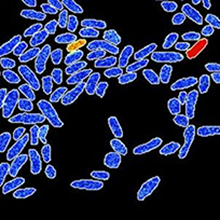
Bakterielle Strategien in fluktuierenden Umweltbedingungen
Die meisten Mikroorganismen in natürlichen und technischen Umwelten sind sich ständig ändernden Umweltbedingungen ausgesetzt. Wie Mikroorganismen mit solchen Umweltänderungen umgehen ist eine wichtige Frage. Wir entwickeln neue experimentelle Ansätze um individuellen Bakterienzellen über die Zeit zu folgen, sowohl im Labor wie auch in natürlichen aquatischen Umgebungen. Diese Experimente helfen Strategien zu identifizieren die es Bakterien erlauben mit Änderungen in den Umweltbedingungen umzugehen: wir beobachten dass Nährstofflimitierung zu Unterschieden im Stoffwechselverhalten zwischen einzelnen Bakterienzellen führt, und dass diese Unterschiede es bakteriellen Populationen erlauben mit raschen Wechseln in der Nährstoffverfügbarkeit umzugehen. Und wir finden dass Bakterien ein zelluläres Gedächtnis bilden können über Umweltsignale die sie in der Vergangenheit empfangen haben, und dadurch besser mit wiederkehrenden Stressbedingungen umgehen können.
array(2 items)0 => Snowflake\Publications\Domain\Model\Publicationprototypepersistent entity (uid=9179, pid=124)originalId => protected9179 (integer)
authors => protected'Zimmermann, M.; Escrig, S.; Hübschmann, T.; Kirf, M.&nb sp;K.; Brand, A.; Inglis, R. F.; Musat, N.; Müller,&nbs p;S.; Meibom, A.; Ackermann, M.; Schreiber, F.' (213 chars)
title => protected'Phenotypic heterogeneity in metabolic traits among single cells of a rare ba cterial species in its natural environment quantified with a combination of flow cell sorting and NanoSIMS' (182 chars)
journal => protected'Frontiers in Microbiology' (25 chars)
year => protected2015 (integer)
volume => protected6 (integer)
issue => protected'3' (1 chars)
startpage => protected'243 (11 pp.)' (12 chars)
otherpage => protected'' (0 chars)
categories => protected'FACS; dinitrogen fixation; Lago di Cadagno; green sulfur bacteria; phenotypi c noise; phenotypic variability; diversity; single-cell analysis' (140 chars)
description => protected'Populations of genetically identical microorganisms residing in the same env ironment can display marked variability in their phenotypic traits; this phe nomenon is termed phenotypic heterogeneity. The relevance of such heterogene ity in natural habitats is unknown, because phenotypic characterization of a sufficient number of single cells of the same species in complex microbial communities is technically difficult. We report a procedure that allows to m easure phenotypic heterogeneity in bacterial populations from natural enviro nments, and use it to analyze N<SUB>2</SUB> and CO<SUB>2</SUB> fixation of s ingle cells of the green sulfur bacterium <I>Chlorobium phaeobacteroides</I> from the meromictic lake Lago di Cadagno. We incubated lake water with <SUP >15</SUP>N<SUB>2</SUB> and <SUP>13</SUP>CO<SUB>2</SUB> under <I>in situ</I> conditions with and without NH<SUB>4</SUB><SUP>+</SUP>. Subsequently, we use d flow cell sorting with auto-fluorescence gating based on a pure culture is olate to concentrate <I>C. phaeobacteroides</I> from its natural abundance o f 0.2% to now 26.5% of total bacteria. <I>C. phaeobacteroides</I> cells were identified using catalyzed-reporter deposition fluorescence <I>in situ</I> hybridization (CARD-FISH) targeting the 16S rRNA in the sorted population wi th a species-specific probe. In a last step, we used nanometer-scale seconda ry ion mass spectrometry to measure the incorporation <SUP>15</SUP>N and <SU P>13</SUP>C stable isotopes in more than 252 cells. We found that <I>C. phae obacteroides</I> fixes N<SUB>2</SUB> in the absence of NH<SUB>4</SUB><SUP>+< /SUP>, but not in the presence of NH<SUB>4</SUB><SUP>+</SUP> as has previous ly been suggested. N<SUB>2</SUB> and CO<SUB>2</SUB> fixation were heterogene ous among cells and positively correlated indicating that N<SUB>2</SUB> and CO<SUB>2</SUB> fixation activity interact and positively facilitate each oth er in individual cells. However, because CARD-FISH identification cannot det ect genetic variability ...' (2377 chars)
serialnumber => protected'' (0 chars)
doi => protected'10.3389/fmicb.2015.00243' (24 chars)
uid => protected9179 (integer)
_localizedUid => protected9179 (integer)modified_languageUid => protectedNULL
_versionedUid => protected9179 (integer)modifiedpid => protected124 (integer)1 => Snowflake\Publications\Domain\Model\Publicationprototypepersistent entity (uid=9122, pid=124)originalId => protected9122 (integer)
authors => protected'Arnoldini, M.; Vizcarra, I. A.; Peña-Miller, R.; Stocke r, N.; Diard, M.; Vogel, V.; Beardmore, R. E.; Hard t, W.-D.; Ackermann, M.' (185 chars)
title => protected'Bistable expression of virulence genes in <I>Salmonella</I> leads to the for mation of an antibiotic-tolerant subpopulation' (122 chars)
journal => protected'PLoS Biology' (12 chars)
year => protected2014 (integer)
volume => protected12 (integer)
issue => protected'8' (1 chars)
startpage => protected'1' (1 chars)
otherpage => protected'8' (1 chars)
categories => protected'' (0 chars)
description => protected'Phenotypic heterogeneity can confer clonal groups of organisms with new func tionality. A paradigmatic example is the bistable expression of virulence ge nes in <I>Salmonella typhimurium</I>, which leads to phenotypically virulent and phenotypically avirulent subpopulations. The two subpopulations have be en shown to divide labor during <I>S. typhimurium</I> infections. Here, we s how that heterogeneous virulence gene expression in this organism also promo tes survival against exposure to antibiotics through a bet-hedging mechanism . Using microfluidic devices in combination with fluorescence time-lapse mic roscopy and quantitative image analysis, we analyzed the expression of virul ence genes at the single cell level and related it to survival when exposed to antibiotics. We found that, across different types of antibiotics and und er concentrations that are clinically relevant, the subpopulation of bacteri al cells that express virulence genes shows increased survival after exposur e to antibiotics. Intriguingly, there is an interplay between the two conseq uences of phenotypic heterogeneity. The bet-hedging effect that arises throu gh heterogeneity in virulence gene expression can protect clonal populations against avirulent mutants that exploit and subvert the division of labor wi thin these populations. We conclude that bet-hedging and the division of lab or can arise through variation in a single trait and interact with each othe r. This reveals a new degree of functional complexity of phenotypic heteroge neity. In addition, our results suggest a general principle of how pathogens can evade antibiotics: Expression of virulence factors often entails metabo lic costs and the resulting growth retardation could generally increase tole rance against antibiotics and thus compromise treatment.' (1804 chars)
serialnumber => protected'1544-9173' (9 chars)
doi => protected'10.1371/journal.pbio.1001928' (28 chars)
uid => protected9122 (integer)
_localizedUid => protected9122 (integer)modified_languageUid => protectedNULL
_versionedUid => protected9122 (integer)modifiedpid => protected124 (integer)
Phenotypic heterogeneity in metabolic traits among single cells of a rare bacterial species in its natural environment quantified with a combination of flow cell sorting and NanoSIMS
Populations of genetically identical microorganisms residing in the same environment can display marked variability in their phenotypic traits; this phenomenon is termed phenotypic heterogeneity. The relevance of such heterogeneity in natural habitats is unknown, because phenotypic characterization of a sufficient number of single cells of the same species in complex microbial communities is technically difficult. We report a procedure that allows to measure phenotypic heterogeneity in bacterial populations from natural environments, and use it to analyze N2 and CO2 fixation of single cells of the green sulfur bacterium Chlorobium phaeobacteroides from the meromictic lake Lago di Cadagno. We incubated lake water with 15N2 and 13CO2 under in situ conditions with and without NH4+. Subsequently, we used flow cell sorting with auto-fluorescence gating based on a pure culture isolate to concentrate C. phaeobacteroides from its natural abundance of 0.2% to now 26.5% of total bacteria. C. phaeobacteroides cells were identified using catalyzed-reporter deposition fluorescence in situ hybridization (CARD-FISH) targeting the 16S rRNA in the sorted population with a species-specific probe. In a last step, we used nanometer-scale secondary ion mass spectrometry to measure the incorporation 15N and 13C stable isotopes in more than 252 cells. We found that C. phaeobacteroides fixes N2 in the absence of NH4+, but not in the presence of NH4+ as has previously been suggested. N2 and CO2 fixation were heterogeneous among cells and positively correlated indicating that N2 and CO2 fixation activity interact and positively facilitate each other in individual cells. However, because CARD-FISH identification cannot detect genetic variability among cells of the same species, we cannot exclude genetic variability as a source for phenotypic heterogeneity in this natural population. Our study demonstrates the technical feasibility of measuring phenotypic heterogeneity in a rare bacterial species in its natural habitat, thus opening the door to study the occurrence and relevance of phenotypic heterogeneity in nature.
Zimmermann, M.; Escrig, S.; Hübschmann, T.; Kirf, M. K.; Brand, A.; Inglis, R. F.; Musat, N.; Müller, S.; Meibom, A.; Ackermann, M.; Schreiber, F. (2015) Phenotypic heterogeneity in metabolic traits among single cells of a rare bacterial species in its natural environment quantified with a combination of flow cell sorting and NanoSIMS, Frontiers in Microbiology, 6(3), 243 (11 pp.), doi:10.3389/fmicb.2015.00243, Institutional Repository
Bistable expression of virulence genes in Salmonella leads to the formation of an antibiotic-tolerant subpopulation
Phenotypic heterogeneity can confer clonal groups of organisms with new functionality. A paradigmatic example is the bistable expression of virulence genes in Salmonella typhimurium, which leads to phenotypically virulent and phenotypically avirulent subpopulations. The two subpopulations have been shown to divide labor during S. typhimurium infections. Here, we show that heterogeneous virulence gene expression in this organism also promotes survival against exposure to antibiotics through a bet-hedging mechanism. Using microfluidic devices in combination with fluorescence time-lapse microscopy and quantitative image analysis, we analyzed the expression of virulence genes at the single cell level and related it to survival when exposed to antibiotics. We found that, across different types of antibiotics and under concentrations that are clinically relevant, the subpopulation of bacterial cells that express virulence genes shows increased survival after exposure to antibiotics. Intriguingly, there is an interplay between the two consequences of phenotypic heterogeneity. The bet-hedging effect that arises through heterogeneity in virulence gene expression can protect clonal populations against avirulent mutants that exploit and subvert the division of labor within these populations. We conclude that bet-hedging and the division of labor can arise through variation in a single trait and interact with each other. This reveals a new degree of functional complexity of phenotypic heterogeneity. In addition, our results suggest a general principle of how pathogens can evade antibiotics: Expression of virulence factors often entails metabolic costs and the resulting growth retardation could generally increase tolerance against antibiotics and thus compromise treatment.
Arnoldini, M.; Vizcarra, I. A.; Peña-Miller, R.; Stocker, N.; Diard, M.; Vogel, V.; Beardmore, R. E.; Hardt, W.-D.; Ackermann, M. (2014) Bistable expression of virulence genes in Salmonella leads to the formation of an antibiotic-tolerant subpopulation, PLoS Biology, 12(8), 1-8, doi:10.1371/journal.pbio.1001928, Institutional Repository