Umsetzung von SSbD in der Praxis: Integration von Überlegungen zur aquatischen Toxizität in den F&E-Prozess für neuartige flammhemmende Vitrimere
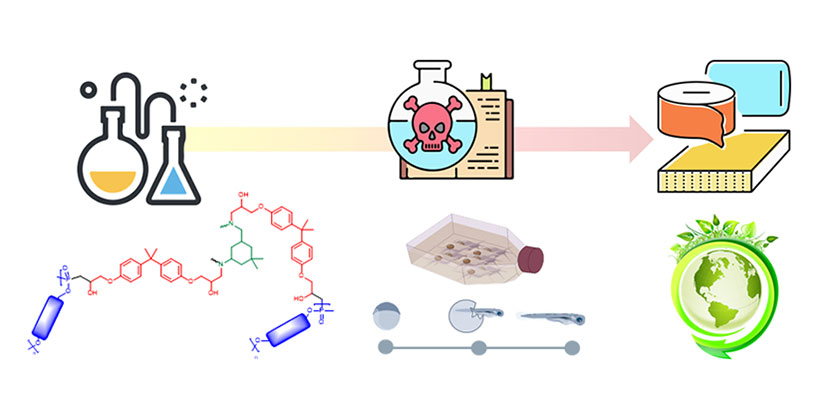
Experimentelle Strategie zur Einbeziehung von Überlegungen zur aquatischen Toxizität in die Entwicklung von „Safe-and-Sustainable-by-Design“-Materialien (Grafik: Ksenia Groh, Arvindh Sekar and needpix.com)
Das Konzept „Safe and Sustainable by Design“ (SSbD, wortwörtlich Sicheres und Nachhaltiges Design) wurde von der Europäischen Kommission im Jahr 2022 als freiwilliges Instrument eingeführt um den „grünen“ Übergang der chemischen Industrie in Europa zu erleichtern, im Einklang mit der EU-Strategie für Nachhaltigkeit bei Chemikalien (CSS). Währenddessen dieses Konzept eine inspirierende Vision für die Vereinbarkeit von chemischer Wirtschaft und Umweltschutzerfordernissen bietet, gibt es bisher nur wenige praktische Erfahrungen mit der Anwendung des SSbD in der Phase des Moleküldesigns oder mit seiner Integration in die Materialentwicklungsroutinen. Weitere Fortschritte bei der SSbD erfordern daher die Entwicklung zweckdienlicher (Engl. «fit-for-purpose») Werkzeuge sowie die Gestaltung intelligenter Arbeitsabläufe, wo effiziente Tests und deren Ergebnisse in den Innovationsprozess von Chemikalien und Materialien einbezogen wurden.
Im Projekt „SSbD-Vitrimers“ arbeiten wir zusammen mit Chemikern und Materialentwicklern an der Empa, um gemeinsam einen praktischen Arbeitsablauf für die Integration von Überlegungen zur aquatischen Toxizität in den Forschungs- und Entwicklungsprozess neuartiger Polymermaterialien zu entwickeln, wobei wir uns auf innovative flammhemmende Vitrimere als Fallstudie konzentrieren.
Das Projekt sieht die Entwicklung eines iterativen Arbeitsablaufs vor, bei dem In-silico-Tools und standardisierte alternative (tierversuchsfreie) Tests für aquatische Toxizität verwendet werden, um Toxizitätsdaten für Testmaterialien zu generieren. Die gesammelten Toxizitätsdaten werden mit Daten zu Materialeigenschaften und -funktionen integriert, um die optimale Zusammensetzung zu finden und/oder potenzielle Probleme oder weiteren Entwicklungsbedarf zu ermitteln und so die nächsten Schritte bei der Materialentwicklung und -optimierung mitzugestalten.
Neben der Verfolgung der skizzierten experimentellen Strategie zielt dieses Projekt auch darauf ab, das konzeptionelle Verständnis des SSbD-Rahmens und des damit verbundenen empirischen Testbedarfs zu verbessern.
array(4 items)0 => Snowflake\Publications\Domain\Model\Publicationprototypepersistent entity (uid=34987, pid=124)originalId => protected34987 (integer)
authors => protected'Leopold, A.; Bloor, M.; Groh, K.; Posthuma, L.; Sanderso n, H.; Schreiber, H.; Schür, C.; Thomas, P.' (140 chars)
title => protected'Research gaps and recommendations to improve the Safe and Sustainable by Des ign framework' (89 chars)
journal => protected'Integrated Environmental Assessment and Management' (50 chars)
year => protected2025 (integer)
volume => protected21 (integer)
issue => protected'4' (1 chars)
startpage => protected'735' (3 chars)
otherpage => protected'738' (3 chars)
categories => protected'' (0 chars)
description => protected'' (0 chars)
serialnumber => protected'1551-3777' (9 chars)
doi => protected'10.1093/inteam/vjaf059' (22 chars)
uid => protected34987 (integer)
_localizedUid => protected34987 (integer)modified_languageUid => protectedNULL
_versionedUid => protected34987 (integer)modifiedpid => protected124 (integer)1 => Snowflake\Publications\Domain\Model\Publicationprototypepersistent entity (uid=32823, pid=124)originalId => protected32823 (integer)
authors => protected'Posthuma, L.; Bloor, M.; Campos, B.; Groh, K.; Leopold,& nbsp;A.; Sanderson, H.; Schreiber, H.; Schür, C.; Thomas,&nb sp;P.' (157 chars)
title => protected'Green Swans countering chemical pollution' (41 chars)
journal => protected'Integrated Environmental Assessment and Management' (50 chars)
year => protected2024 (integer)
volume => protected20 (integer)
issue => protected'3' (1 chars)
startpage => protected'888' (3 chars)
otherpage => protected'891' (3 chars)
categories => protected'' (0 chars)
description => protected'If a problem has exponential features, its solution asks for counter-exponen tial approaches. Chemical pollution appears to be such a problem. Analyses o f chemical hazards to human health, biodiversity, and ecosystem services and estimates of the cost of inaction suggest the potential for adverse impacts , and analyses of trends in the chemical economy appear exponential in kind. Here, we argue that we need and can develop an exponential and application- focused mindset in thinking about solutions.' (500 chars)
serialnumber => protected'1551-3777' (9 chars)
doi => protected'10.1002/ieam.4915' (17 chars)
uid => protected32823 (integer)
_localizedUid => protected32823 (integer)modified_languageUid => protectedNULL
_versionedUid => protected32823 (integer)modifiedpid => protected124 (integer)2 => Snowflake\Publications\Domain\Model\Publicationprototypepersistent entity (uid=33402, pid=124)originalId => protected33402 (integer)
authors => protected'Leopold, A.; Bloor, M.; Campos, B.; Groh, K.; Posthuma,& nbsp;L.; Sanderson, H.; Schreiber, H.; Thomas, P.' (140 chars)
title => protected'SETAC–European Commission Green Deal Safe and sustainable by design consul tation series and anticipated end products' (118 chars)
journal => protected'SETAC Globe' (11 chars)
year => protected2024 (integer)
volume => protected0 (integer)
issue => protected'' (0 chars)
startpage => protected'(10 pp.)' (8 chars)
otherpage => protected'' (0 chars)
categories => protected'' (0 chars)
description => protected'' (0 chars)
serialnumber => protected'' (0 chars)
doi => protected'' (0 chars)
uid => protected33402 (integer)
_localizedUid => protected33402 (integer)modified_languageUid => protectedNULL
_versionedUid => protected33402 (integer)modifiedpid => protected124 (integer)3 => Snowflake\Publications\Domain\Model\Publicationprototypepersistent entity (uid=26237, pid=124)originalId => protected26237 (integer)
authors => protected'Groh, K. J.; Arp, H. P. H.; MacLeod, M.; Wang, Z.' (84 chars)
title => protected'Assessing and managing environmental hazards of polymers: historical develop ment, science advances and policy options' (117 chars)
journal => protected'Environmental Science: Processes and Impacts' (44 chars)
year => protected2023 (integer)
volume => protected25 (integer)
issue => protected'1' (1 chars)
startpage => protected'10' (2 chars)
otherpage => protected'25' (2 chars)
categories => protected'' (0 chars)
description => protected'Polymers are the main constituents of many materials and products in our mod ern world. However, their environmental safety is not assessed with the same level of detail as done for non-polymeric chemical substances. Moreover, th e fundamentals of contemporary regulatory approaches for polymers were devel oped in the early 1990s, with little change occurring since then. Currently, the European Commission is working on a proposal to initiate registration o f polymers under the European Union's (EU) chemicals legislation REACH. This provides a unique opportunity for regulation to catch up on recent scientif ic advances. To inform this process, we here critically appraise the suggest ed regulatory approaches to the environmental assessment and management of p olymers against the latest scientific findings regarding their environmental fate, exposure, and effects, and identify the remaining critical knowledge gaps. While we use the EU draft proposal as an example, our findings are bro adly applicable to other polymer legislations worldwide, due to the similari ty of polymer assessment criteria being used. We emphasize four major aspect s that require more attention in the regulation of polymers: (i) increased t ransparency about chemical identities, physical characteristics and grouping approaches for in-use polymers; (ii) improved understanding of the environm ental fate of polymers and materials composed of polymers across size and de nsity categories and exposure profiles; (iii) comprehensive assessment of th e environmental hazards of polymers, considering the effects of degradation and weathering and taking into account the actual uptake, long-term toxicity , and geophysical impacts; and (iv) consideration of the production volume a nd use/release patterns in determining regulatory data and testing requireme nts. Transitioning toward a toxic-free and sustainable circular economy will likely require additional policy instruments that will reduce the overall c omplexity and diversity ...' (2043 chars)
serialnumber => protected'2050-7887' (9 chars)
doi => protected'10.1039/D2EM00386D' (18 chars)
uid => protected26237 (integer)
_localizedUid => protected26237 (integer)modified_languageUid => protectedNULL
_versionedUid => protected26237 (integer)modifiedpid => protected124 (integer)
Leopold, A.; Bloor, M.; Groh, K.; Posthuma, L.; Sanderson, H.; Schreiber, H.; Schür, C.; Thomas, P. (2025) Research gaps and recommendations to improve the Safe and Sustainable by Design framework, Integrated Environmental Assessment and Management, 21(4), 735-738, doi:10.1093/inteam/vjaf059, Institutional Repository
Green Swans countering chemical pollution
If a problem has exponential features, its solution asks for counter-exponential approaches. Chemical pollution appears to be such a problem. Analyses of chemical hazards to human health, biodiversity, and ecosystem services and estimates of the cost of inaction suggest the potential for adverse impacts, and analyses of trends in the chemical economy appear exponential in kind. Here, we argue that we need and can develop an exponential and application-focused mindset in thinking about solutions.
Posthuma, L.; Bloor, M.; Campos, B.; Groh, K.; Leopold, A.; Sanderson, H.; Schreiber, H.; Schür, C.; Thomas, P. (2024) Green Swans countering chemical pollution, Integrated Environmental Assessment and Management, 20(3), 888-891, doi:10.1002/ieam.4915, Institutional Repository
Leopold, A.; Bloor, M.; Campos, B.; Groh, K.; Posthuma, L.; Sanderson, H.; Schreiber, H.; Thomas, P. (2024) SETAC–European Commission Green Deal Safe and sustainable by design consultation series and anticipated end products, SETAC Globe, (10 pp.), Institutional Repository
Assessing and managing environmental hazards of polymers: historical development, science advances and policy options
Polymers are the main constituents of many materials and products in our modern world. However, their environmental safety is not assessed with the same level of detail as done for non-polymeric chemical substances. Moreover, the fundamentals of contemporary regulatory approaches for polymers were developed in the early 1990s, with little change occurring since then. Currently, the European Commission is working on a proposal to initiate registration of polymers under the European Union's (EU) chemicals legislation REACH. This provides a unique opportunity for regulation to catch up on recent scientific advances. To inform this process, we here critically appraise the suggested regulatory approaches to the environmental assessment and management of polymers against the latest scientific findings regarding their environmental fate, exposure, and effects, and identify the remaining critical knowledge gaps. While we use the EU draft proposal as an example, our findings are broadly applicable to other polymer legislations worldwide, due to the similarity of polymer assessment criteria being used. We emphasize four major aspects that require more attention in the regulation of polymers: (i) increased transparency about chemical identities, physical characteristics and grouping approaches for in-use polymers; (ii) improved understanding of the environmental fate of polymers and materials composed of polymers across size and density categories and exposure profiles; (iii) comprehensive assessment of the environmental hazards of polymers, considering the effects of degradation and weathering and taking into account the actual uptake, long-term toxicity, and geophysical impacts; and (iv) consideration of the production volume and use/release patterns in determining regulatory data and testing requirements. Transitioning toward a toxic-free and sustainable circular economy will likely require additional policy instruments that will reduce the overall complexity and diversity of in-use polymers and polymeric materials.
Groh, K. J.; Arp, H. P. H.; MacLeod, M.; Wang, Z. (2023) Assessing and managing environmental hazards of polymers: historical development, science advances and policy options, Environmental Science: Processes and Impacts, 25(1), 10-25, doi:10.1039/D2EM00386D, Institutional Repository