EcoImpact 2.0: Wirkung der weitergehenden Abwasserreinigung auf die Toleranz von Periphyton gegenüber Mikroverunreinigungen
Die Aufrüstung von rund 100 Schweizer Abwasserreinigungsanlagen (ARA) zur spezifischen Entfernung von Mikroverunreinigungen (MV) bietet eine einmalige Gelegenheit, die Effizienz von Technologien zur MV-Eliminierung und die daraus resultierenden Veränderungen bei Wasserorganismen in Gewässern zu untersuchen. Im Rahmen von EcoImpact 1 wurden klare biologische Reaktionen auf das Vorhandensein von MV in geklärten Abwässern auf verschiedenen biologischen Organisationsstufen festgestellt – von Zellen über Organismen bis hin zu Lebensgemeinschaften. Es konnte gezeigt werden, dass der Biofilm auf der Flusssohle, auch Periphyton genannt, unterhalb von Abwasserreinigungsanlagen toleranter gegenüber den eingeleiteten MV ist als oberhalb. Diese Toleranz einzelner Lebensgemeinschaften auf spezifische Verunreinigungen PICT (= Pollution-Induced Community Tolerance) verschwand nach der Aufrüstung der ARA. Diese Erkenntnisse zeigt erstmals die Relevanz von PICT und Periphyton zur Untersuchung der biologischen Wirkung der Aufrüstung von ARAs im Gewässer.
Projektziele und Forschungsfragen:
EcoImpact 2.0 konzentriert sich auf die zuvor beobachtete Toleranzentwicklung des Periphytons als biologische Reaktion auf das Vorhandensein von MV. Das Ziel besteht darin, zu ermitteln, wie die PICT für einen Vergleich der biologischen Wirkung von Aufbereitungstechnologien herangezogen und ob PICT in der Praxis als Methode zur Analyse der Wasserqualität eingesetzt werden kann.
Die folgenden vier Forschungsfragen werden experimentell beantwortet untersucht:
F1. Lässt sich PICT bei Periphyton beobachten, welches sich in Modellrinnen mit ARA-Abwässern entwickelt? F2. Wird PICT beim Periphyton durch die MV-Belastung oder durch die Freisetzung toleranter Mikroorganismen aus den ARAs oder durch eine Kombination von beidem induziert? F3. Inwieweit beeinflussen verschiedene (Kombinationen von) Abwasserreinigungstechnologien die Toleranzentwicklung des Periphytons gegenüber MV? F4. Welche mögliche Rolle spielt die PICT für die zukünftige Überwachung der biologischen Wirkung einer Aufrüstung der ARAs?
Experimenteller Ansatz
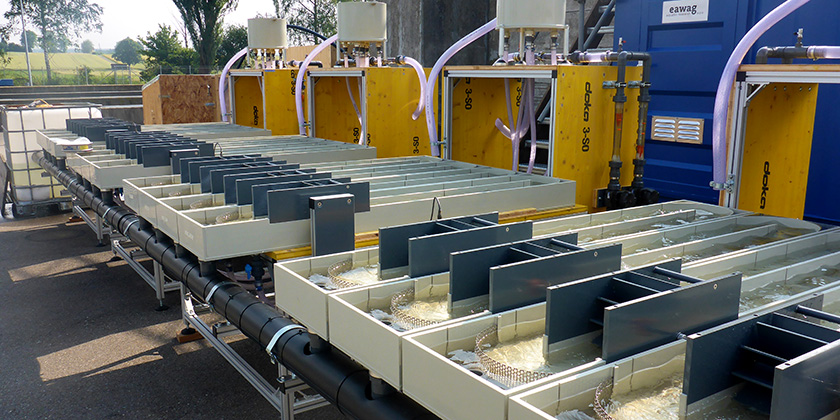
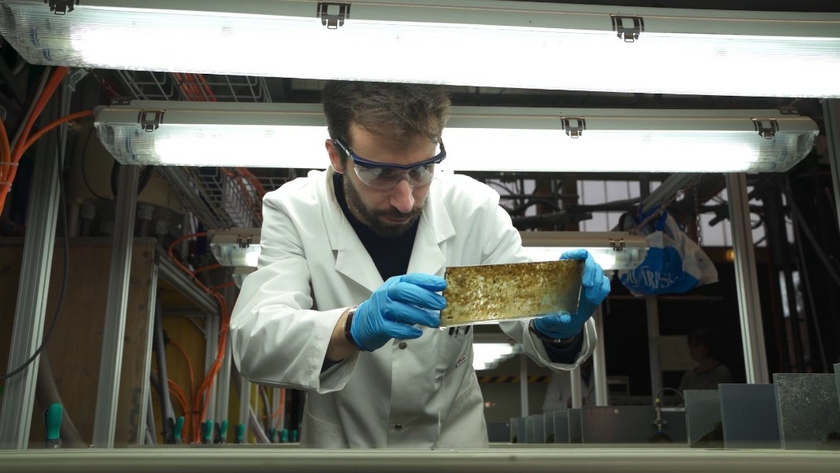
Im Rinnensystem Maiandros wurden Untersuchungen mit unterschiedlichen Graden experimenteller Kontrolle durchgeführt. Das System besteht aus 20 Rinnen, in denen Periphyton auf Glasplatten heranwächst. Die Durchflussrinnen wurden in der Versuchshalle der Eawag aufgebaut. Die chemische und biologische Zusammensetzung der ARA-Abwässer wurde mit verschieden kombinierten Reinigungsverfahren variiert. Dabei wird die Wirkung dieser Mischungen auf die chemische und biologische Wasserqualität mit Fokus auf die Toleranz, Struktur und Funktion des Periphytons als biologische Wirkungsindikatoren untersucht. Damit die Rolle der PICT für zukünftige Überwachungsprogramme ermittelt werden kann, werden neben den Experimenten im Rinnensystem auch Feldstudien an Standorten durchgeführt, an denen die ARAs aufgerüstet werden.
array(3 items)0 => Snowflake\Publications\Domain\Model\Publicationprototypepersistent entity (uid=30748, pid=124)originalId => protected30748 (integer)
authors => protected'Lafuente, E.; Carles, L.; Walser, J. C.; Giulio, M. ; Wullschleger, S.; Stamm, C.; Räsänen, K.' (135 chars)
title => protected'Effects of anthropogenic stress on hosts and their microbiomes: treated wast ewater alters performance and gut microbiome of a key detritivore (<em>Asell us aquaticus</em>)' (170 chars)
journal => protected'Evolutionary Applications' (25 chars)
year => protected2023 (integer)
volume => protected16 (integer)
issue => protected'4' (1 chars)
startpage => protected'824' (3 chars)
otherpage => protected'848' (3 chars)
categories => protected'chemical pollution; environmental stress; freshwater ecosystems; host–micr obiome interactions; isopods' (104 chars)
description => protected'Human activity is a major driver of ecological and evolutionary change in wi ld populations and can have diverse effects on eukaryotic organisms as well as on environmental and host-associated microbial communities. Although host –microbiome interactions can be a major determinant of host fitness, few s tudies consider the joint responses of hosts and their microbiomes to anthro pogenic changes. In freshwater ecosystems, wastewater is a widespread anthro pogenic stressor that represents a multifarious environmental perturbation. Here, we experimentally tested the impact of treated wastewater on a keyston e host (the freshwater isopod Asellus aquaticus) and its gut microbiome. We used a semi-natural flume experiment, in combination with 16S rRNA amplicon sequencing, to assess how different concentrations (0%, 30%, and 80%) of non filtered wastewater (i.e. with chemical toxicants, nutrients, organic partic les, and microbes) versus ultrafiltered wastewater (i.e. only dissolved poll utants and nutrients) affected host survival, growth, and food consumption a s well as mid- and hindgut bacterial community composition and diversity. Ou r results show that while host survival was not affected by the treatments, host growth increased and host feeding rate decreased with nonfiltered waste water – potentially indicating that A. aquaticus fed on organic matter and microbes available in nonfiltered wastewater. Furthermore, even though the midgut microbiome (diversity and composition) was not affected by any of our treatments, nonfiltered wastewater influenced bacterial composition (but no t diversity) in the hindgut. Ultrafiltered wastewater, on the other hand, af fected both community composition and bacterial diversity in the hindgut, an effect that in our system differed between sexes. While the functional cons equences of microbiome changes and their sex specificity are yet to be teste d, our results indicate that different components of multifactorial stressor s (i.e. different consti...' (2183 chars)
serialnumber => protected'1752-4571' (9 chars)
doi => protected'10.1111/eva.13540' (17 chars)
uid => protected30748 (integer)
_localizedUid => protected30748 (integer)modified_languageUid => protectedNULL
_versionedUid => protected30748 (integer)modifiedpid => protected124 (integer)1 => Snowflake\Publications\Domain\Model\Publicationprototypepersistent entity (uid=25790, pid=124)originalId => protected25790 (integer)
authors => protected'Carles, L.; Wullschleger, S.; Joss, A.; Eggen, R. I . L.; Schirmer, K.; Schuwirth, N.; Stamm, C.; Tlili,&nbs p;A.' (156 chars)
title => protected'Wastewater microorganisms impact microbial diversity and important ecologica l functions of stream periphyton' (108 chars)
journal => protected'Water Research' (14 chars)
year => protected2022 (integer)
volume => protected225 (integer)
issue => protected'' (0 chars)
startpage => protected'119119 (13 pp.)' (15 chars)
otherpage => protected'' (0 chars)
categories => protected'stream biofilm; prokaryotes; eukaryotes; DNA metabarcoding; micropollutants; pollution-induced community tolerance' (114 chars)
description => protected'Effluents of wastewater treatment plants can impact microbial communities in the receiving streams. However, little is known about the role of microorga nisms in wastewater as opposed to other wastewater constituents, such as nut rients and micropollutants. We aimed therefore at determining the impact of wastewater microorganisms on the microbial diversity and function of periphy ton, key microbial communities in streams. We used a flow-through channel sy stem to grow periphyton upon exposure to a mixture of stream water and unfil tered or ultra-filtered wastewater. Impacts were assessed on periphyton biom ass, activities and tolerance to micropollutants, as well as on microbial di versity. Our results showed that wastewater microorganisms colonized periphy ton and modified its community composition, resulting for instance in an inc reased abundance of Chloroflexi and a decreased abundance of diatoms and gre en algae. This led to shifts towards heterotrophy, as suggested by the chang es in nutrient stoichiometry and the increased mineralization potential of c arbon substrates. An increased tolerance towards micropollutants was only fo und for periphyton exposed to unfiltered wastewater but not to ultra-filtere d wastewater, suggesting that wastewater microorganisms were responsible for this increased tolerance. Overall, our results highlight the need to consid er the role of wastewater microorganisms when studying potential impacts of wastewater on the receiving water body.' (1483 chars)
serialnumber => protected'0043-1354' (9 chars)
doi => protected'10.1016/j.watres.2022.119119' (28 chars)
uid => protected25790 (integer)
_localizedUid => protected25790 (integer)modified_languageUid => protectedNULL
_versionedUid => protected25790 (integer)modifiedpid => protected124 (integer)2 => Snowflake\Publications\Domain\Model\Publicationprototypepersistent entity (uid=23265, pid=124)originalId => protected23265 (integer)
authors => protected'Carles, L.; Wullschleger, S.; Joss, A.; Eggen, R. I . L.; Schirmer, K.; Schuwirth, N.; Stamm, C.; Tlili,&nbs p;A.' (156 chars)
title => protected'Impact of wastewater on the microbial diversity of periphyton and its tolera nce to micropollutants in an engineered flow-through channel system' (143 chars)
journal => protected'Water Research' (14 chars)
year => protected2021 (integer)
volume => protected203 (integer)
issue => protected'' (0 chars)
startpage => protected'117486 (14 pp.)' (15 chars)
otherpage => protected'' (0 chars)
categories => protected'pollution-induced community tolerance; aquatic biofilm; passive sampler; org anic micropollutants; microbial diversity; 16S and 18S rRNA gene sequencing' (151 chars)
description => protected'Wastewater treatment plants (WWTPs) play an important role in retaining orga nic matter and nutrients but to a lesser extent micropollutants. Therefore, treated wastewater is recognized as a major source of multiple stressors, in cluding complex mixtures of micropollutants. These can potentially affect mi crobial communities in the receiving water bodies and the ecological functio ns they provide. In this study, we evaluated in flow-through channels the co nsequences of an exposure to a mixture of stream water and different percent ages of urban WWTP effluent, ranging from 0% to 80%, on the microbial divers ity and function of periphyton communities. Assuming that micropollutants ex ert a selective pressure for tolerant microorganisms within communities, we further examined the periphyton sensitivity to a micropollutant mixture extr acted from passive samplers that were immersed in the wastewater effluent. A s well, micropollutants in water and in periphyton were comprehensively quan tified. Our results show that micropollutants detected in periphyton differe d from those found in water, both in term of concentration and composition. Especially photosystem II inhibitors accumulated in periphyton more than oth er pesticides. Although effects of other substances cannot be excluded, this accumulation may have contributed to the observed higher tolerance of photo trophic communities to micropollutants upon exposure to 30% and 80% of waste water. On the contrary, no difference in tolerance was observed for heterotr ophic communities. Exposure to the gradient of wastewater led to structural differences in both prokaryotic and eukaryotic communities. For instance, th e relative abundance of cyanobacteria was higher with increasing percentage of wastewater effluent, whereas the opposite was observed for diatoms. Such results could indicate that differences in community structure do not necess arily lead to higher tolerance. This highlights the need to consider other w astewater constituents s...' (2512 chars)
serialnumber => protected'0043-1354' (9 chars)
doi => protected'10.1016/j.watres.2021.117486' (28 chars)
uid => protected23265 (integer)
_localizedUid => protected23265 (integer)modified_languageUid => protectedNULL
_versionedUid => protected23265 (integer)modifiedpid => protected124 (integer)
Effects of anthropogenic stress on hosts and their microbiomes: treated wastewater alters performance and gut microbiome of a key detritivore (Asellus aquaticus)
Human activity is a major driver of ecological and evolutionary change in wild populations and can have diverse effects on eukaryotic organisms as well as on environmental and host-associated microbial communities. Although host–microbiome interactions can be a major determinant of host fitness, few studies consider the joint responses of hosts and their microbiomes to anthropogenic changes. In freshwater ecosystems, wastewater is a widespread anthropogenic stressor that represents a multifarious environmental perturbation. Here, we experimentally tested the impact of treated wastewater on a keystone host (the freshwater isopod Asellus aquaticus) and its gut microbiome. We used a semi-natural flume experiment, in combination with 16S rRNA amplicon sequencing, to assess how different concentrations (0%, 30%, and 80%) of nonfiltered wastewater (i.e. with chemical toxicants, nutrients, organic particles, and microbes) versus ultrafiltered wastewater (i.e. only dissolved pollutants and nutrients) affected host survival, growth, and food consumption as well as mid- and hindgut bacterial community composition and diversity. Our results show that while host survival was not affected by the treatments, host growth increased and host feeding rate decreased with nonfiltered wastewater – potentially indicating that A. aquaticus fed on organic matter and microbes available in nonfiltered wastewater. Furthermore, even though the midgut microbiome (diversity and composition) was not affected by any of our treatments, nonfiltered wastewater influenced bacterial composition (but not diversity) in the hindgut. Ultrafiltered wastewater, on the other hand, affected both community composition and bacterial diversity in the hindgut, an effect that in our system differed between sexes. While the functional consequences of microbiome changes and their sex specificity are yet to be tested, our results indicate that different components of multifactorial stressors (i.e. different constituents of wastewater) can affect hosts and their microbiome in distinct (even opposing) manners and have a substantial impact on eco-evolutionary responses to anthropogenic stressors.
Lafuente, E.; Carles, L.; Walser, J. C.; Giulio, M.; Wullschleger, S.; Stamm, C.; Räsänen, K. (2023) Effects of anthropogenic stress on hosts and their microbiomes: treated wastewater alters performance and gut microbiome of a key detritivore (Asellus aquaticus), Evolutionary Applications, 16(4), 824-848, doi:10.1111/eva.13540, Institutional Repository
Wastewater microorganisms impact microbial diversity and important ecological functions of stream periphyton
Effluents of wastewater treatment plants can impact microbial communities in the receiving streams. However, little is known about the role of microorganisms in wastewater as opposed to other wastewater constituents, such as nutrients and micropollutants. We aimed therefore at determining the impact of wastewater microorganisms on the microbial diversity and function of periphyton, key microbial communities in streams. We used a flow-through channel system to grow periphyton upon exposure to a mixture of stream water and unfiltered or ultra-filtered wastewater. Impacts were assessed on periphyton biomass, activities and tolerance to micropollutants, as well as on microbial diversity. Our results showed that wastewater microorganisms colonized periphyton and modified its community composition, resulting for instance in an increased abundance of Chloroflexi and a decreased abundance of diatoms and green algae. This led to shifts towards heterotrophy, as suggested by the changes in nutrient stoichiometry and the increased mineralization potential of carbon substrates. An increased tolerance towards micropollutants was only found for periphyton exposed to unfiltered wastewater but not to ultra-filtered wastewater, suggesting that wastewater microorganisms were responsible for this increased tolerance. Overall, our results highlight the need to consider the role of wastewater microorganisms when studying potential impacts of wastewater on the receiving water body.
Carles, L.; Wullschleger, S.; Joss, A.; Eggen, R. I. L.; Schirmer, K.; Schuwirth, N.; Stamm, C.; Tlili, A. (2022) Wastewater microorganisms impact microbial diversity and important ecological functions of stream periphyton, Water Research, 225, 119119 (13 pp.), doi:10.1016/j.watres.2022.119119, Institutional Repository
Impact of wastewater on the microbial diversity of periphyton and its tolerance to micropollutants in an engineered flow-through channel system
Wastewater treatment plants (WWTPs) play an important role in retaining organic matter and nutrients but to a lesser extent micropollutants. Therefore, treated wastewater is recognized as a major source of multiple stressors, including complex mixtures of micropollutants. These can potentially affect microbial communities in the receiving water bodies and the ecological functions they provide. In this study, we evaluated in flow-through channels the consequences of an exposure to a mixture of stream water and different percentages of urban WWTP effluent, ranging from 0% to 80%, on the microbial diversity and function of periphyton communities. Assuming that micropollutants exert a selective pressure for tolerant microorganisms within communities, we further examined the periphyton sensitivity to a micropollutant mixture extracted from passive samplers that were immersed in the wastewater effluent. As well, micropollutants in water and in periphyton were comprehensively quantified. Our results show that micropollutants detected in periphyton differed from those found in water, both in term of concentration and composition. Especially photosystem II inhibitors accumulated in periphyton more than other pesticides. Although effects of other substances cannot be excluded, this accumulation may have contributed to the observed higher tolerance of phototrophic communities to micropollutants upon exposure to 30% and 80% of wastewater. On the contrary, no difference in tolerance was observed for heterotrophic communities. Exposure to the gradient of wastewater led to structural differences in both prokaryotic and eukaryotic communities. For instance, the relative abundance of cyanobacteria was higher with increasing percentage of wastewater effluent, whereas the opposite was observed for diatoms. Such results could indicate that differences in community structure do not necessarily lead to higher tolerance. This highlights the need to consider other wastewater constituents such as nutrients and wastewater-derived microorganisms that can modulate community structure and tolerance. By using engineered flow-through channels that mimic to some extent the required field conditions for the development of tolerance in periphyton, our study constitutes a base to investigate the mechanisms underlying the increased tolerance, such as the potential role of microorganisms originating from wastewater effluents, and different treatment options to reduce the micropollutant load in effluents.
Carles, L.; Wullschleger, S.; Joss, A.; Eggen, R. I. L.; Schirmer, K.; Schuwirth, N.; Stamm, C.; Tlili, A. (2021) Impact of wastewater on the microbial diversity of periphyton and its tolerance to micropollutants in an engineered flow-through channel system, Water Research, 203, 117486 (14 pp.), doi:10.1016/j.watres.2021.117486, Institutional Repository
EcotoxicoMicYR: Erstes internationales Webinar für junge Forscher im Bereich der mikrobiellen Ökotoxikologie 14 Dezember, 2021 - Louis Carles, Postdoktorand in der Abteilung für Umwelttoxikologie, gewann den Preis für die beste Live-Präsentation während des Webinars "EcotoxicoMic for Young Researchers". Er präsentierte seine im Rahmen des Projekts EcoImpact 2.0 durchgeführte Arbeit über die Auswirkungen von Abwässern auf Biofilme in Fließgewässern. Louis Carles ist nun eingeladen, seine Arbeit auf der Konferenz EcotoxicoMic 2022 (Montpellier, Frankreich, 15.-18. November 2022) vorzustellen.