Archiv Detail

Folgen des Pestizideinsatzes in den Tropen

27 giugno 2023 | Andri Bryner

Während der Einsatz von Pestiziden in Industriestaaten immer kritischer hinterfragt wird, ist in tropischen Ländern über dessen Folgen für die Gesundheit von Mensch und Umwelt weniger bekannt. Das interdisziplinäre Projekt «Pestrop» ändert das und zeigt auf, wo die Hebel angesetzt werden müssen.

Geht es um Wasser im globalen Süden, steht meist die mikrobiologische Qualität im Fokus. Kein Wunder, verbreiten sich doch Krankheiten wie Cholera oder Typhus über verschmutztes Trinkwasser. Pestizide sind in tropischen Regionen dagegen ein wenig erforschtes Thema. Nun hat jedoch ein Team mit Expertinnen und Experten aus Umweltchemie, Humantoxikologie sowie Politikwissenschaften in zwei Testregionen in Costa Rica und Uganda von 2017 bis 2020 untersucht, welche Pestizide dort zum Einsatz kommen und welche Wirkstoffe in Bächen sowie bei der Trinkwassergewinnung gefunden werden. Gleichzeitig wurde erforscht, wie Landwirtinnen und Landwirte mit Pestiziden umgehen und wie gut sie über deren Risiken informiert sind. Das Team fand klare Nachweise für langfristige negative Auswirkungen des Pestizideinsatzes auf die Gesundheit von Landwirtinnen und Landwirten. Zudem deckte das Projekt Defizite auf: bei Umweltdaten, bei einer ungenügenden Beratung der Bäuerinnen und Bauern und bei veralteten gesetzlichen Vorgaben zum Pestizideinsatz.
 

Überraschende Insektizidfunde

Im Fokus des Projekts standen «moderne», oft polare Wirkstoffe wie Fungizide und Insektizide. Zu denen gibt es sowohl in Afrika als auch in Zentralamerika noch kaum Regulierungen. Sie werden aber offensichtlich breit angewendet. In einzelnen Proben aus Bächen fanden die Forschenden Wirkstoffe in Konzentrationen, die deutlich über den Grenzwerten lagen, wie sie die Schweiz kennt. Und auch in Bohrlöchern und Weihern, aus denen die Bevölkerung ihr Trinkwasser bezieht, wurden problematische Konzentrationen gefunden. Ausserdem – und das war überraschend – fand das Team Substanzen im Wasser, die kaum auf den Feldern versprüht werden, darunter das in der Schweiz inzwischen verbotene Insektizid Chlorpyrifos. Die Forschenden vermuten, dass das Mittel zur Bekämpfung von Mücken und Milben in Ställen eingesetzt wird und zum Beispiel mit Hofdünger in die Umwelt gelangt.

Das Projekt «Pestrop» wurde gemeinsam geleitet vom Wasserforschungsinstitut Eawag und dem Schweizerischen Tropen- und Public Health-Institut.

Philipp Staudacher über den Einsatz von Pestiziden in Entwicklungsländern

Vortrag am Eawag Infotag 2023

Am Eawag Infotag «Wasserforschung für nachhaltige Entwicklung» am 14. September 2023 in Dübendorf wird Christian Stamm, stellvertretender Direktor der Eawag, die Untersuchungen der Eawag zum Einsatz von Pestiziden im Globalen Süden, aber auch in der Schweiz näher beleuchten und die Forschungsresultate vorstellen. Er wird insbesondere den Zielkonflikt zwischen Pflanzenschutz versus Umwelt- und Gesundheitsschutz erläutern, die Ursachen der Probleme identifizieren und mögliche Lösungsstrategien skizzieren.

Weitere Informationen zum Programm des Eawag Infotages und zur Anmeldung

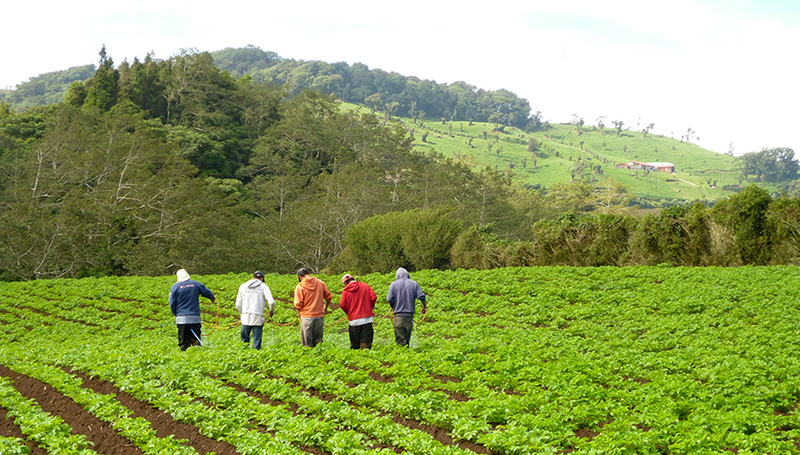
Titelbild: Bauern beim Spritzen von Gemüse in der Region Zarcero, Costa Rica. (Foto: Mirko Winkler, Swiss TPH)
 

Originalpublikation

Extbase Variable Dump
array(3 items)
   publications => '25705' (5 chars)
   libraryUrl => '' (0 chars)
   layout => '0' (1 chars)
Extbase Variable Dump
array(1 item)
   0 => Snowflake\Publications\Domain\Model\Publicationprototypepersistent entity (uid=25705, pid=124)
      originalId => protected25705 (integer)
      authors => protected'Oltramare, C.; Weiss, F. T.; Staudacher, P.; Kibirango,&
         nbsp;O.; Atuhaire, A.; Stamm, C.
' (118 chars) title => protected'Pesticides monitoring in surface water of a subsistence agricultural catchme
         nt in Uganda using passive samplers
' (111 chars) journal => protected'Environmental Science and Pollution Research' (44 chars) year => protected2023 (integer) volume => protected30 (integer) issue => protected'9' (1 chars) startpage => protected'10312' (5 chars) otherpage => protected'10328' (5 chars) categories => protected'smallholder farming; surface water; drinking water; pesticides; passive samp
         ling; environmental monitoring; Uganda; high-resolution mass spectrometry
' (149 chars) description => protected'Convolutional Neural Networks (CNNs) offer an alternative to the image cross
         -correlation methods used in Particle Image Velocimetry (PIV) to reconstruct
          the fluid velocity field from the experimental recording. Despite the flexi
         bility of CNNs, the accuracy and robustness of the standard image processing
          remains unsurpassed for general PIV data. As CNNs are non-linear and typica
         lly entail up to millions of trainable parameters, they require large and ca
         refully designed training datasets to avoid over-fitting and to obtain resul
         ts that are accurate for a wide range of flow conditions and length scales.
         Most training datasets consist of PIV-like data that are generated from disp
         lacement fields resulting from numerical flow simulations, which, in additio
         n of being computationally expensive, may be able to inform the network only
          about relatively few classes of flow problems. To overcome this issue and i
         mprove the accuracy of the velocity reconstructed by CNNs, we propose to tra
         in the networks with synthetic PIV-like data generated from random displacem
         ent fields. The underlying idea is that the training dataset simply needs to
          teach the network about the kinematic relationship between position and vel
         ocity. These kinematic training datasets are computationally inexpensive and
          may allow a much richer variability in terms of length scales by varying th
         e generation parameters. By training a state-of-the-art CNN, we investigate
         the accuracy of the reconstructed displacement and velocity with synthetic a
         nd experimental test cases, such as a sinusoidal flow and wind-tunnel data f
         rom a turbulent-boundary-layer and a cylinder-wake experiment. We demonstrat
         e that kinematic training can drastically improve the accuracy of the CNN an
         d allows the network to outperform conventional cross-correlation methods, b
         eing more robust with respect to data noise and providing reconstructed velo
         city fields that have considerably higher spatial resolution (at pixel level
         ).
' (1978 chars) serialnumber => protected'0944-1344' (9 chars) doi => protected'10.1007/s11356-022-22717-2' (26 chars) uid => protected25705 (integer) _localizedUid => protected25705 (integer)modified _languageUid => protectedNULL _versionedUid => protected25705 (integer)modified pid => protected124 (integer)
Oltramare, C.; Weiss, F. T.; Staudacher, P.; Kibirango, O.; Atuhaire, A.; Stamm, C. (2023) Pesticides monitoring in surface water of a subsistence agricultural catchment in Uganda using passive samplers, Environmental Science and Pollution Research, 30(9), 10312-10328, doi:10.1007/s11356-022-22717-2, Institutional Repository

Finanzierung / Kooperationen

  • Eawag
  • Schweizerisches Tropen- und Public Health-Institut (Swiss TPH)
  • Universität Bern
  • Universität Basel
  • Nationale Universität, Costa Rica
  • Makerere-Universität, Uganda
  • Uganda National Association of Community and Occupational Health (UNACOH)