CWIS markiert einen Paradigmenwechsel in der städtischen Abwasserentsorgung und rückt Gerechtigkeit, öffentliche Gesundheit, Umweltschutz sowie die Koexistenz hybrider Abwassersysteme in den Fokus. Dieses Konzept befindet sich in kontinuierlicher Weiterentwicklung, wobei Forschung und Praxis sich gegenseitig befruchten. Ziel ist es, einen Konsens zu schaffen, indem wichtige Akteure des Sektors wie die Weltbank, die Gates Stiftung, NROs wie WaterAid, sowie andere zusammengebracht werden, um ihre Anstrengungen an einer gemeinsamen Front zu bündeln.
Sandec nimmt bei der Forschung im Bereich der städtischen Abwasserentsorgung eine führende Rolle ein, und mehrere Projekte tragen zur CWIS-Initiative bei. Die folgenden Projekte haben einen direkten Bezug
CWIS Planung
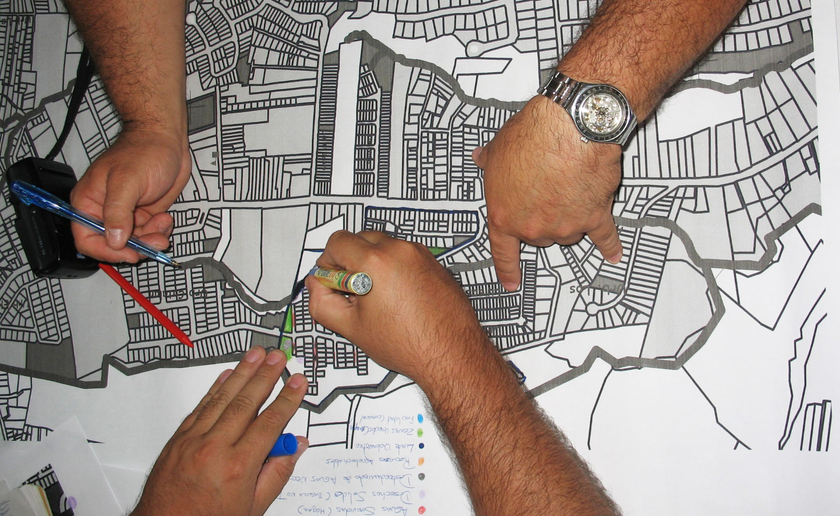
Im Rahmen dieses Projekts wurde eine innovative Planungsmethodik namens "Bridged Approach to Inclusive Planning (BAIS)" entwickelt. Diese Methodik zielt darauf ab, die städtische Abwasserentsorgung für Städte in Entwicklungsländern nach den CWIS-Prinzipien zu planen. Sie verbindet Top-down- und Bottom-up-Planungsansätze für unterschiedliche sanitäre Kontexte. Projektschwerpunkt liegt in Indien, wo die Abwasserentsorgung höchste Priorität hat, sowie in anderen Ländern südlich der Sahara und in Lateinamerika nimmt diese Forschung eine ganzheitliche Perspektive auf die Planung für CWIS ein.
array(1 item)0 => Snowflake\Publications\Domain\Model\Publicationprototypepersistent entity (uid=25653, pid=124)originalId => protected25653 (integer)
authors => protected'Sankara Narayan, A.' (24 chars)
title => protected'Planning citywide inclusive sanitation. Mapping the paradigm shift in the Gl obal and Indian context' (99 chars)
journal => protected'' (0 chars)
year => protected2022 (integer)
volume => protected0 (integer)
issue => protected'' (0 chars)
startpage => protected'182 p' (10 chars)
otherpage => protected'' (0 chars)
categories => protected'' (0 chars)
description => protected'Sanitation is fundamental to a city’s health, liveability, and social and economic development. Yet, as the world continues to urbanise, progress in u rban sanitation is outpaced by rapid urbanisation and population growth. Tod ay, about 40% of the world’s urban residents do not have safely managed sa nitation, with a vast majority of them are living in low- and middle-income countries (LMICs). In the last five decades, numerous international developm ent agendas on urban sanitation have been set and failed to reach the expect ed sanitation outcomes in LMICs. Reasons for this failure include poor plann ing, narrow infrastructure focussed approach, inadequate consideration of co ntextual factors, lack of attention to policy and institutions, and absence of community involvement. [...]<br /><br />Die Abwasserentsorgung ist von gr undlegender Bedeutung für die Gesundheit, die Lebensqualität sowie die soz iale und wirtschaftliche Entwicklung einer Stadt. Doch während die Welt imm er weiter verstädtert, werden die Fortschritte bei der städtischen Abwasse rentsorgung durch die rasche Urbanisierung und das Bevölkerungswachstum üb erholt. Heute verfügen etwa 40 % der Stadtbewohner weltweit nicht über ein e sichere Abwasserentsorgung, wobei die überwiegende Mehrheit von ihnen in Ländern mit niedrigem und mittlerem Einkommen (LMICs) lebt. In den letzten fünf Jahrzehnten wurden zahlreiche internationale Entwicklungspläne für d ie städtische Abwasserentsorgung aufgestellt, ohne dass die erwarteten Erge bnisse in den LMICs erreicht wurden. Zu den Gründen für dieses Scheitern g ehören schlechte Planung, ein eng auf die Infrastruktur ausgerichteter Ansa tz, eine unzureichende Berücksichtigung kontextbezogener Faktoren, mangelnd e Aufmerksamkeit für Politik und Institutionen sowie eine fehlende Einbezie hung der Bevölkerung. [...]' (1852 chars)
serialnumber => protected'' (0 chars)
doi => protected'10.3929/ethz-b-000561822' (24 chars)
uid => protected25653 (integer)
_localizedUid => protected25653 (integer)modified_languageUid => protectedNULL
_versionedUid => protected25653 (integer)modifiedpid => protected124 (integer)
Planning citywide inclusive sanitation. Mapping the paradigm shift in the Global and Indian context
Sanitation is fundamental to a city’s health, liveability, and social and economic development. Yet, as the world continues to urbanise, progress in urban sanitation is outpaced by rapid urbanisation and population growth. Today, about 40% of the world’s urban residents do not have safely managed sanitation, with a vast majority of them are living in low- and middle-income countries (LMICs). In the last five decades, numerous international development agendas on urban sanitation have been set and failed to reach the expected sanitation outcomes in LMICs. Reasons for this failure include poor planning, narrow infrastructure focussed approach, inadequate consideration of contextual factors, lack of attention to policy and institutions, and absence of community involvement. [...]
Die Abwasserentsorgung ist von grundlegender Bedeutung für die Gesundheit, die Lebensqualität sowie die soziale und wirtschaftliche Entwicklung einer Stadt. Doch während die Welt immer weiter verstädtert, werden die Fortschritte bei der städtischen Abwasserentsorgung durch die rasche Urbanisierung und das Bevölkerungswachstum überholt. Heute verfügen etwa 40 % der Stadtbewohner weltweit nicht über eine sichere Abwasserentsorgung, wobei die überwiegende Mehrheit von ihnen in Ländern mit niedrigem und mittlerem Einkommen (LMICs) lebt. In den letzten fünf Jahrzehnten wurden zahlreiche internationale Entwicklungspläne für die städtische Abwasserentsorgung aufgestellt, ohne dass die erwarteten Ergebnisse in den LMICs erreicht wurden. Zu den Gründen für dieses Scheitern gehören schlechte Planung, ein eng auf die Infrastruktur ausgerichteter Ansatz, eine unzureichende Berücksichtigung kontextbezogener Faktoren, mangelnde Aufmerksamkeit für Politik und Institutionen sowie eine fehlende Einbeziehung der Bevölkerung. [...]
Das ConCaD Projekt hat zum Ziel, die Beratungskapazitäten des Privatsektors für die Planung, Gestaltung und Umsetzung einer flächendeckenden, inklusiven Abwasserentsorgung auszubauen. Durch den Ausbau der Beratungskapazitäten sollen die Bereitstellung und Nachhaltigkeit von Sanitärdienstleistungen für alle verbessert werden. Zudem soll die Wirkung von Investitionen in die Sanitärversorgung auf städtischer Ebene in Afrika und in Südasien erhöht werden, wobei der Fokus auf groß angelegten Programme der Siedlungswasserwirtschaft liegt, die von Regierungen und/oder internationalen Finanzierungsinstitutionen und Entwicklungspartnern finanziert werden.
Towards CWIS Series (Auf dem Weg zu CWIS)
Die Video-Serie Towards CWIS Series porträtiert afrikanische und asiatische Städte, die sich auf dem Weg zu einer stadtweiten inklusiven Abwasserentsorgung befinden. Abwasserexperten aus Kampala (Uganda), Lusaka (Sambia), Kathmandu (Nepal), Abidjan (Elfenbeinküste) und Dhaka (Bangladesch) erzählen die Geschichte der Abwasserentsorgung in ihren Städten, gewähren persönliche Einblicke in ihre Arbeit, liefern Hintergrundinformationen über die aktuelle Situation der Abwasserentsorgung und teilen ihre Visionen. Sektor Innovationen werden dabei besonders hervorgehoben.
array(13 items)0 => Snowflake\Publications\Domain\Model\Publicationprototypepersistent entity (uid=33253, pid=124)originalId => protected33253 (integer)
authors => protected'Wallock, W.; Narayan, A. S.; Thomson, P.' (60 chars)
title => protected'Exploring the barriers to scaling up sanitation enterprises using Q-methodol ogy' (79 chars)
journal => protected'ACS ES&T Water' (14 chars)
year => protected2024 (integer)
volume => protected4 (integer)
issue => protected'9' (1 chars)
startpage => protected'3986' (4 chars)
otherpage => protected'3995' (4 chars)
categories => protected'water; sanitation; SDG6; Q-method; sustainability; enterprise; LMICs' (68 chars)
description => protected'Despite decades of effort, progress in safely managed sanitation─a public sector mandate─is stalling due to limited public funding and poor governan ce, among other reasons. As a result, public health has suffered and environ mental degradation has continued. Social enterprises that use innovative bus iness models to provide on-site sanitation services, also known as sanitatio n enterprises, are considered an emerging solution. However, sanitation ente rprises have not yet successfully replaced public provision at scale. This w ork explores the barriers that sanitation enterprises encounter in lower- an d middle-income countries. Q-Method, a mixed-methods approach that assesses social perspectives on an issue, is used to evaluate major barriers and grou ps of dominant perception for 19 sanitation enterprises operating across 20 countries. A total of 25 mutually exclusive, collectively exhaustive barrier s are identified, ranging from affording capital expenses to navigating poli tical corruption. The results show that most of the identified barriers fall into the financial barrier category, with reaching economies of scale being the greatest obstacle for sanitation enterprises. On the basis of these res ults, the premise of independent profitability underlying the sanitation ent erprise value proposition should be reevaluated. Four enterprise types are p roposed and can explain half of the variance among the sanitation enterprise s studied. The context of a sanitation enterprise, including its countries o f operation, size, customer base, sources of revenue, and section of the san itation value chain, influences the barriers that the enterprise encounters. This research underscores the crucial role of context in influencing barrie rs for sanitation enterprises, emphasizing the need for investment and for p olicy makers to take these contextual dimensions into account.' (1886 chars)
serialnumber => protected'' (0 chars)
doi => protected'10.1021/acsestwater.4c00274' (27 chars)
uid => protected33253 (integer)
_localizedUid => protected33253 (integer)modified_languageUid => protectedNULL
_versionedUid => protected33253 (integer)modifiedpid => protected124 (integer)1 => Snowflake\Publications\Domain\Model\Publicationprototypepersistent entity (uid=33665, pid=124)originalId => protected33665 (integer)
authors => protected'Narayan, A. S.; Dorea, C.; Willetts, J.; Friedman, L.; Kalbar, P.; Chandran, K.' (114 chars)
title => protected'A portfolio approach to achieving universal sanitation' (54 chars)
journal => protected'Nature Water' (12 chars)
year => protected2024 (integer)
volume => protected2 (integer)
issue => protected'11' (2 chars)
startpage => protected'1044' (4 chars)
otherpage => protected'1047' (4 chars)
categories => protected'' (0 chars)
description => protected'Sanitation could evolve beyond its traditional focus on public health and en vironmental protection to address broader challenges. A portfolio approach i s proposed, integrating diverse systems at various scales to optimize benefi ts including economic value, resource efficiency, climate resilience and hum an dignity.' (315 chars)
serialnumber => protected'' (0 chars)
doi => protected'10.1038/s44221-024-00336-0' (26 chars)
uid => protected33665 (integer)
_localizedUid => protected33665 (integer)modified_languageUid => protectedNULL
_versionedUid => protected33665 (integer)modifiedpid => protected124 (integer)2 => Snowflake\Publications\Domain\Model\Publicationprototypepersistent entity (uid=33224, pid=124)originalId => protected33224 (integer)
authors => protected'Schelbert, V.; Narayan, A.' (36 chars)
title => protected'Citywide inclusive sanitation: reviewing the state of the art' (61 chars)
journal => protected'' (0 chars)
year => protected2024 (integer)
volume => protected0 (integer)
issue => protected'' (0 chars)
startpage => protected'43 p' (9 chars)
otherpage => protected'' (0 chars)
categories => protected'' (0 chars)
description => protected'Urban sanitation is a basic service essential for public and environmental h ealth. Incorporating various advances over the past two decades, the urban s anitation agenda has evolved towards the paradigm shift of Citywide Inclusiv e Sanitation (CWIS). Overall, CWIS aims at providing equitable and sustainab le sanitation services and is closely linked to Sustainable Development Goal (SDGs) 6 on clean water and sanitation and directly and indirectly benefits several other SDGs. Since its inception in 2016, CWIS has evolved through v arious research and implementation experiences, resulting in four conceptual frameworks that redefine sanitation as a service delivery process, emphasiz ing the entire sanitation value chain and the coexistence of sewered and non -sewered technologies. This discussion paper draws on 77 journal articles an d grey literature explicitly linked to CWIS, reviews the state of the art on the topic by comparing the four prominent CWIS frameworks and by identifyin g key advances, current gaps, and emerging issues to inform ways forward tow ards a more unified CWIS framework.' (1099 chars)
serialnumber => protected'' (0 chars)
doi => protected'10.2166/9781789064964' (21 chars)
uid => protected33224 (integer)
_localizedUid => protected33224 (integer)modified_languageUid => protectedNULL
_versionedUid => protected33224 (integer)modifiedpid => protected124 (integer)3 => Snowflake\Publications\Domain\Model\Publicationprototypepersistent entity (uid=33263, pid=124)originalId => protected33263 (integer)
authors => protected'Narayan, A. S.; Hashimoto, K.; Parekhelashvili, N.; Dure mdes, S. C.' (97 chars)
title => protected'Citywide inclusive sanitation: aligning investments with the global sanitati on and wastewater goals' (99 chars)
journal => protected'' (0 chars)
year => protected2024 (integer)
volume => protected0 (integer)
issue => protected'' (0 chars)
startpage => protected'16 p' (9 chars)
otherpage => protected'' (0 chars)
categories => protected'' (0 chars)
description => protected'' (0 chars)
serialnumber => protected'' (0 chars)
doi => protected'10.56506/CRRI4938' (17 chars)
uid => protected33263 (integer)
_localizedUid => protected33263 (integer)modified_languageUid => protectedNULL
_versionedUid => protected33263 (integer)modifiedpid => protected124 (integer)4 => Snowflake\Publications\Domain\Model\Publicationprototypepersistent entity (uid=32119, pid=124)originalId => protected32119 (integer)
authors => protected'Spuhler, D.; Sherpa, M.; Rajchal, Y.' (51 chars)
title => protected'A systematic approach to CWIS planning. Learning brief from the experiences in Changunarayan municipality. September 2023' (121 chars)
journal => protected'' (0 chars)
year => protected2023 (integer)
volume => protected0 (integer)
issue => protected'' (0 chars)
startpage => protected'22 p' (9 chars)
otherpage => protected'' (0 chars)
categories => protected'' (0 chars)
description => protected'City-wide inclusive sanitation (CWIS) aims at providing safe sanitation serv ices to the entire population in line with SDG 6.3. In urban Nepal, the situ ation is challenging as only 11% of dwellers have access to toilets connecte d to sewers and the rest of the population relies on onsite sanitation with often no safe containment and no regular emptying, collection, treatment and disposal or reuse of sludge. [...]' (415 chars)
serialnumber => protected'' (0 chars)
doi => protected'' (0 chars)
uid => protected32119 (integer)
_localizedUid => protected32119 (integer)modified_languageUid => protectedNULL
_versionedUid => protected32119 (integer)modifiedpid => protected124 (integer)5 => Snowflake\Publications\Domain\Model\Publicationprototypepersistent entity (uid=30807, pid=124)originalId => protected30807 (integer)
authors => protected'Heidler, A.; Luies, S. K.; Kamal, A.; Ul-Alam, M.; Lüthi, C.; Crevoisier, O.' (112 chars)
title => protected'On whose terms: utilities, enterprises or communities? The territorial polit ical economy of water and sanitation sector reforms in Dhaka' (136 chars)
journal => protected'Environment and Urbanization' (28 chars)
year => protected2023 (integer)
volume => protected35 (integer)
issue => protected'1' (1 chars)
startpage => protected'156' (3 chars)
otherpage => protected'177' (3 chars)
categories => protected'citywide inclusive sanitation; Dhaka; non-sewered sanitation; policy analysi s; power cube; sanitation economy; SDG 6; territorial political economy' (147 chars)
description => protected'Citywide inclusive sanitation (CWIS) is becoming the dominant paradigm for a chieving safe sanitation for all by 2030. Its technical benefits have been e xplored, but the bargaining over financial and organizational changes CWIS e ntails have not yet been adequately addressed. Our case study explains the s talled rollout of CWIS in Dhaka, Bangladesh. We analyse policy pathways over the past 30 years through a combined territorial political economy and powe r perspective to understand their effects on equality. We highlight how dono rs link the introduction of CWIS to the organization of sanitation through a market; how the utility uses CWIS as an opportunity to avoid costly respons ibilities in non-sewered sanitation; and how service co-production through c ommunity-based solutions is neglected. CWIS has successfully overcome the do gmatic technological focus in the sanitation system, but for citywide sanita tion to be scaled inclusively, the dogmatic focus in the organization and fi nancing of the sanitation sector must also be overcome.' (1043 chars)
serialnumber => protected'0956-2478' (9 chars)
doi => protected'10.1177/09562478221149915' (25 chars)
uid => protected30807 (integer)
_localizedUid => protected30807 (integer)modified_languageUid => protectedNULL
_versionedUid => protected30807 (integer)modifiedpid => protected124 (integer)6 => Snowflake\Publications\Domain\Model\Publicationprototypepersistent entity (uid=26128, pid=124)originalId => protected26128 (integer)
authors => protected'Sundar Navamany, C. G.; Narayan, A. S.; Scholten, L .' (77 chars)
title => protected'There is no environmental health without public health: exploring the links between sanitation and waterbody health in Bengaluru, India' (135 chars)
journal => protected'Environment and Urbanization' (28 chars)
year => protected2022 (integer)
volume => protected34 (integer)
issue => protected'1' (1 chars)
startpage => protected'76' (2 chars)
otherpage => protected'98' (2 chars)
categories => protected'citywide inclusive sanitation; environmental health; India; public health; u rban wastewater; waterbody rejuvenation' (115 chars)
description => protected'Over 70 per cent of India’s surface water is polluted by human excreta and other waste and less than 35 per cent of urban wastewater is treated. This poses a severe risk to public and environmental health. Urban waterbody reju venation in India often focuses on aesthetic improvements rather than addres sing its systemic interdependencies with sanitation. This paper establishes these systemic links through a mixed-methods study using water-quality testi ng and stakeholder interviews in the city of Bengaluru, India. A conceptual system dynamics model of technical, social, institutional and environmental factors is developed. Results show that sewage leaks into lakes via stormwat er drains are a major pollution pathway, among others. Three system levers f or positive change have been identified: coordination of government entities , adequate faecal sludge management and strong citizen involvement. Citywide inclusive sanitation (CWIS) is proposed as an approach to provide leverage and solve the intertwined issues of public and environmental health.' (1056 chars)
serialnumber => protected'0956-2478' (9 chars)
doi => protected'10.1177/09562478221084243' (25 chars)
uid => protected26128 (integer)
_localizedUid => protected26128 (integer)modified_languageUid => protectedNULL
_versionedUid => protected26128 (integer)modifiedpid => protected124 (integer)7 => Snowflake\Publications\Domain\Model\Publicationprototypepersistent entity (uid=25321, pid=124)originalId => protected25321 (integer)
authors => protected'Mitra, A.; Narayan, A. S.; Lüthi, C.' (57 chars)
title => protected'Sanitation potpourri: criteria for planning mix of sanitation systems for ci tywide inclusive sanitation' (103 chars)
journal => protected'Environment and Planning B: Urban Analytics and City Science' (60 chars)
year => protected2022 (integer)
volume => protected49 (integer)
issue => protected'8' (1 chars)
startpage => protected'2195' (4 chars)
otherpage => protected'2215' (4 chars)
categories => protected'city wide inclusive sanitation; sanitation planning; criteria catalogue; Ind ia; Chennai; mix of technologies' (108 chars)
description => protected'Sanitation is a universal need and thus requires universal access. Despite h aving the world’s largest sanitation campaign, only 37% of urban India has access to safely managed sanitation systems. Due to the heterogeneity of In dian cities, a mix of different sanitation systems is required to meet the d emands of these rapidly urbanising cities. The Manila principles on Citywide Inclusive Sanitation (CWIS) propose a mix of technologies as a key pillar i n achieving the Sustainable Development Goals on urban sanitation. However, there is a lack of understanding on the criteria to consider when planning t he technological options for CWIS. The mega-city of Chennai is chosen as a c ase study, and mixed methods including a Faecal Waste Flow diagram (SFD), So cial Network Analysis (SNA) and interviews are applied. This study then pres ents a set of 14 contextually relevant criteria for the implementation of se wered and non-sewered technologies in the city. The SFD shows that 35% of Ch ennai’s faecal waste remains unsafely managed while using SNA identified t hat the water and sanitation utility, the municipal corporation and the slum clearance board are the best placed stakeholders in the city to create a ch ange in the sanitation situation. Furthermore, 17 drivers and barriers for t he implementation of non-sewered technologies are identified. The criteria c atalogue was also theoretically tested for an example ward in Chennai. The f indings of the study show that a catalogue of physical, technical, instituti onal and financial criteria is useful for planning a mix of technologies wit h the CWIS approach.' (1616 chars)
serialnumber => protected'2399-8083' (9 chars)
doi => protected'10.1177/23998083221091568' (25 chars)
uid => protected25321 (integer)
_localizedUid => protected25321 (integer)modified_languageUid => protectedNULL
_versionedUid => protected25321 (integer)modifiedpid => protected124 (integer)8 => Snowflake\Publications\Domain\Model\Publicationprototypepersistent entity (uid=24905, pid=124)originalId => protected24905 (integer)
authors => protected'Saker, A.; Pedraza, A. B.; Narayan, A. S.' (66 chars)
title => protected'Regulating citywide inclusive sanitation (CWIS) in Colombia' (59 chars)
journal => protected'International Journal of Environmental Research and Public Health' (65 chars)
year => protected2022 (integer)
volume => protected19 (integer)
issue => protected'9' (1 chars)
startpage => protected'5669 (21 pp.)' (13 chars)
otherpage => protected'' (0 chars)
categories => protected'citywide inclusive sanitation; regulatory framework; urban sanitation; Colom bia' (79 chars)
description => protected'The conventional top-down scope of relying only on centralised sewerage has proven insufficient to reach the entire global population with safely manage d sanitation and meet Sustainable Development Goals 6.2. and 6.3 by 2030. Ci tywide Inclusive Sanitation (CWIS) has emerged as an approach to accelerate progress by considering different technologies and service provision models within the same city to expand sanitation access equitably and sustainably. However, to generate an enabling environment for CWIS to be implemented succ essfully, regulatory frameworks must be adapted, as they are often unsuited for non-sewered sanitation solutions. By analysing the Colombian case study through a mixed qualitative methodology comprised of a policy review, semi-s tructured interviews, and workshops with key stakeholders in the urban sanit ation sector, the country's regulatory framework was evaluated to determine if it is adequate to implement CWIS. Regulations were identified to pose bar riers for CWIS and produced a disabling environment for its application. Thi s research proposes recommendations to adapt the regulatory framework to all ow CWIS application in Colombia based on the encountered barriers. This is t he first comprehensive study on regulations for CWIS in the Latin American c ontext and therefore provides the basis for further research to understand t he dynamics related to effective regulations for CWIS globally.' (1431 chars)
serialnumber => protected'1661-7827' (9 chars)
doi => protected'10.3390/ijerph19095669' (22 chars)
uid => protected24905 (integer)
_localizedUid => protected24905 (integer)modified_languageUid => protectedNULL
_versionedUid => protected24905 (integer)modifiedpid => protected124 (integer)9 => Snowflake\Publications\Domain\Model\Publicationprototypepersistent entity (uid=23688, pid=124)originalId => protected23688 (integer)
authors => protected'Narayan, A. S.; Maurer, M.; Lüthi, C.' (58 chars)
title => protected'The clean plan: analysing sanitation planning in India using the CWIS planni ng framework' (88 chars)
journal => protected'Journal of Water, Sanitation and Hygiene for Development' (56 chars)
year => protected2021 (integer)
volume => protected11 (integer)
issue => protected'6' (1 chars)
startpage => protected'1036' (4 chars)
otherpage => protected'1047' (4 chars)
categories => protected'Citywide Inclusive Sanitation; CWIS planning framework; India; sanitation pl anning; Swachh Bharat Mission' (105 chars)
description => protected'Sanitation in India has received national attention for over a decade, espec ially with the Swachh Bharat Mission (SBM) making it a political priority. H owever, due to the lack of appropriate sanitation planning practices, there have been little long-term gains made in urban sanitation beyond the ending of open defaecation. In this paper, we analyse the key barriers to sanitatio n planning, in India, in the context of the emerging paradigm of Citywide In clusive Sanitation (CWIS). A mixed method approach of shit flow diagrams, so cial network analysis, policy analysis, interviews and workshops at the nati onal, state (2) and city (4) levels was conducted. Eight factors were identi fied as important barriers for planning including inadequate planning capaci ties, lack of ownership of city sanitation plans among city governments, poo r community involvement, absence of a uniform planning framework, unreliable political and financial support, overlapping jurisdictions, and scheme-base d funding. The paper also proposes the CWIS Planning Framework which offers a perspective at overcoming these barriers with the recommendation of bridgi ng top-down and bottom-up planning approaches. While there is increasingly m ore clarity on what CWIS means, there is little understanding on how to plan for it. Therefore, this framework provides the theoretical basis for planni ng with the CWIS approach.' (1394 chars)
serialnumber => protected'2043-9083' (9 chars)
doi => protected'10.2166/washdev.2021.130' (24 chars)
uid => protected23688 (integer)
_localizedUid => protected23688 (integer)modified_languageUid => protectedNULL
_versionedUid => protected23688 (integer)modifiedpid => protected124 (integer)10 => Snowflake\Publications\Domain\Model\Publicationprototypepersistent entity (uid=21202, pid=124)originalId => protected21202 (integer)
authors => protected'Narayan, A. S.; Lüthi, C.' (41 chars)
title => protected'Solving urban sanitation - sustainably and equitably' (52 chars)
journal => protected'World Water' (11 chars)
year => protected2020 (integer)
volume => protected43 (integer)
issue => protected'4' (1 chars)
startpage => protected'18' (2 chars)
otherpage => protected'21' (2 chars)
categories => protected'' (0 chars)
description => protected'Citywide Inclusive Sanitation (CWIS) is gaining traction as an integrated ap proach that can achieve multiple United Nations Sustainable Development Goal s (SDGs). <em>Abishek S. Narayan</em> and <em>Christoph Lüthi</em> at the D epartment of Sanitation, Water and Solid Waste for Development (Sandec) at t he Swiss Federal Institute of Aquatic Science and Technology (Eawag) in Zuri ch, Switzerland, explain the concept and its implementation through current projects.' (465 chars)
serialnumber => protected'1354-313X' (9 chars)
doi => protected'' (0 chars)
uid => protected21202 (integer)
_localizedUid => protected21202 (integer)modified_languageUid => protectedNULL
_versionedUid => protected21202 (integer)modifiedpid => protected124 (integer)11 => Snowflake\Publications\Domain\Model\Publicationprototypepersistent entity (uid=19941, pid=124)originalId => protected19941 (integer)
authors => protected'Narayan, A. S.; Fischer, M.; Lüthi, C.' (59 chars)
title => protected'Social network analysis for water, sanitation, and hygiene (WASH): applicati on in governance of decentralized wastewater treatment in India using a nove l validation methodology' (176 chars)
journal => protected'Frontiers in Environmental Science' (34 chars)
year => protected2020 (integer)
volume => protected7 (integer)
issue => protected'' (0 chars)
startpage => protected'198 (18 pp.)' (12 chars)
otherpage => protected'' (0 chars)
categories => protected'social network analysis; validation methodology; decentralized wastewater tr eatment; mega and secondary cities; citywide inclusive sanitation' (141 chars)
description => protected'Social network analysis (SNA) is a versatile and increasingly popular method ological tool to understand structures of relationships between actors invol ved in governance situations. Given the complexity of the set of stakeholder s involved in the governance of Water, Sanitation and Hygiene (WASH) and the diversity of their interests, this article proposes SNA to the WASH sector. The use of SNA as an appropriate diagnostic tool for planning Citywide Incl usive Sanitation is explored. Missing data is a major problem for SNA in the studies of governance situations, especially in low- and middle-income coun tries. Therefore, a novel validation methodology for incomplete SNA data, re lying on information from internal and external experts is proposed. SNA and the validation method is then applied to study the governance of decentrali zed wastewater treatment in four cities of India. The results corroborate ke y differences between mega and secondary cities in terms of institutions, co mmunity engagement and overall sanitation situation including aspects of dec entralized wastewater treatment plants, based on the city types.' (1128 chars)
serialnumber => protected'' (0 chars)
doi => protected'10.3389/fenvs.2019.00198' (24 chars)
uid => protected19941 (integer)
_localizedUid => protected19941 (integer)modified_languageUid => protectedNULL
_versionedUid => protected19941 (integer)modifiedpid => protected124 (integer)12 => Snowflake\Publications\Domain\Model\Publicationprototypepersistent entity (uid=18323, pid=124)originalId => protected18323 (integer)
authors => protected'Lüthi, C.; Narayan, A. S.' (41 chars)
title => protected'Citywide inclusive sanitation: achieving the urban water SDGs' (61 chars)
journal => protected'In: Camarena, L.; Machado-Filho, H.; Casagrande, L.; Byrd,&nb sp;R.; Tsakanika, A.; Wotton, S. (Eds.), Urban waters - How does w ater impact and is impacted by cities and human settlements?' (212 chars)
year => protected2018 (integer)
volume => protected0 (integer)
issue => protected'' (0 chars)
startpage => protected'11' (2 chars)
otherpage => protected'13' (2 chars)
categories => protected'' (0 chars)
description => protected'' (0 chars)
serialnumber => protected'' (0 chars)
doi => protected'' (0 chars)
uid => protected18323 (integer)
_localizedUid => protected18323 (integer)modified_languageUid => protectedNULL
_versionedUid => protected18323 (integer)modifiedpid => protected124 (integer)
Exploring the barriers to scaling up sanitation enterprises using Q-methodology
Despite decades of effort, progress in safely managed sanitation─a public sector mandate─is stalling due to limited public funding and poor governance, among other reasons. As a result, public health has suffered and environmental degradation has continued. Social enterprises that use innovative business models to provide on-site sanitation services, also known as sanitation enterprises, are considered an emerging solution. However, sanitation enterprises have not yet successfully replaced public provision at scale. This work explores the barriers that sanitation enterprises encounter in lower- and middle-income countries. Q-Method, a mixed-methods approach that assesses social perspectives on an issue, is used to evaluate major barriers and groups of dominant perception for 19 sanitation enterprises operating across 20 countries. A total of 25 mutually exclusive, collectively exhaustive barriers are identified, ranging from affording capital expenses to navigating political corruption. The results show that most of the identified barriers fall into the financial barrier category, with reaching economies of scale being the greatest obstacle for sanitation enterprises. On the basis of these results, the premise of independent profitability underlying the sanitation enterprise value proposition should be reevaluated. Four enterprise types are proposed and can explain half of the variance among the sanitation enterprises studied. The context of a sanitation enterprise, including its countries of operation, size, customer base, sources of revenue, and section of the sanitation value chain, influences the barriers that the enterprise encounters. This research underscores the crucial role of context in influencing barriers for sanitation enterprises, emphasizing the need for investment and for policy makers to take these contextual dimensions into account.
A portfolio approach to achieving universal sanitation
Sanitation could evolve beyond its traditional focus on public health and environmental protection to address broader challenges. A portfolio approach is proposed, integrating diverse systems at various scales to optimize benefits including economic value, resource efficiency, climate resilience and human dignity.
Narayan, A. S.; Dorea, C.; Willetts, J.; Friedman, L.; Kalbar, P.; Chandran, K. (2024) A portfolio approach to achieving universal sanitation, Nature Water, 2(11), 1044-1047, doi:10.1038/s44221-024-00336-0, Institutional Repository
Citywide inclusive sanitation: reviewing the state of the art
Urban sanitation is a basic service essential for public and environmental health. Incorporating various advances over the past two decades, the urban sanitation agenda has evolved towards the paradigm shift of Citywide Inclusive Sanitation (CWIS). Overall, CWIS aims at providing equitable and sustainable sanitation services and is closely linked to Sustainable Development Goal (SDGs) 6 on clean water and sanitation and directly and indirectly benefits several other SDGs. Since its inception in 2016, CWIS has evolved through various research and implementation experiences, resulting in four conceptual frameworks that redefine sanitation as a service delivery process, emphasizing the entire sanitation value chain and the coexistence of sewered and non-sewered technologies. This discussion paper draws on 77 journal articles and grey literature explicitly linked to CWIS, reviews the state of the art on the topic by comparing the four prominent CWIS frameworks and by identifying key advances, current gaps, and emerging issues to inform ways forward towards a more unified CWIS framework.
Narayan, A. S.; Hashimoto, K.; Parekhelashvili, N.; Duremdes, S. C. (2024) Citywide inclusive sanitation: aligning investments with the global sanitation and wastewater goals, 16 p, doi:10.56506/CRRI4938, Institutional Repository
A systematic approach to CWIS planning. Learning brief from the experiences in Changunarayan municipality. September 2023
City-wide inclusive sanitation (CWIS) aims at providing safe sanitation services to the entire population in line with SDG 6.3. In urban Nepal, the situation is challenging as only 11% of dwellers have access to toilets connected to sewers and the rest of the population relies on onsite sanitation with often no safe containment and no regular emptying, collection, treatment and disposal or reuse of sludge. [...]
Spuhler, D.; Sherpa, M.; Rajchal, Y. (2023) A systematic approach to CWIS planning. Learning brief from the experiences in Changunarayan municipality. September 2023, 22 p, Institutional Repository
On whose terms: utilities, enterprises or communities? The territorial political economy of water and sanitation sector reforms in Dhaka
Citywide inclusive sanitation (CWIS) is becoming the dominant paradigm for achieving safe sanitation for all by 2030. Its technical benefits have been explored, but the bargaining over financial and organizational changes CWIS entails have not yet been adequately addressed. Our case study explains the stalled rollout of CWIS in Dhaka, Bangladesh. We analyse policy pathways over the past 30 years through a combined territorial political economy and power perspective to understand their effects on equality. We highlight how donors link the introduction of CWIS to the organization of sanitation through a market; how the utility uses CWIS as an opportunity to avoid costly responsibilities in non-sewered sanitation; and how service co-production through community-based solutions is neglected. CWIS has successfully overcome the dogmatic technological focus in the sanitation system, but for citywide sanitation to be scaled inclusively, the dogmatic focus in the organization and financing of the sanitation sector must also be overcome.
Heidler, A.; Luies, S. K.; Kamal, A.; Ul-Alam, M.; Lüthi, C.; Crevoisier, O. (2023) On whose terms: utilities, enterprises or communities? The territorial political economy of water and sanitation sector reforms in Dhaka, Environment and Urbanization, 35(1), 156-177, doi:10.1177/09562478221149915, Institutional Repository
There is no environmental health without public health: exploring the links between sanitation and waterbody health in Bengaluru, India
Over 70 per cent of India’s surface water is polluted by human excreta and other waste and less than 35 per cent of urban wastewater is treated. This poses a severe risk to public and environmental health. Urban waterbody rejuvenation in India often focuses on aesthetic improvements rather than addressing its systemic interdependencies with sanitation. This paper establishes these systemic links through a mixed-methods study using water-quality testing and stakeholder interviews in the city of Bengaluru, India. A conceptual system dynamics model of technical, social, institutional and environmental factors is developed. Results show that sewage leaks into lakes via stormwater drains are a major pollution pathway, among others. Three system levers for positive change have been identified: coordination of government entities, adequate faecal sludge management and strong citizen involvement. Citywide inclusive sanitation (CWIS) is proposed as an approach to provide leverage and solve the intertwined issues of public and environmental health.
Sundar Navamany, C. G.; Narayan, A. S.; Scholten, L. (2022) There is no environmental health without public health: exploring the links between sanitation and waterbody health in Bengaluru, India, Environment and Urbanization, 34(1), 76-98, doi:10.1177/09562478221084243, Institutional Repository
Sanitation potpourri: criteria for planning mix of sanitation systems for citywide inclusive sanitation
Sanitation is a universal need and thus requires universal access. Despite having the world’s largest sanitation campaign, only 37% of urban India has access to safely managed sanitation systems. Due to the heterogeneity of Indian cities, a mix of different sanitation systems is required to meet the demands of these rapidly urbanising cities. The Manila principles on Citywide Inclusive Sanitation (CWIS) propose a mix of technologies as a key pillar in achieving the Sustainable Development Goals on urban sanitation. However, there is a lack of understanding on the criteria to consider when planning the technological options for CWIS. The mega-city of Chennai is chosen as a case study, and mixed methods including a Faecal Waste Flow diagram (SFD), Social Network Analysis (SNA) and interviews are applied. This study then presents a set of 14 contextually relevant criteria for the implementation of sewered and non-sewered technologies in the city. The SFD shows that 35% of Chennai’s faecal waste remains unsafely managed while using SNA identified that the water and sanitation utility, the municipal corporation and the slum clearance board are the best placed stakeholders in the city to create a change in the sanitation situation. Furthermore, 17 drivers and barriers for the implementation of non-sewered technologies are identified. The criteria catalogue was also theoretically tested for an example ward in Chennai. The findings of the study show that a catalogue of physical, technical, institutional and financial criteria is useful for planning a mix of technologies with the CWIS approach.
Mitra, A.; Narayan, A. S.; Lüthi, C. (2022) Sanitation potpourri: criteria for planning mix of sanitation systems for citywide inclusive sanitation, Environment and Planning B: Urban Analytics and City Science, 49(8), 2195-2215, doi:10.1177/23998083221091568, Institutional Repository
Regulating citywide inclusive sanitation (CWIS) in Colombia
The conventional top-down scope of relying only on centralised sewerage has proven insufficient to reach the entire global population with safely managed sanitation and meet Sustainable Development Goals 6.2. and 6.3 by 2030. Citywide Inclusive Sanitation (CWIS) has emerged as an approach to accelerate progress by considering different technologies and service provision models within the same city to expand sanitation access equitably and sustainably. However, to generate an enabling environment for CWIS to be implemented successfully, regulatory frameworks must be adapted, as they are often unsuited for non-sewered sanitation solutions. By analysing the Colombian case study through a mixed qualitative methodology comprised of a policy review, semi-structured interviews, and workshops with key stakeholders in the urban sanitation sector, the country's regulatory framework was evaluated to determine if it is adequate to implement CWIS. Regulations were identified to pose barriers for CWIS and produced a disabling environment for its application. This research proposes recommendations to adapt the regulatory framework to allow CWIS application in Colombia based on the encountered barriers. This is the first comprehensive study on regulations for CWIS in the Latin American context and therefore provides the basis for further research to understand the dynamics related to effective regulations for CWIS globally.
Saker, A.; Pedraza, A. B.; Narayan, A. S. (2022) Regulating citywide inclusive sanitation (CWIS) in Colombia, International Journal of Environmental Research and Public Health, 19(9), 5669 (21 pp.), doi:10.3390/ijerph19095669, Institutional Repository
The clean plan: analysing sanitation planning in India using the CWIS planning framework
Sanitation in India has received national attention for over a decade, especially with the Swachh Bharat Mission (SBM) making it a political priority. However, due to the lack of appropriate sanitation planning practices, there have been little long-term gains made in urban sanitation beyond the ending of open defaecation. In this paper, we analyse the key barriers to sanitation planning, in India, in the context of the emerging paradigm of Citywide Inclusive Sanitation (CWIS). A mixed method approach of shit flow diagrams, social network analysis, policy analysis, interviews and workshops at the national, state (2) and city (4) levels was conducted. Eight factors were identified as important barriers for planning including inadequate planning capacities, lack of ownership of city sanitation plans among city governments, poor community involvement, absence of a uniform planning framework, unreliable political and financial support, overlapping jurisdictions, and scheme-based funding. The paper also proposes the CWIS Planning Framework which offers a perspective at overcoming these barriers with the recommendation of bridging top-down and bottom-up planning approaches. While there is increasingly more clarity on what CWIS means, there is little understanding on how to plan for it. Therefore, this framework provides the theoretical basis for planning with the CWIS approach.
Narayan, A. S.; Maurer, M.; Lüthi, C. (2021) The clean plan: analysing sanitation planning in India using the CWIS planning framework, Journal of Water, Sanitation and Hygiene for Development, 11(6), 1036-1047, doi:10.2166/washdev.2021.130, Institutional Repository
Solving urban sanitation - sustainably and equitably
Citywide Inclusive Sanitation (CWIS) is gaining traction as an integrated approach that can achieve multiple United Nations Sustainable Development Goals (SDGs). Abishek S. Narayan and Christoph Lüthi at the Department of Sanitation, Water and Solid Waste for Development (Sandec) at the Swiss Federal Institute of Aquatic Science and Technology (Eawag) in Zurich, Switzerland, explain the concept and its implementation through current projects.
Narayan, A. S.; Lüthi, C. (2020) Solving urban sanitation - sustainably and equitably, World Water, 43(4), 18-21, Institutional Repository
Social network analysis for water, sanitation, and hygiene (WASH): application in governance of decentralized wastewater treatment in India using a novel validation methodology
Social network analysis (SNA) is a versatile and increasingly popular methodological tool to understand structures of relationships between actors involved in governance situations. Given the complexity of the set of stakeholders involved in the governance of Water, Sanitation and Hygiene (WASH) and the diversity of their interests, this article proposes SNA to the WASH sector. The use of SNA as an appropriate diagnostic tool for planning Citywide Inclusive Sanitation is explored. Missing data is a major problem for SNA in the studies of governance situations, especially in low- and middle-income countries. Therefore, a novel validation methodology for incomplete SNA data, relying on information from internal and external experts is proposed. SNA and the validation method is then applied to study the governance of decentralized wastewater treatment in four cities of India. The results corroborate key differences between mega and secondary cities in terms of institutions, community engagement and overall sanitation situation including aspects of decentralized wastewater treatment plants, based on the city types.
Narayan, A. S.; Fischer, M.; Lüthi, C. (2020) Social network analysis for water, sanitation, and hygiene (WASH): application in governance of decentralized wastewater treatment in India using a novel validation methodology, Frontiers in Environmental Science, 7, 198 (18 pp.), doi:10.3389/fenvs.2019.00198, Institutional Repository
Lüthi, C.; Narayan, A. S. (2018) Citywide inclusive sanitation: achieving the urban water SDGs, In: Camarena, L.; Machado-Filho, H.; Casagrande, L.; Byrd, R.; Tsakanika, A.; Wotton, S. (Eds.), Urban waters - How does water impact and is impacted by cities and human settlements?, 11-13, Institutional Repository
Es wurde eine Sonderausgabe zum Thema "Citywide Inclusive Sanitation" zusammengestellt, und mehrere Artikel wurden in der internationalen Fachzeitschrift "Frontiers in Environmental Science" veröffentlicht.